Bringing Talent Llama's AI Interviewer into Ashby

6 minute read
This week at Ashby One, we announced a new product we’ve been working on: an AI Interviewer. Alongside that, we also shared that we acquired the team and assets behind Talent Llama in 2025 — an early-stage company building in this space. Since then, we’ve been rebuilding the product natively within Ashby. This is our first acquisition.
I want to share a bit more context on how we approach acquisitions, what changed my thinking on AI interviewing, and how we’re approaching this as part of the product.
Why this wasn’t obvious (at least to me)
If you had asked me a year ago whether AI interviewing would be relevant for most of our customers, I would have been skeptical. A lot of what I saw in the market felt early — particularly video-based AI interviewers that put candidates in front of an avatar. My assumption was that this would not be well received, especially for knowledge worker hiring.
That changed once we started using Talent Llama internally in mid-2025. We were recently hiring for APAC team members without having a recruiter present in those timezones. We reviewed all resumes internally, and then offered two options to those advancing: schedule a call with our recruiting during their availability, or take an AI interview at a time that’s convenient for the candidate.
We saw 36% of candidates opt for an AI interview. And as we reviewed results internally, it was clear the Talent Llama approach was different: voice and text-based, without trying to simulate a human interviewer. It felt more elegant, and importantly, candidates responded to it more positively than I expected.
At the same time, we started hearing more from customers exploring this category. It began showing up in feature requests, RFPs, and conversations with teams running higher-volume hiring processes.
Individually, none of these signals were decisive. Taken together, they pointed in a clear direction: This is a space that’s evolving quickly, and one we’re likely to participate in over time.
Why we decided to acquire Talent Llama
When considering acquisitions, we’re primarily looking for strong product and engineering teams who have gone deep on a problem we care about, and who are excited to rebuild within Ashby. Talent Llama fit that well.
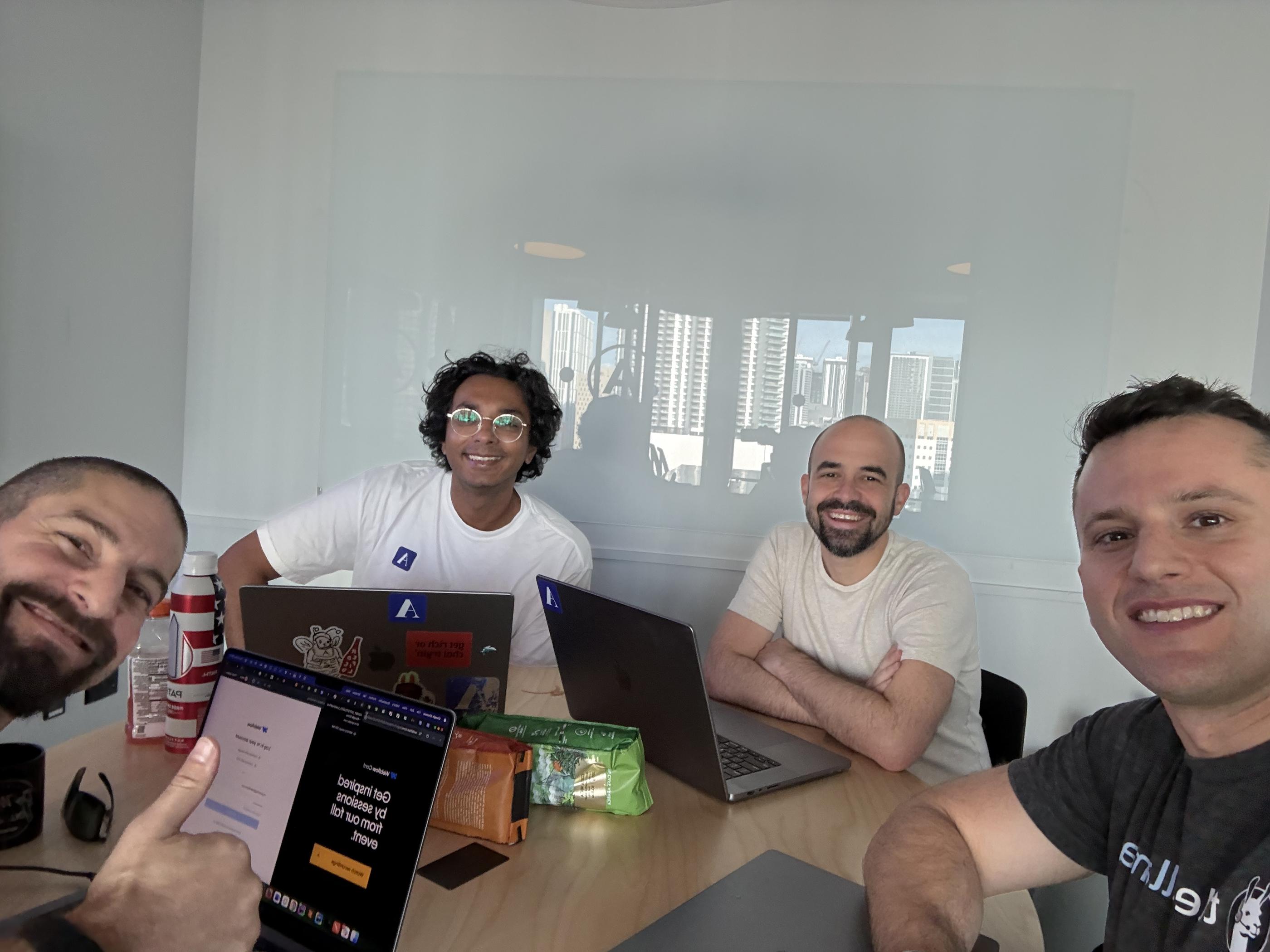
Co-founders Adam and Ben are repeat founders who spent the last two years building, iterating, and learning directly from customers in a similar way we approached building Ashby at its onset. When we went through technical diligence, it became clear that they could both accelerate our timeline on an AI interviewer as well as contribute to our broader AI platform.
After the transaction closed in late 2025, the team has spent the first part of this year rebuilding Talent Llama on the Ashby platform. This matters because our shared platform powers every feature — enabling consistent reporting, stronger AI, and more reliable automation on a single, connected data set.
What we’re building (and how we’re thinking about it)
The AI Interviewer we announced at Ashby One is being built as part of our broader set of AI capabilities. Conceptually, it’s one piece of a larger shift towards agents that can help augment appropriate parts of the recruiting workflow; in this case, early-stage screening conversations.
There are a few reasons we think this belongs directly inside Ashby:
- Workflow integration. Interviewing is tightly connected to scheduling, scorecards, and downstream decisions. Keeping this in one system avoids fragmentation.
- Data context. Because Ashby already has structured data across the entire hiring process, we can make these interactions more relevant and useful.
- Candidate experience. We can design this as part of the overall journey, rather than as a disconnected step.
At the same time, this is an area where we’re being thoughtful about product design. Our AI approach here will continue to follow the same principles we've applied elsewhere: transparency, human oversight, fairness testing, and clear guardrails on how features are designed and evaluated.
Why now
More broadly, this fits into a pattern we’re seeing across recruiting where AI is starting to move from assistive tooling (drafting emails, summarizing notes), into areas that are closer to core workflows.
At the same time, hiring teams are under pressure to handle higher volumes, move faster, and still maintain quality. For some segments — particularly higher-volume hiring — tools like AI interviewers are already becoming commonplace.
For many customers, we’re still early on how AI interviewing will shape recruiting. Our goal, as is true for everything else we commit to, is to build this in a way that is actually useful in practice.
What happens next
The version we announced today is an early step. Like most things we build, it will go through the same iterative process working with design partners (sign up for waitlist here), refining based on real usage, and expanding over time. As always, we’ll stay close to customer feedback as this evolves.
We’ll keep building from here.
Subscribe to our Community and Event Updates
Join our community of recruiting teams at fast growing companies.