Ben is a Data Analyst at Ashby
6 minute read
Topics
Did hiring pick up in 2025?
For bite-sized talent trends straight to your inbox, subscribe to our newsletter.
As companies reflect on 2025 and dive into 2026 hiring, one question emerged from our community a few times: Has hiring picked back up, or does it just feel that way?
While broader labor market indicators such as the U.S. jobs report showed mixed signals — including the unemployment rate rising to a four-year high in late 2025 even as job gains continued — headlines have broadly characterized the U.S. hiring environment as cautious.
To better understand how hiring has actually changed over time, this report examines a fixed cohort of hundreds of companies across eight consecutive quarters spanning 2024 and 2025. By tracking the same set of organizations, we focus on relative changes in hiring behavior rather than point-in-time market snapshots.
The findings show that hiring did increase in 2025, though unevenly:
- Larger companies drove most of that growth, while smaller startups remained more conservative.
- Regional differences also persisted, with North America consistently outpacing EMEA.
Below we break down these dynamics further to provide context for how hiring decisions are evolving.
1. Hiring Was Up in 2025
Looking at top-line hiring activity across the full cohort, hiring increased in 2025 relative to 2024. Across the year:
- Each quarter of 2025 featured more hiring than the same quarter from the year prior
- All four quarters of 2025 featured at least 11% more hiring than our baseline quarter (Q1 2024)
At a high level, this indicates that hiring momentum did return for many companies following a subdued 2024. However, the job market is not monolithic. Even as hiring rose on average across the cohort, many companies scaled back their recruiting goals or became more judicious in their approach to adding headcount.
Breaking the data down by company size reveals where these differences were most pronounced.
2. Larger Companies Fueled the Rise in Hiring
As aforementioned, all companies included in this analysis were hiring prior to the start of 2024, ensuring that two full years of hiring data could be included. Using Q1 2024 as a baseline, we examined how hiring evolved across company size over the following eight quarters.
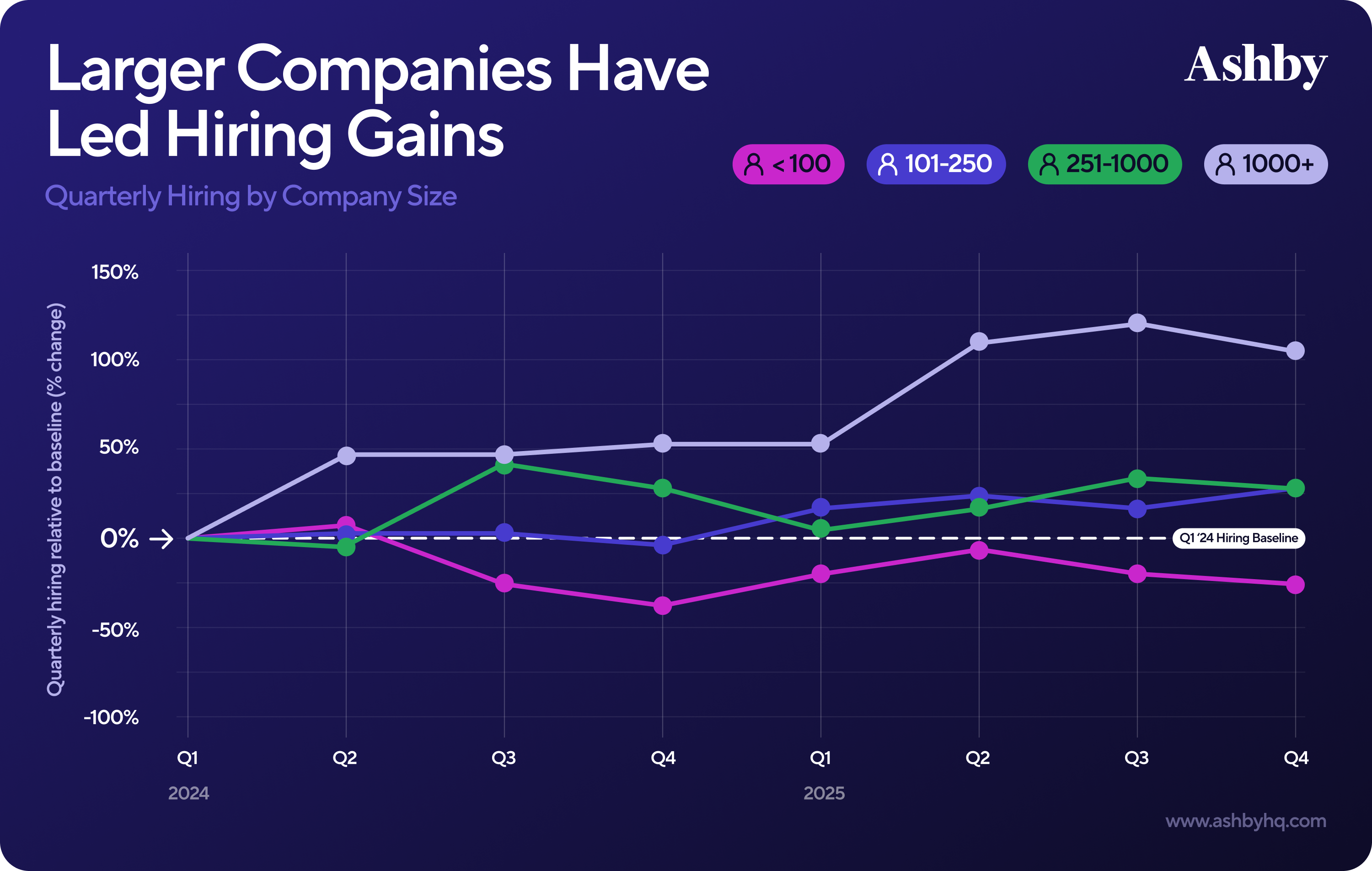
The differences in hiring are stark. For smaller companies (<100 employees):
- Hiring declined in all four quarters of 2025 relative to Q1 2024.
- These smaller orgs on average reduced quarterly hiring by as much as 25% compared to baseline.
For more mature startups (101-200 employees) and mid-sized companies (201-1001 employees):
- Hiring increased in 2025 relative to 2024, but that growth fluctuated from quarter to quarter.
- For companies with between 250 and 1,000 employees, hiring levels were nearly unchanged year over year.
Overall, the increase in hiring observed across the cohort was driven primarily by the largest companies included in this analysis. For companies with over 1,001 employees:
- Larger organizations continued to expand hiring steadily from the start of 2024 through the end of 2025.
- While smaller companies pulled back, larger organizations were consistently more aggressive in adding headcount over the same time period.
3. EMEA Lagged Behind AMER in Hiring
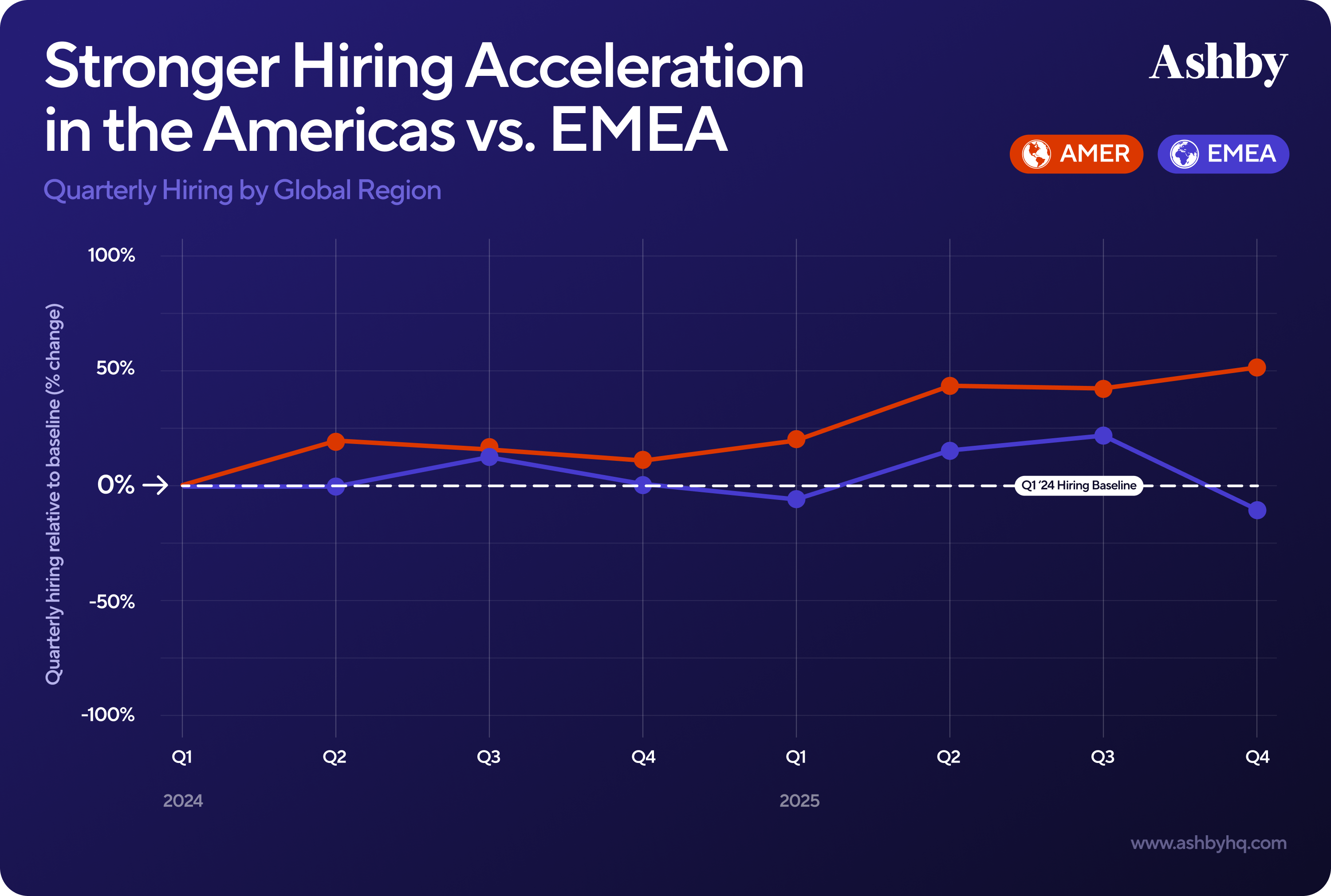
In considering geography, we see a regional difference emerge: Hiring activity among companies based in North America (AMER) was more robust than among companies based in EMEA over the period examined.
While hiring trends in AMER and EMEA broadly moved in the same direction over the last two years, EMEA-based companies consistently lagged behind relative to their own baseline.
- Across the cohort, hiring among EMEA-based companies increased by just 2% from 2024 to 2025.
- In contrast, hiring gains in AMER were both more consistent and larger in magnitude.
When company size and region are considered together, the regional differences become more pronounced:
- For smaller companies, the gap between hiring in AMER and EMEA was relatively small
- As company size increases, this gap widened steadily with larger organizations driving most of the divergence between regions.
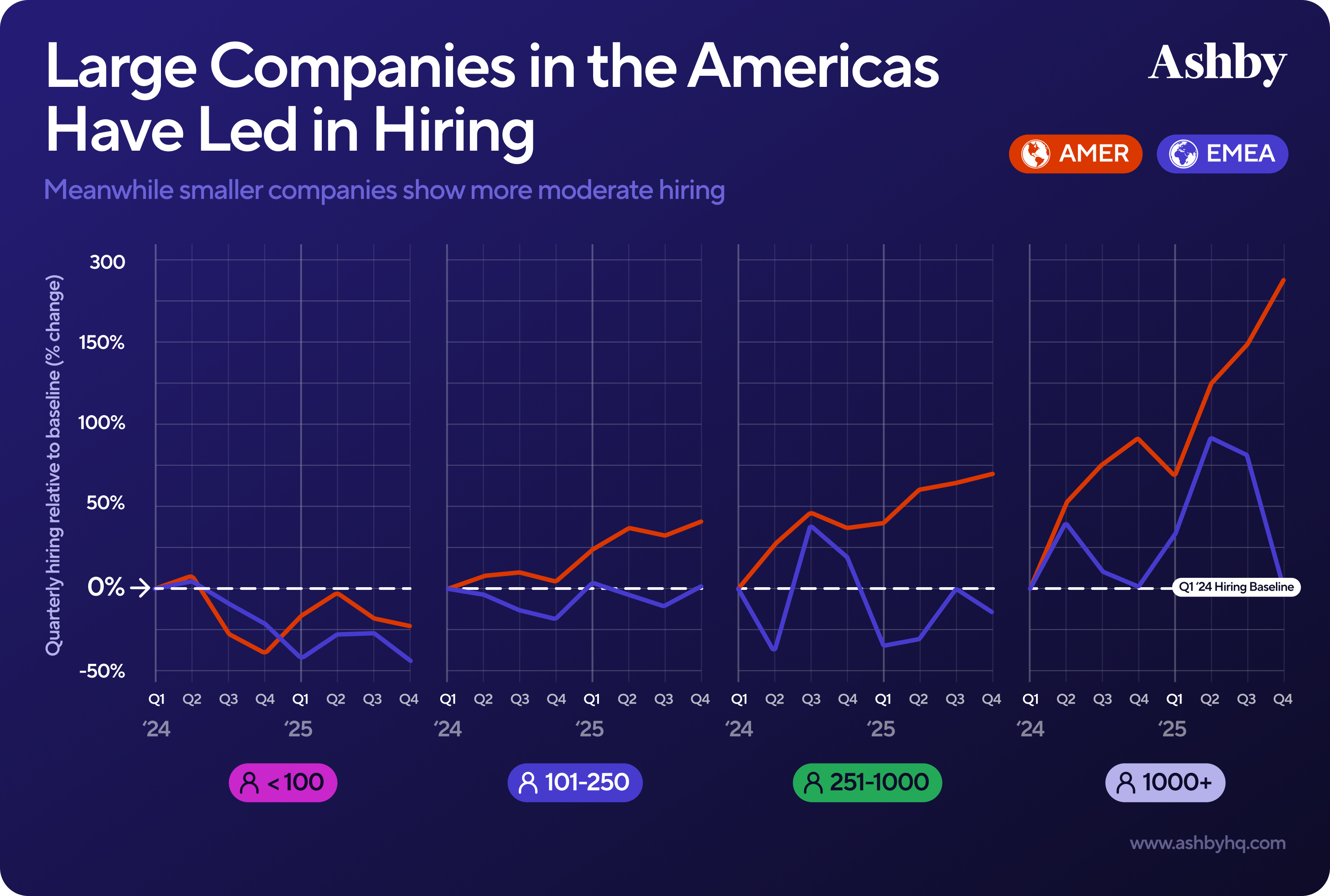
Taken together, this analysis shows that hiring in 2025 increased relative to 2024, but in a selective and uneven way. Larger companies drove most of the gains, while smaller startups remained cautious, reflecting a continued emphasis on efficiency and fit over rapid expansion. Regional differences further shaped these outcomes.
It’s also important to situate these findings within a broader post-pandemic context. Even as hiring volumes ticked up for some companies in 2025, hiring remains fundamentally different from the boom years that followed 2020. Talent teams are interviewing significantly more candidates per hire while AI, interest rates, and regulatory environments all influence behavior.
We’ll continue tracking this cohort to understand how these dynamics evolve as market conditions change.