Ben is a Data Analyst at Ashby
4 minute read
Topics
The Rise of AI in Job Postings
This report is based on over 200,000 qualifying job postings and corresponding job descriptions from the start of 2021 through Q2 of 2026. AI jobs here refer to jobs with any relevant reference to AI, artificial intelligence, or similar terms in either the job description or the job title itself.
Artificial intelligence is changing the ways in which we do our jobs. While AI certainly feels omnipresent when discussing work today, we were interested in evaluating how often companies were listing AI within the job description.
To do this, we parsed through over 200,000 job postings over the last several years. The resulting data provides insight into how common AI is within job listings today, though how commonly depends a lot on role, function, and company size.
Key Findings:
- Job titles with AI in the name were rare until 2024. From the start of 2024 through Q2 2026, we see a rapid increase in AI in job titles for technical roles.
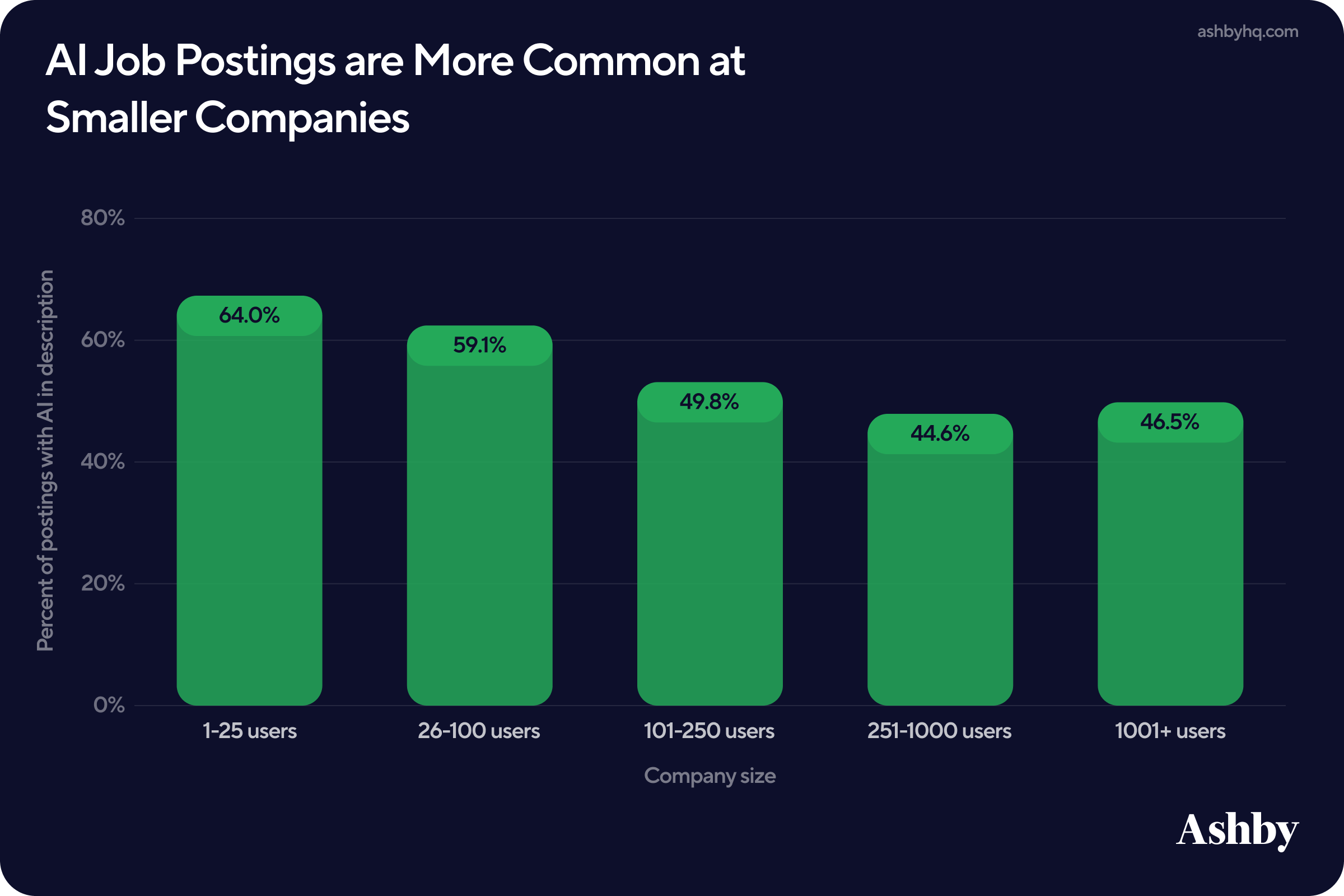
- Smaller companies write AI into their postings more often than larger organizations.
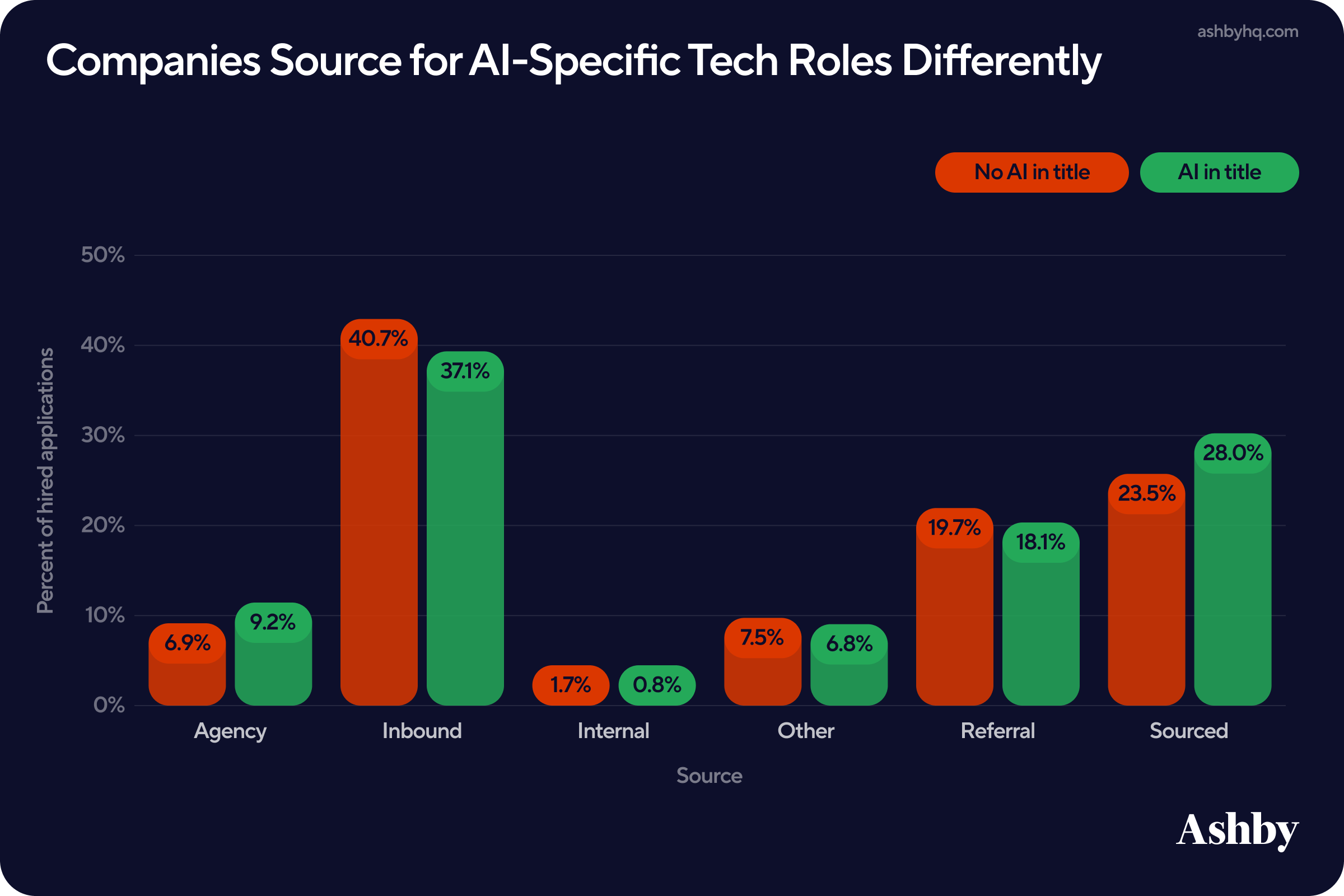
- Tech roles that name AI in the title are sourced and hired differently than other roles.
We break down each of these below. If you want a related look at where AI-specific roles are emerging, you can see additional data in the Beyond Benchmarks Report we partnered with Emergence, Pave, Carta, and more on.
1. The Word “AI” Is Entering Job Titles — And Tech Is Driving It
The appearance of AI in a job title was rare until the start of 2024, more than a full year after ChatGPT launched publicly. Since then, AI has become considerably more common in tech roles while growing modestly in business functions.
AI Engineer, AI Infrastructure Engineer, AI Product Manager, and AI Solutions Specialist are examples of job titles that now appear with some frequency, many of which represent roles at leading AI companies.
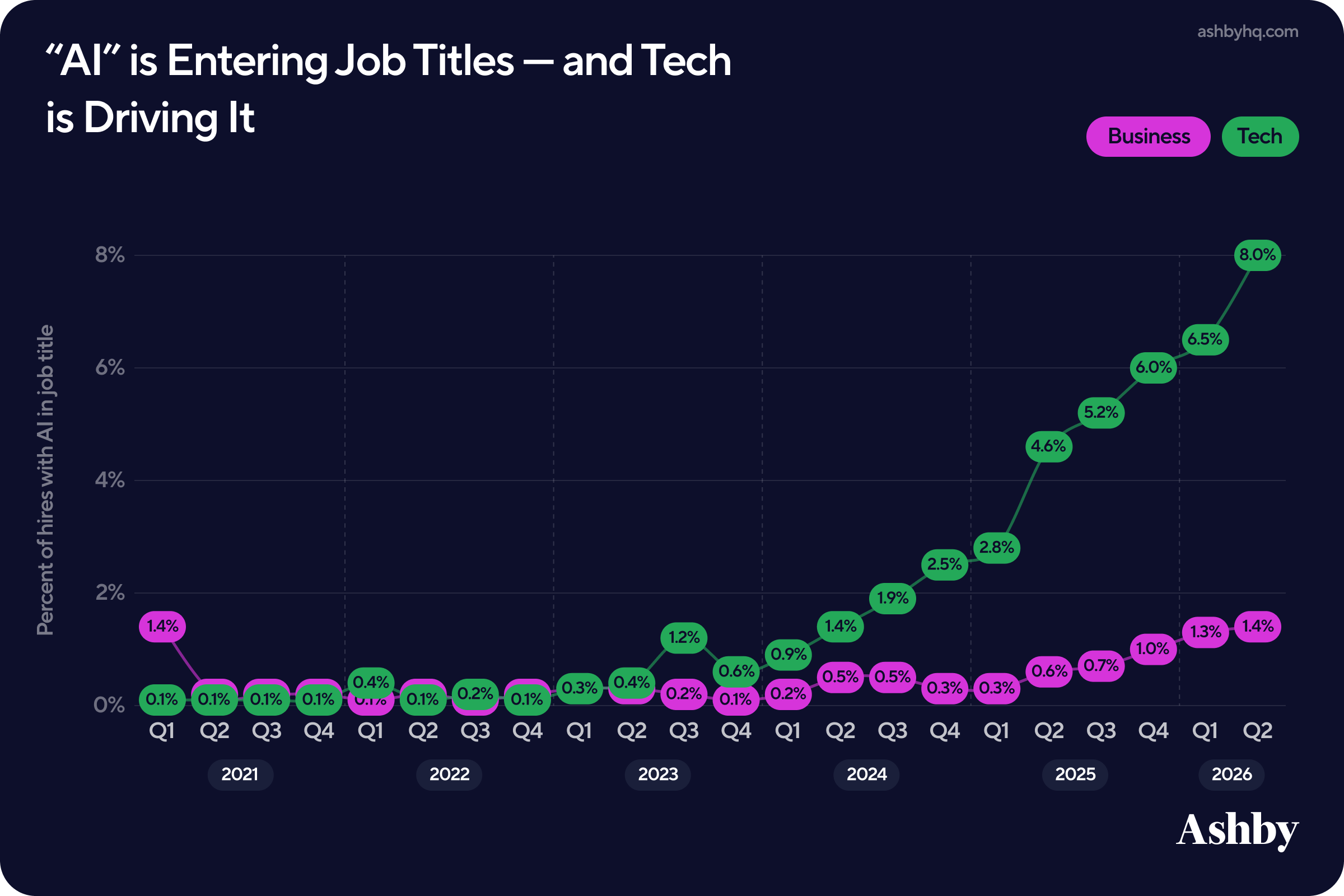
Though business roles rarely feature AI as part of their title, AI is still incorporated into their list of job requirements. AI appears in roughly one-third of business job posting descriptions with 2026 hired dates. While that frequency is still well below the rate for tech roles, which is above 50%, it still represents a healthy fraction of all hired jobs.
Despite the recent emergence of AI-specific technical roles, most postings leave AI out of the job title.
2. Engineering and Data Roles Most Often Include “AI” in Job Descriptions
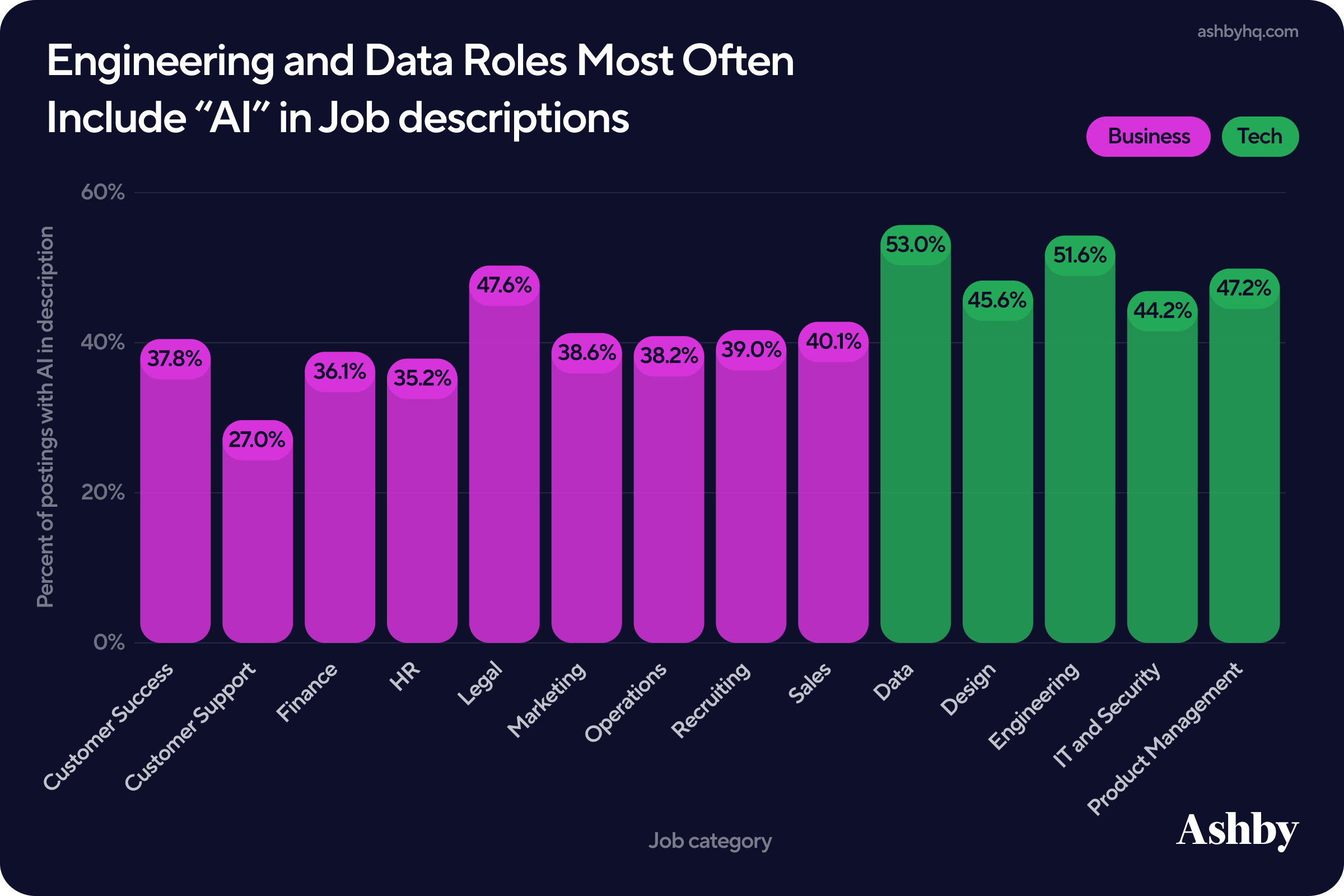
Whether a job references AI in its description varies considerably based on the category of job. The chart below depicts the fraction of jobs with AI in the description dating back to the start of 2025.
Engineering or Data roles have referenced AI about half the time over the last year-plus. Other business functions (except for Legal) don't have a significant number of roles that call out AI in their job descriptions at the same rate compared to tech roles.
Interestingly, smaller companies are more likely to include AI in their job descriptions by a significant margin. While enterprises more often make the news with public declarations about the future of AI in the workplace, early stage startups explicitly tie their role responsibilities to AI more often. One potential interpretation for this is that many new startups, and much of startup funding, remains focused on AI. We also explore the rise of AI in VC-backed startups more thoroughly in our Startups Report.
Meanwhile, there does not appear to be a significant discrepancy in the share of descriptions mentioning AI across global regions, namely AMER and EMEA. Neither region appears to be embracing AI in their posted roles more than the other.
3. Companies Source for AI-Specific Roles Differently
Teams fill the top of the hiring funnel differently for AI roles than for non-AI roles. Because AI so rarely appears in job titles for business functions, the following data covers technical functions only.
Tech jobs explicitly including AI in their titles are less likely to be filled from inbound or referral applications. Instead, those hires come more often through agencies and sourcing. This suggests that teams hiring for AI roles have to be more proactive in identifying AI candidates than for other tech roles.
No job is exactly the same, and most jobs differ widely across roles, seniority, geography, and industry. That variety makes it more meaningful that AI appears as often as it does, likely more often now than seemingly universal requirements like "time management" and "attention to detail."
The spread of AI in job descriptions is well underway, but it's still uneven. Smaller organizations seem to be embracing AI more widely across listed jobs, and tech functions reference it more than business functions. Regardless, whether you work as an engineer, in legal, or product management, there is a strong likelihood that AI will be a necessary component of your role going forward.
For more bite-sized talent trends straight to your inbox, subscribe to our newsletter.