The State of Startup Hiring | 2026 Talent Trends Reports

25 minute read
Topics
Table Of Contents
As a YC startup ourselves, the startup community remains one of the most meaningful segments we serve. We’ve experienced firsthand how talent becomes a durable moat for building the next generation of companies — especially when the right team, resourcing, and technology are in place. Today, we’re proud to support 52% of the fastest-growing startups on Brex’s 2025 Benchmarks list, giving us a unique vantage point into how early-stage teams hire, scale, and adapt.
Like the talent industry at large, startups are navigating significant changes from shifting funding environments to the rapid emergence of AI. Startups also often move first. With fewer constraints than enterprise organizations, startup talent leaders are frequently the earliest adopters of new tooling and workflows, experimenting with AI long before it becomes standard practice.
In this report, we begin by examining all the ways AI is taking shape inside our organizations and workflows. We then follow the hiring lifecycle end-to-end, from inbound and sourcing through interviews and offer acceptance rates, to establish clear benchmarks across the recruiting funnel.
While our Talent Trends Reports typically span companies of all sizes, this edition focuses specifically on startups. Our analysis digs into over 1,200 venture-backed startups globally, covering 32K hires and 11M applications, with findings segmented by company size:
- Less than 25 employees
- 25-49 employees
- 50-99 employees
- 100-300 employees
This report excluded any organizations larger than 300 employees to contain the scope and provide insights specific to early startup stages. Most of this data is from 2025, though you will find some charts showing trends over time which can have a longer timeframe
A preview of the data reveals:
- AI adoption is no longer fringe as over half of startup talent teams are already using AI across multiple hiring workflows.
- Remote roles materially change hiring dynamics, driving significantly higher application volume and stronger offer acceptance rates.
- Startups that involve recruiters earlier hire meaningfully faster, cutting time to hire by nearly a third at the smallest stages.
Together, these trends help spotlight how startup hiring operates today. We’ll go in detail through each section below.
II. The Rise of AI
In 2025, Pitchbook reported on the priority investors were placing on AI startups, making up 64% of all U.S. venture capital by dollars invested. From our position as an ATS, we’re able to look at the rise of AI through role expectations, talent tooling, and the products startups are building overall.
The Rise of the AI Startup
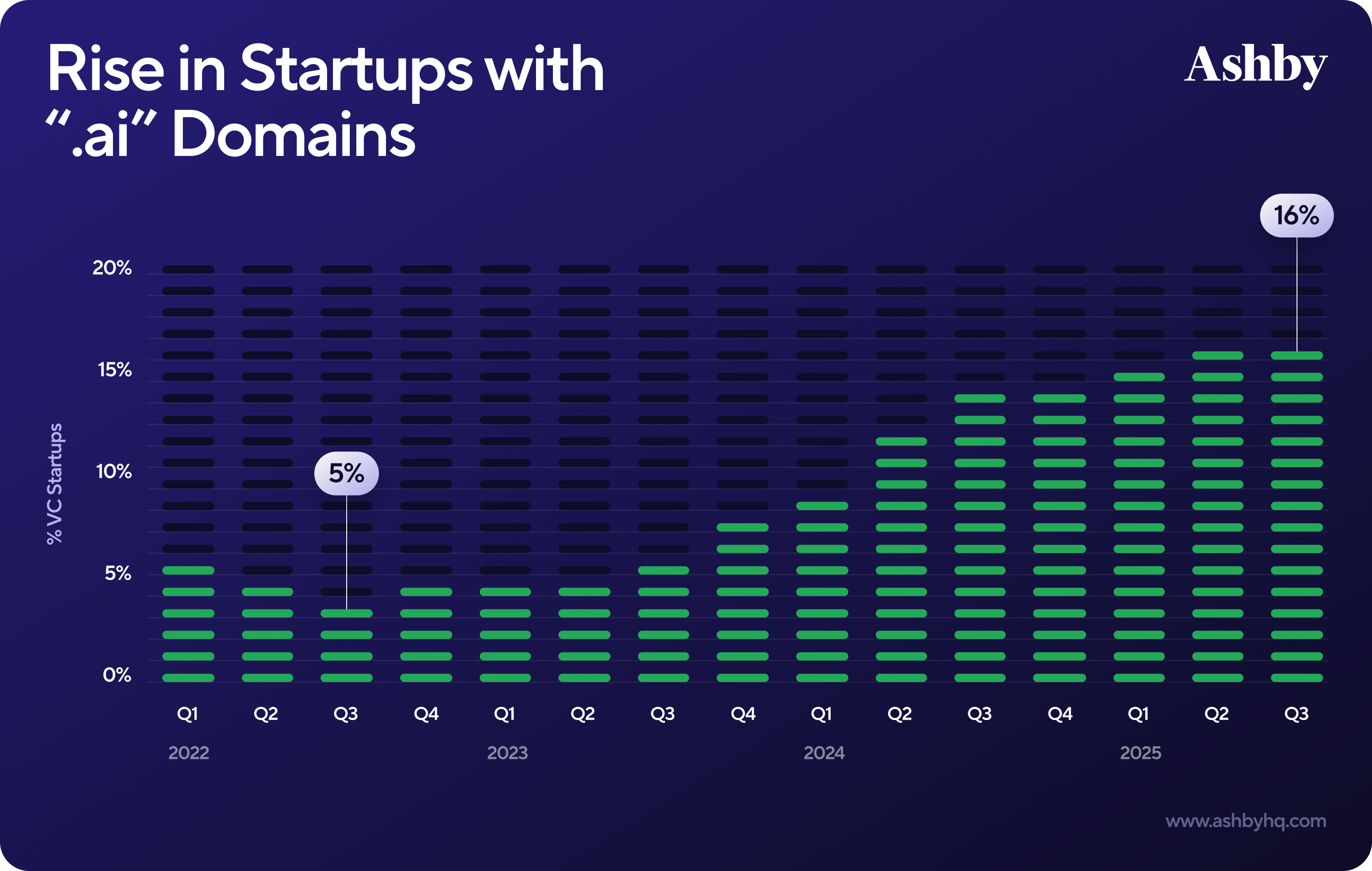
We started by looking at startups overall to understand how common AI-focused products have become. As one proxy, we examined the use of “.ai” domains. Over the past two years, “.ai” domains increased 11% from just 5% of startups in 2023 to 16% by the end of 2025.
The Rise of AI in Job Descriptions
Next we looked at how often startups are seeking candidates with AI-related experience. We see a clear increase across startups, regardless of whether they build AI products themselves.
Looking across 11M startup job applications in Ashby, we find:
- The percent of jobs with “AI” in the title doubled (from 2% to 4%). As a comparison, titles with “data” remained steady at 3% across this same time period.
- Mentions of AI appear in roughly a third of job postings (33%). Tech roles, unsurprisingly, mention AI more often, though both tech and business increases are significant.
The Rise of AI in Recruiting Workflows
With some context around AI startups and AI work experience to ground us, we turned to usage of AI by startup talent teams.
In conversations with Startup Talent Leaders, we regularly hear how AI workflows and tooling are appearing in their workflows. In 2026, the use of AI in talent has evolved from interested-but-hesitant to an emergence of AI solutions crowding the market. Because Ashby’s unified data foundation allowed us to be the first ATS to market with AI features, we have the privilege of exploring how AI is being used by TA from as early as 2023. Of course, our view is primarily driven from the functionality we have built and the associated usage data from it. Though it’s worth noting that this report does not include AI usage through our integration partners, so you can consider these AI usage metrics a lower bound.
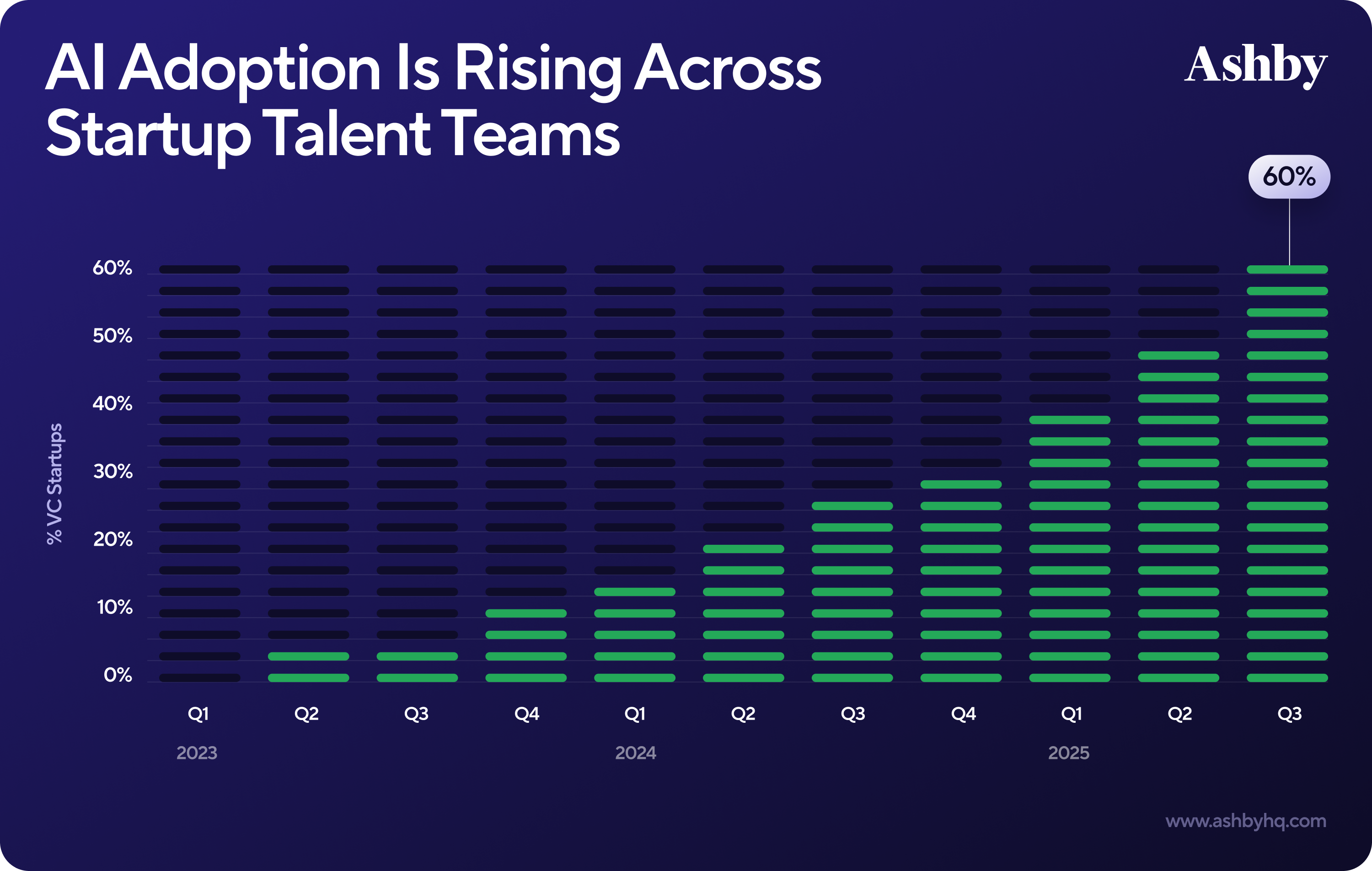
Every quarter over the past two years, we see a steady increase in the percentage of startup customers using AI, with over half (60%) using AI in Q3 2025.
Rather than concentrating in a single area, AI usage from this cohort is distributed across the hiring lifecycle. Here’s a sample look at AI features in Ashby at different stages.
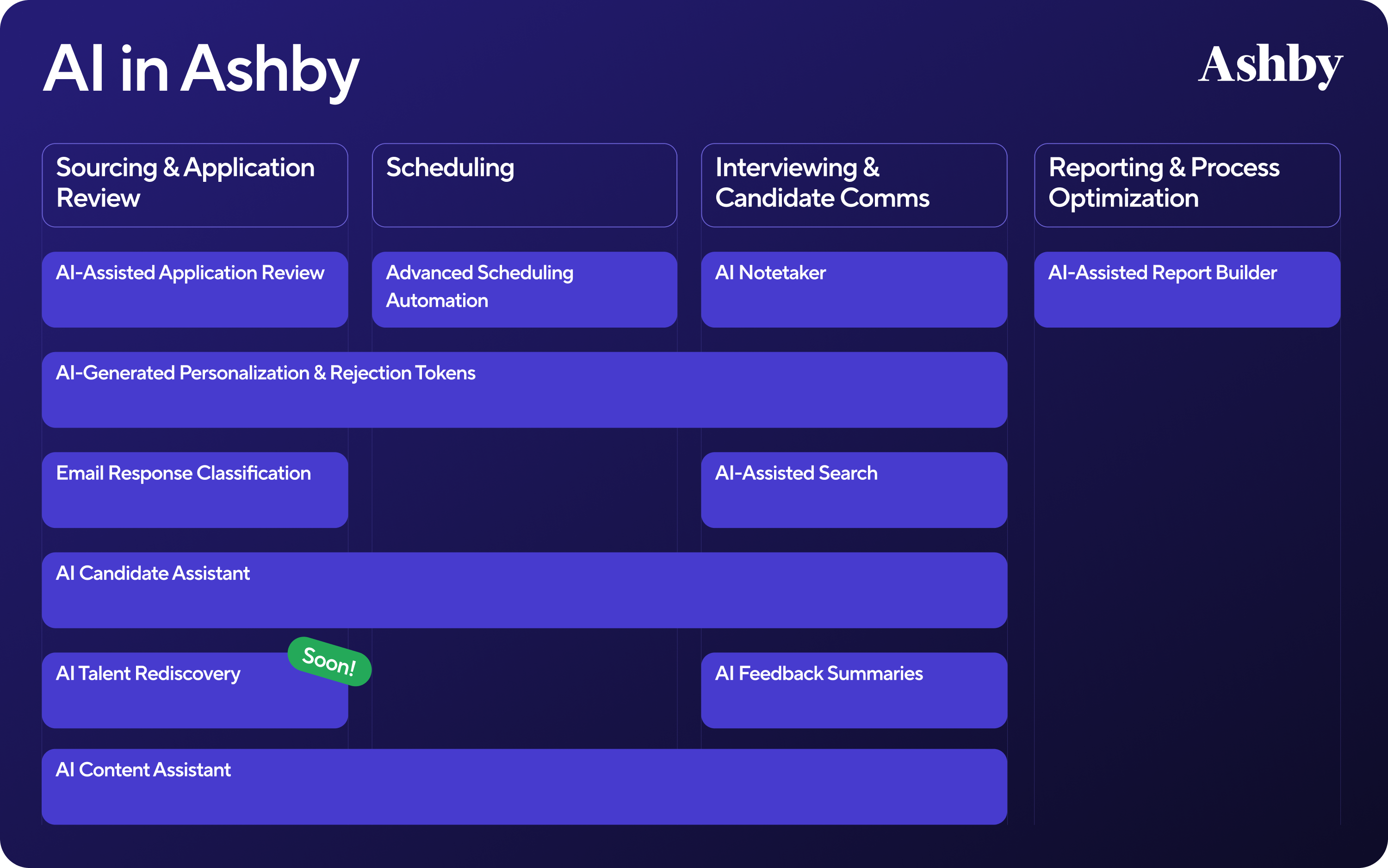
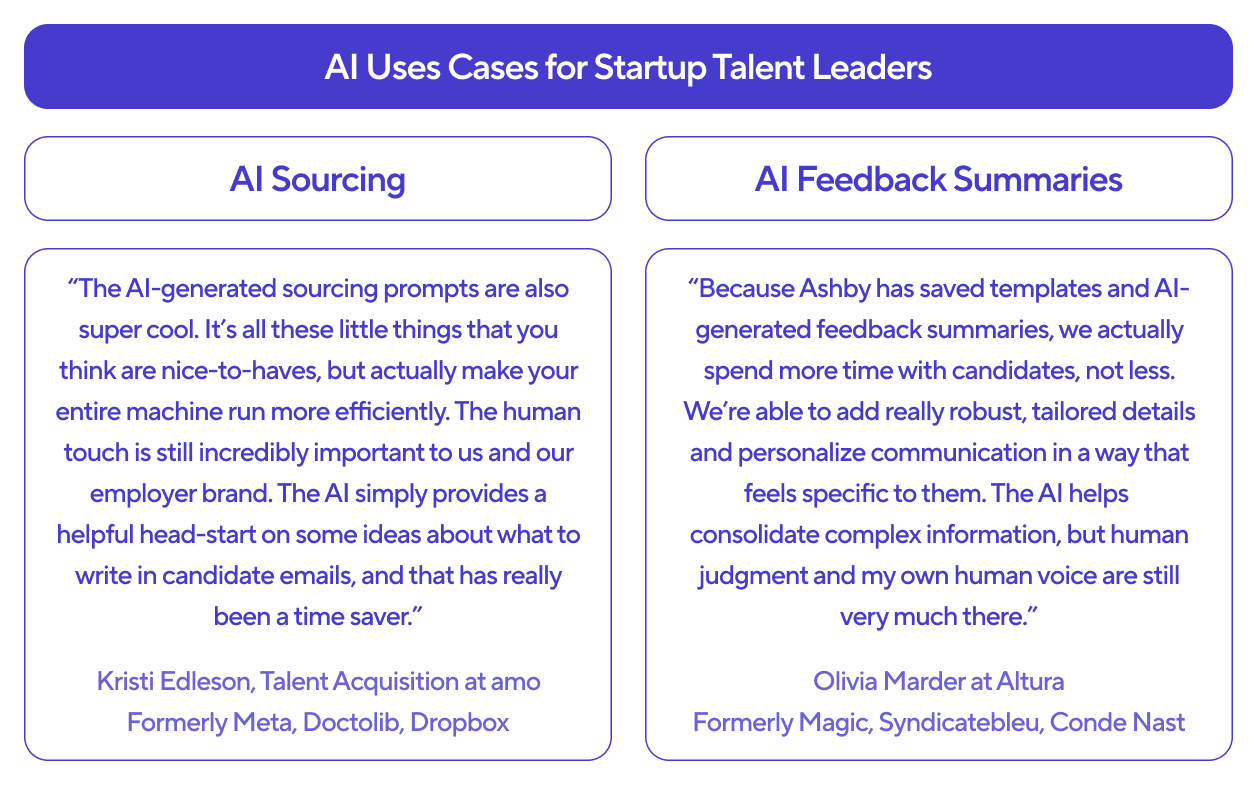
This spread of usage intuitively makes sense; every startup has different brand recognition, founder networks, and size of talent teams (when there is one) that would influence how hiring happens. Some startups we speak with, such as French startup Amo, rely heavily on sourcing where Ashby’s AI Generated Email Tokens help drive personalized outreach efficiently.
Others such as Amsterdam-based Altura, operate as a one-woman talent team by relying on AI Generated Feedback Summaries to help stakeholders stay aligned around pipeline movement. We released a native AI Notetaker in 2025, which early data in another report signals is helping talent teams keep up momentum in hiring decisions.
Across the 60% of startup customers using AI functionality in Ashby, we see that most use one or two features regularly, while 10% use 5+ features actively and are fully adopting AI across hiring. Looking across startup size, we see that as startups grow in size, they use AI more in their recruiting workflows. It’s possible that as startups scale, growing pains such as increased hiring volume, interviewer load, and coordination complexity create stronger incentives to adopt AI more broadly.
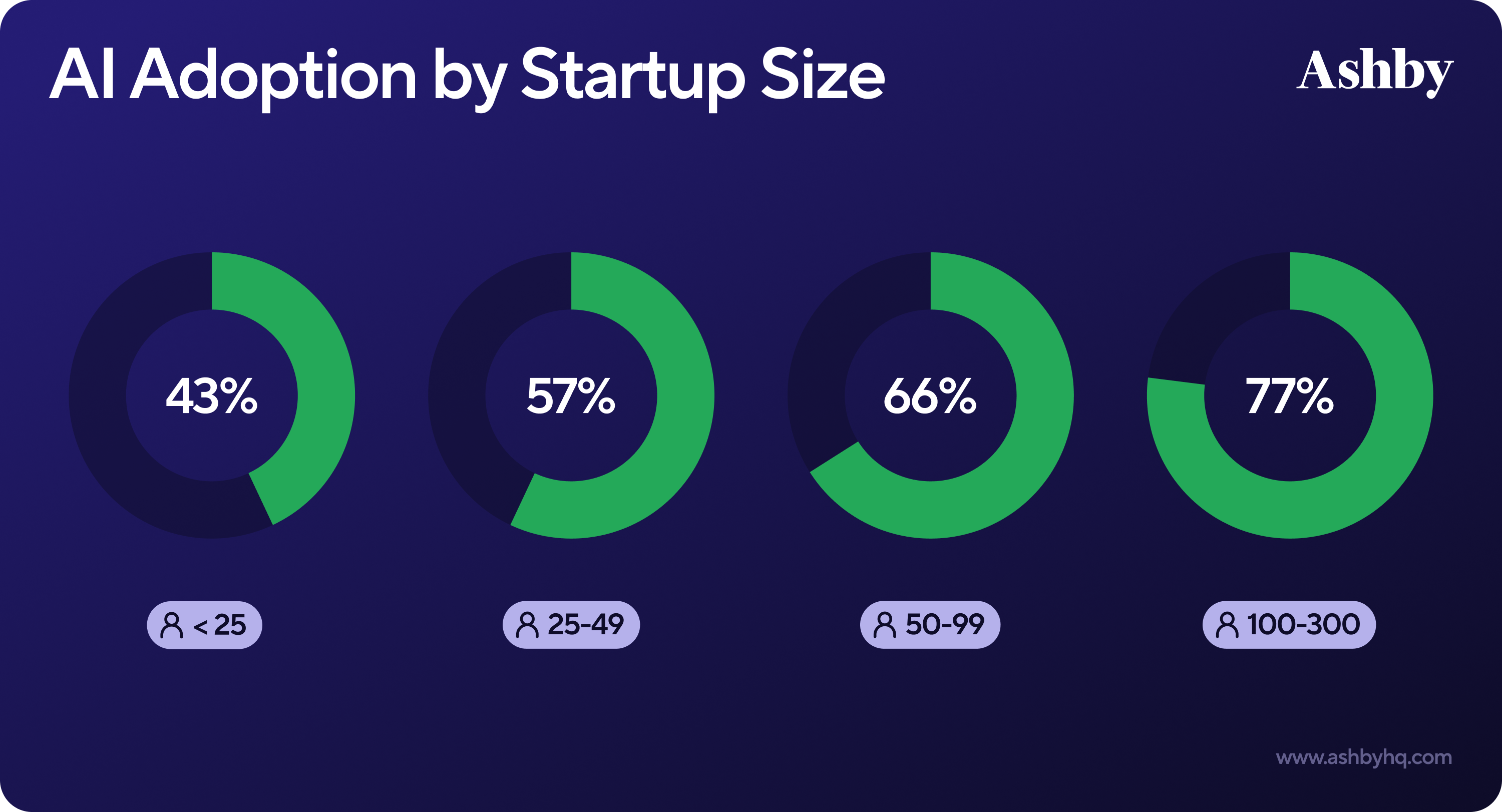
Overall, these patterns reflect what we consistently hear from startup talent teams and ecosystem partners about how startups are adopting AI. With that context, the rest of this report examines the full hiring lifecycle from a startup talent leader’s perspective, acknowledging that responsibilities and workflows differ widely by stage, team size, founder involvement, company recognition, and more.
III. Inbound & Sourcing
We’ll start at the top of the funnel. In a 2025 analysis on source of hire, we observed an interesting dumbbell pattern for startups: Some leaned heavily on inbound while others did not. Typically when inbound was low, sourcing dominated. Let’s explore both paths, though feel free to jump to the content most relevant to how your startup gathers pipeline. Note that this prior analysis looked at all small organizations, not just venture-backed startups.
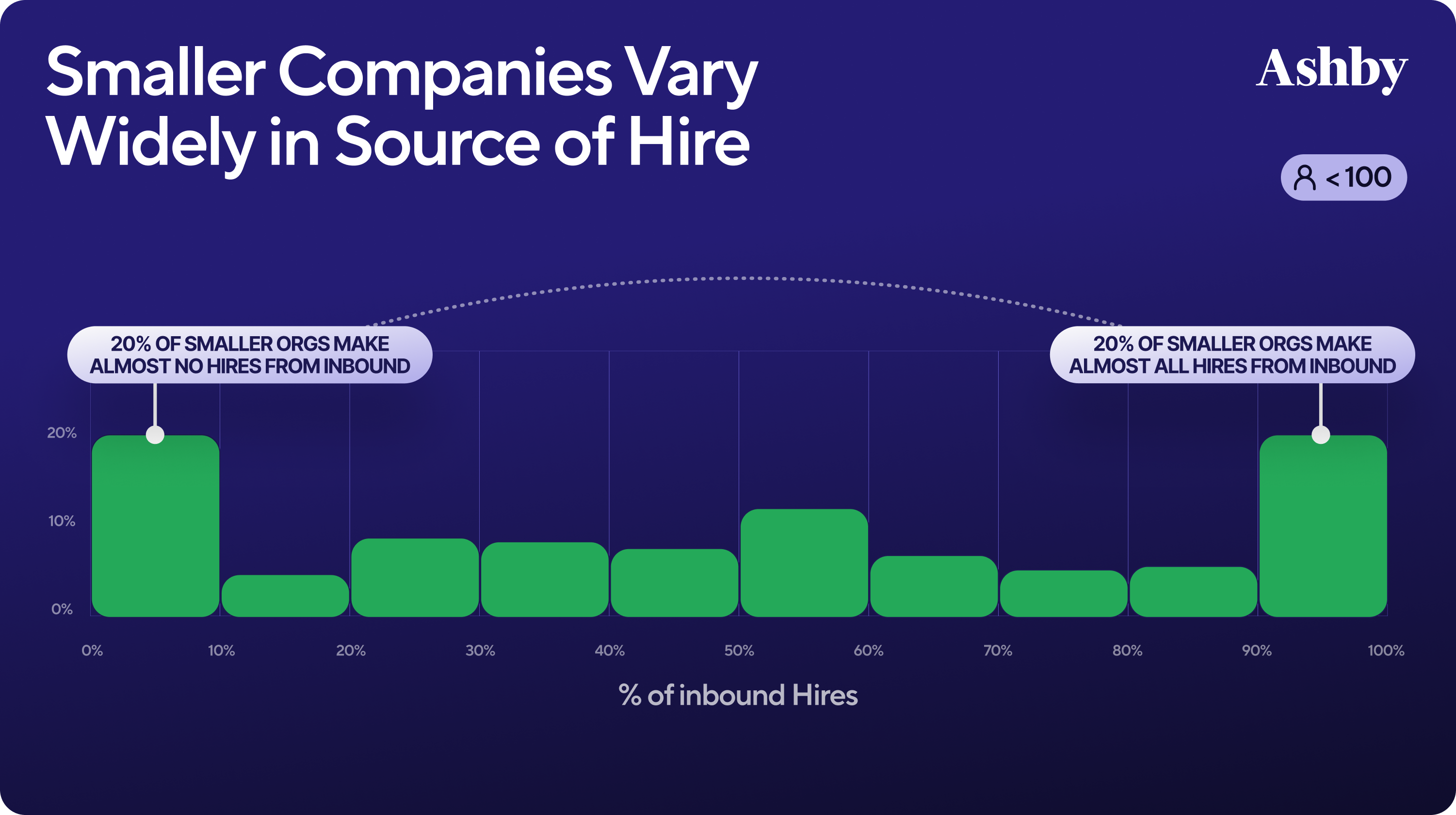
Source of Hire
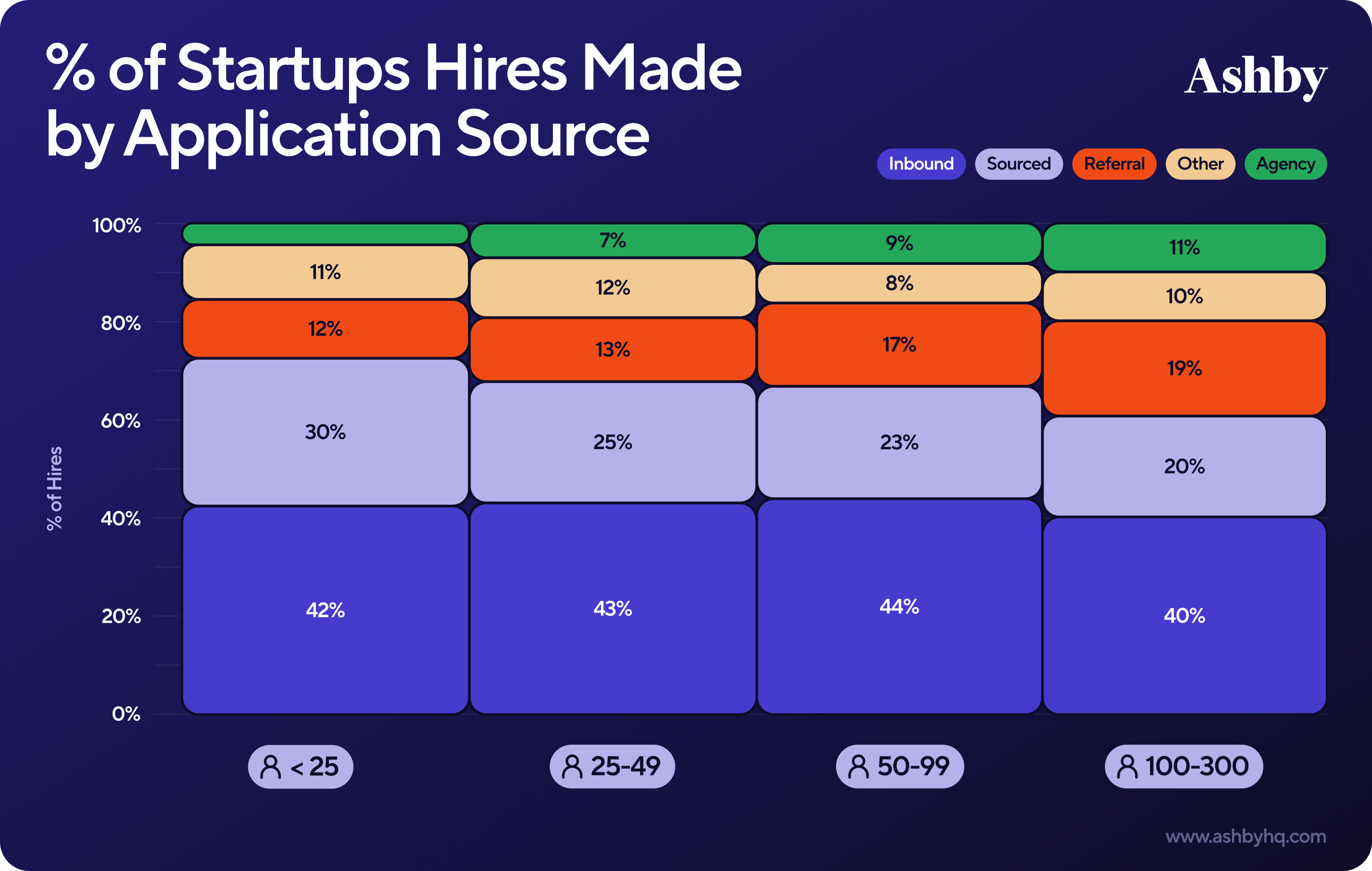
Let’s begin by breaking out the mix of where startup hires are made. We see this mix change, though not dramatically, as startups grow in size. Immediately we can see that the most hires at a startup come from inbound, followed by sourced.
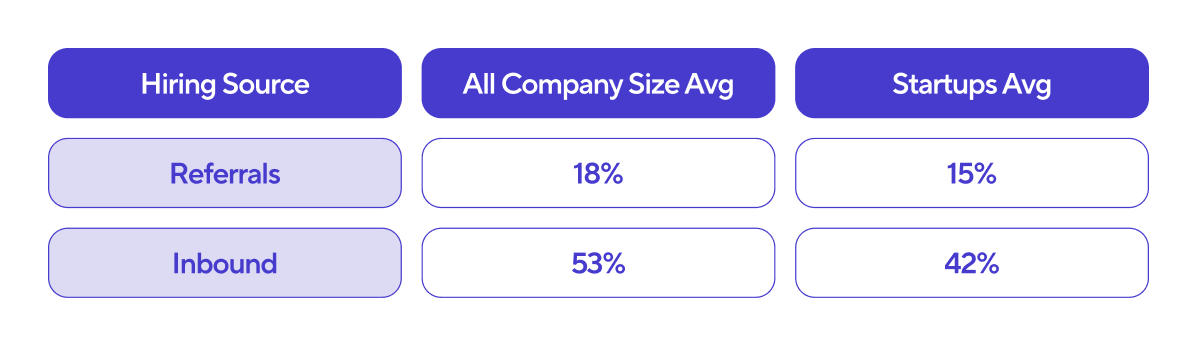
Referrals, as always, is an interesting area of exploration. In 2025, we analyzed referred candidates more closely given all the chatter around the importance of a referral to land a job. In that report (which analyzed all company sizes), we found that fewer hires were coming from referral sources over time while more hires were coming from inbound. Looking at this same data segmented by startups, we see that referrals make up slightly fewer hires at startups (15%) than all company sizes (18%). This is particularly interesting given the emphasis early founding teams typically place on using their own networks. Instead, we see that smaller orgs focus much more on sourcing, and supplement that with referrals as they grow their team.
Sourcing
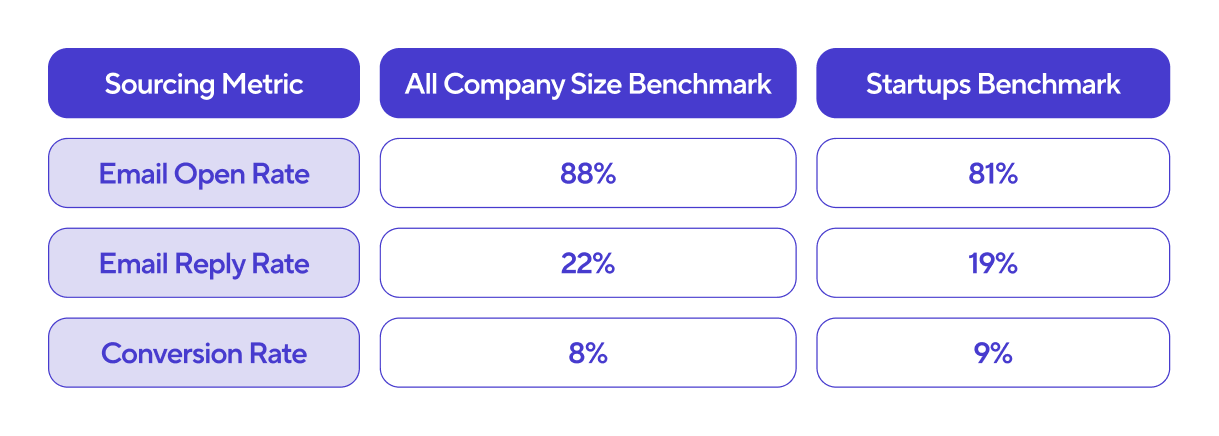
After inbound, sourcing was consistently the second most common source of startup hires. This is most dramatic for the smallest startups, who see 30% of hires come from sourcing. In a 2024 analysis on sourcing across company sizes, we found that email open rates remained fairly consistent at 86%.
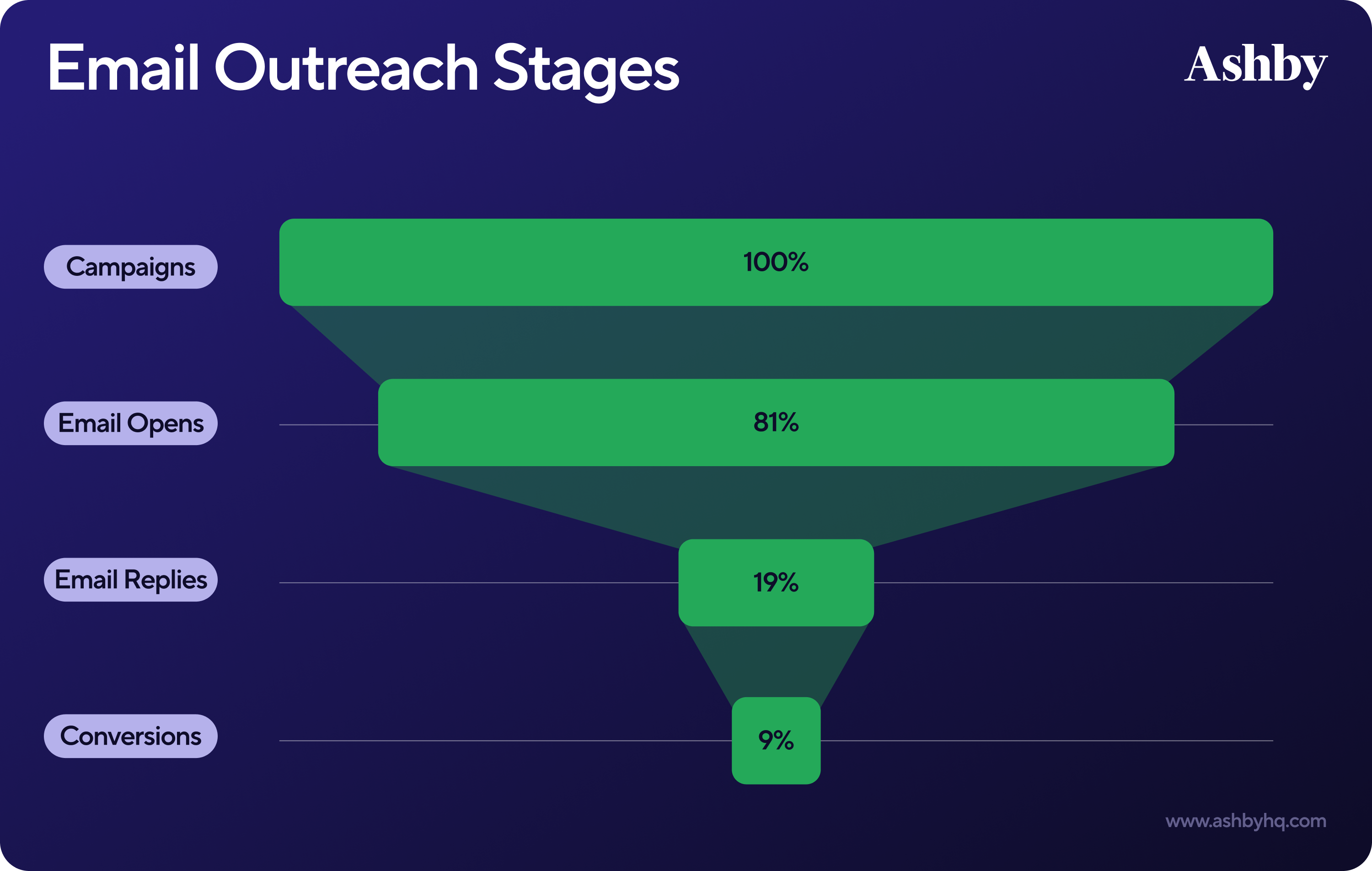
Even with lower brand recognition than larger orgs, our startup customers experience an ~81% email open rate. Reply rates are also right on par with the all company average at 19%, and overall conversion is strong as well.
Here’s how this looks through the funnel.
III. Application Volume
We’ve been reporting on the growing increase in inbound application volume since 2024. What first started as a rush of available talent in the market has only grown through the ease of applying with AI and the flood of fraudulent candidates muddying pipelines.
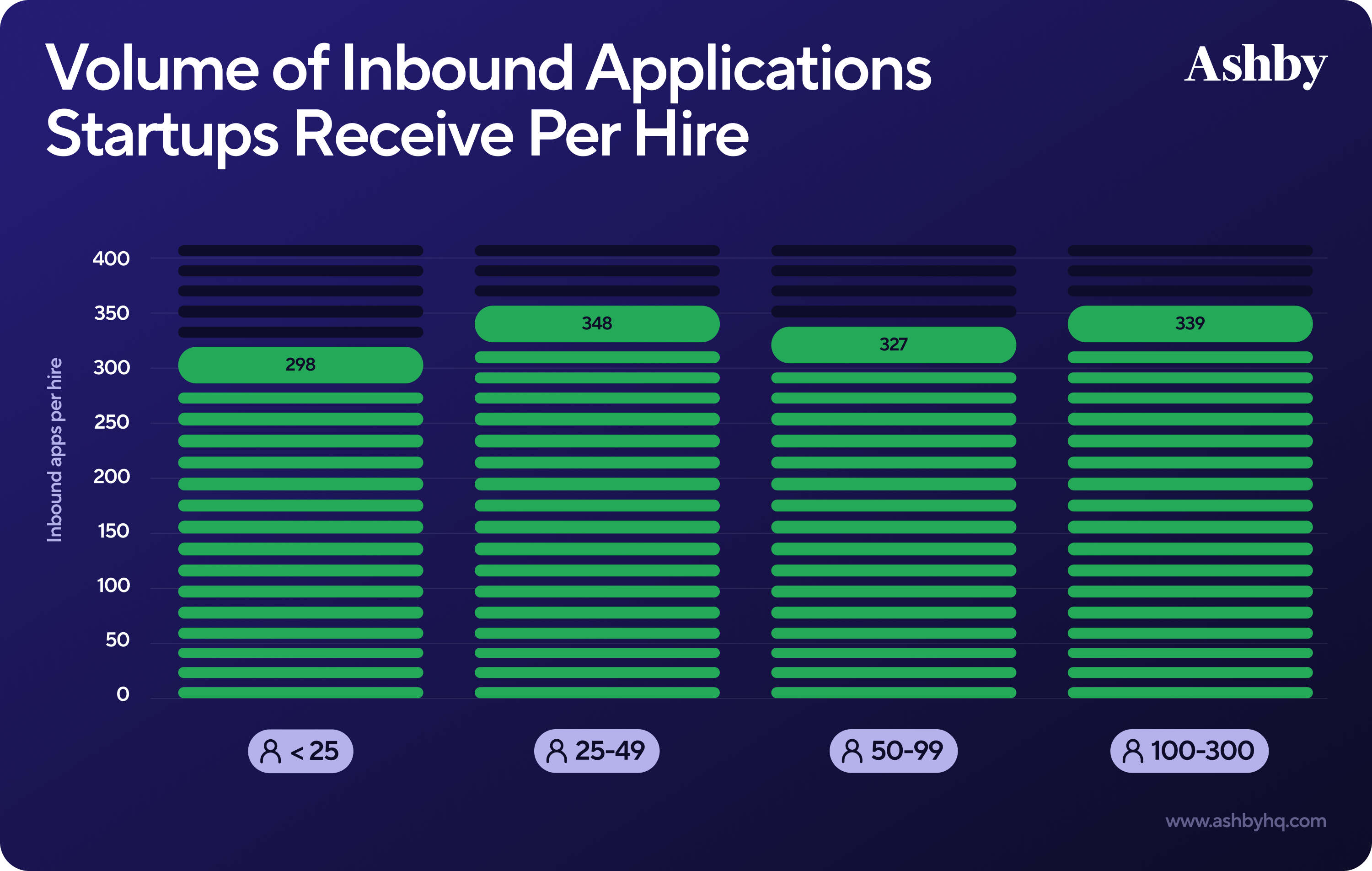
Looking specifically at applications per hire today, we see the smallest startups receive the fewest applications (not surprising). Across all sizes, we see that inbound application volumes for startups are experiencing a similar increase as all companies have been since 2021.
In many ways, startups benefit from having more talent availability as it can influence some candidates to take roles outside their initial search parameters (such as an early stage startup instead of a growth stage company or a lesser known brand). Still, managing this volume can prove challenging and has led to a series of solutions on the market. At Ashby, we help support teams with:
- AI Assisted Application Review, which allows teams to define criteria that can help parse through evidence of if a candidate “meets” or “does not meet” the essentials. For example, helping rule out Bay area talent for a New York in-office role.
- Candidate Fraud Detection, which detects and marks candidates as potentially fraudulent based on signals such as device, IP, email history, and more, and then highlights it directly on the candidate profile for teams to review.
Applications for Remote Jobs
As we looked at application data we got curious: With many startups staying remote-only, how does that translate in their hiring pipelines?
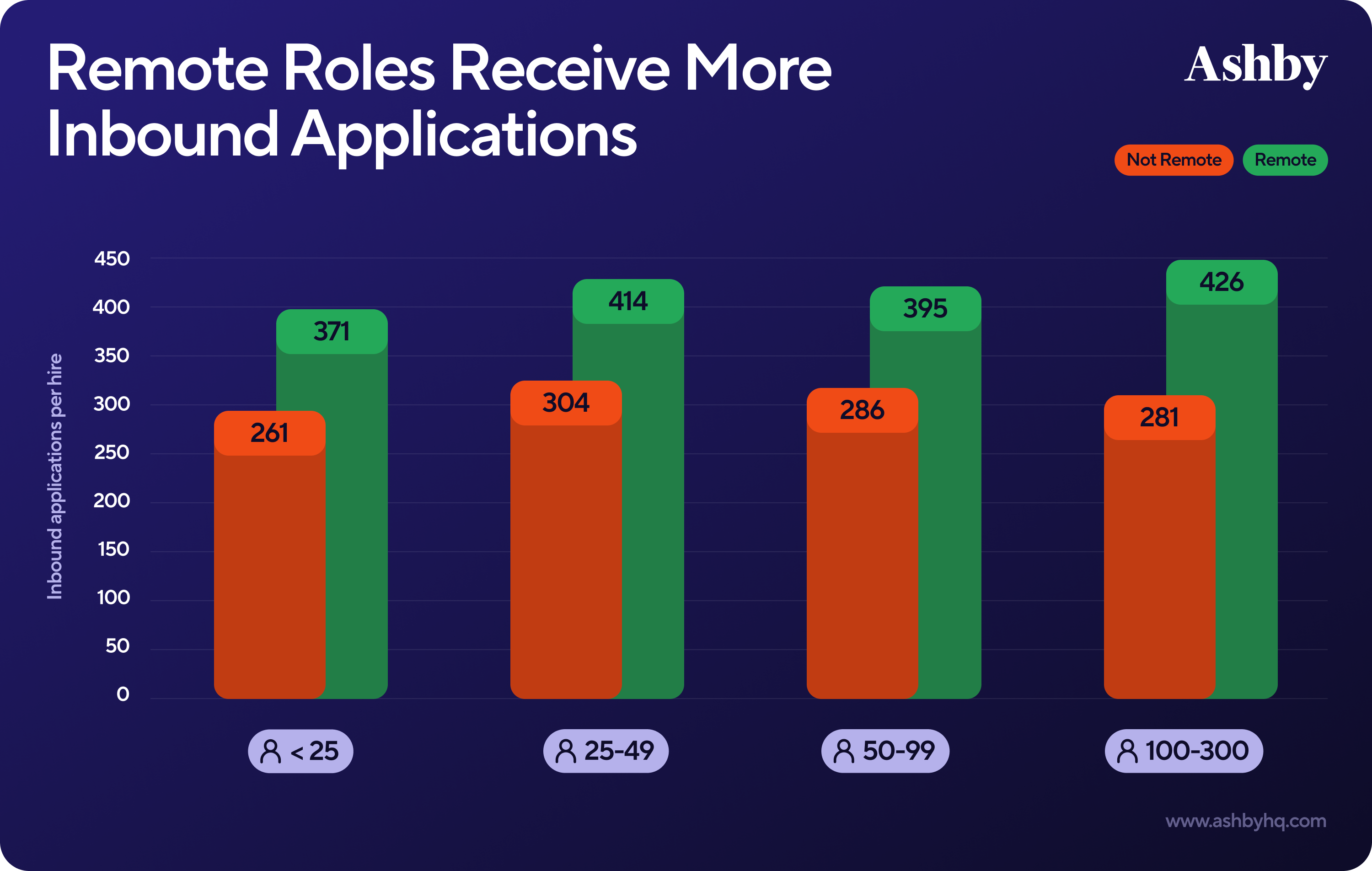
A clear pattern emerged where remote startup jobs received a material 42% more inbound applications than in-office startup jobs. This pattern holds consistently across startup sizes. Later in this report, we’ll look at how remote roles impact offer acceptance rates.
Of course, the data only tells a partial story. Some startups require in-office or local hiring, whether due to factory, legal, or other business requirements. Others choose to work in real life as a component of their culture and want to attract talent that values such. Startups that offer remote work may want to compete for national or global talent.
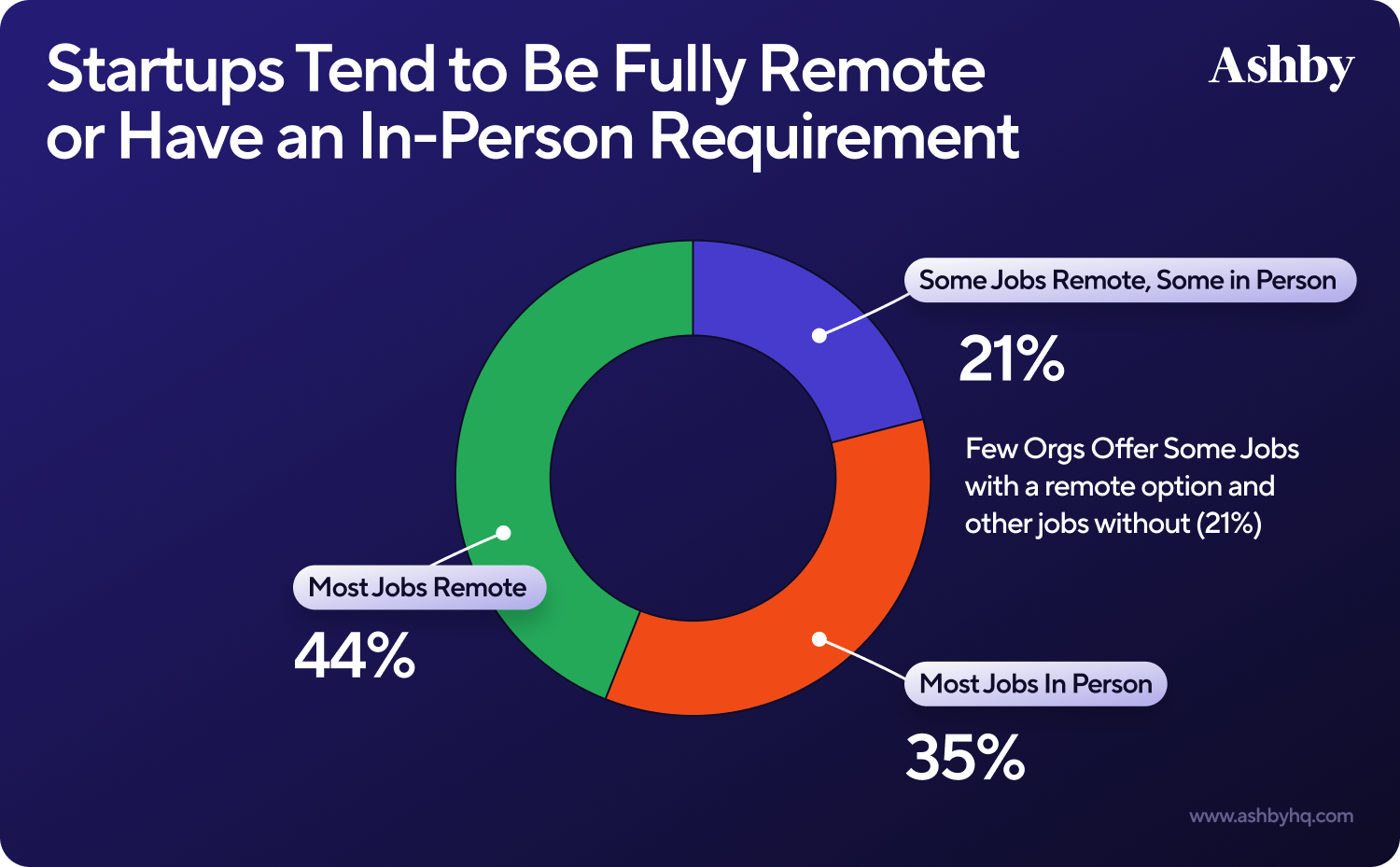
Of course this sparks curiosity over how many of the startups in our database offer remote job opportunities. We see that:
- 44% of venture-backed startups using Ashby have almost all jobs with remote options
- 35% have no full remote option
- 21% provide both (some jobs with remote, some without) options
This indicates that most (79%) startups go all in on having an in-person requirement or no in-person requirement. Few startups provide some jobs that have a remote option while having other jobs without a remote option.
With growing applications and a healthy mix of where hires originate from, we next looked at the cost involved across interviewers and candidates.
IV. The Time Cost of a Hire
Startup hiring teams are some of the most varied in how they take shape. Some founders lead hiring through many stages of company sizes. Others hire a talent leader as an early key hire. Some startups have a lean recruiting team. Others operate as solo teams. Rather than attempting to capture every variation, this section simply looks at the hiring team as “interviewers.”
Moving now to the middle of the hiring funnel, we analyzed a variety of activities related to candidate interviews. The time cost of a hire is important for the productivity of your current employees who are already working on projects for your business, the speed at which you can add new talent, and the candidate experience.
Across all groups, we see that:
-
For every hire made, 15 applicants receive an interview
- For every technical hire, 18 applicants receive an interview
- For every business hire, 13 applicants receive an interview
An early preview of this data was reviewed with Heather Doshay to share how the data matches up to her lived experiences working with dozens of startup talent teams and founders.
"This data confirms that more interviews don’t lead to better outcomes. High-performing startups define competencies up front, and run only high-signal steps. That creates a better candidate experience and keeps interviewer time from becoming a hidden tax."
— Heather Doshay, Former Partner, Head of Talent, SignalFire
We’ll look next at hours invested by those involved with hiring.
Interviewer Hours
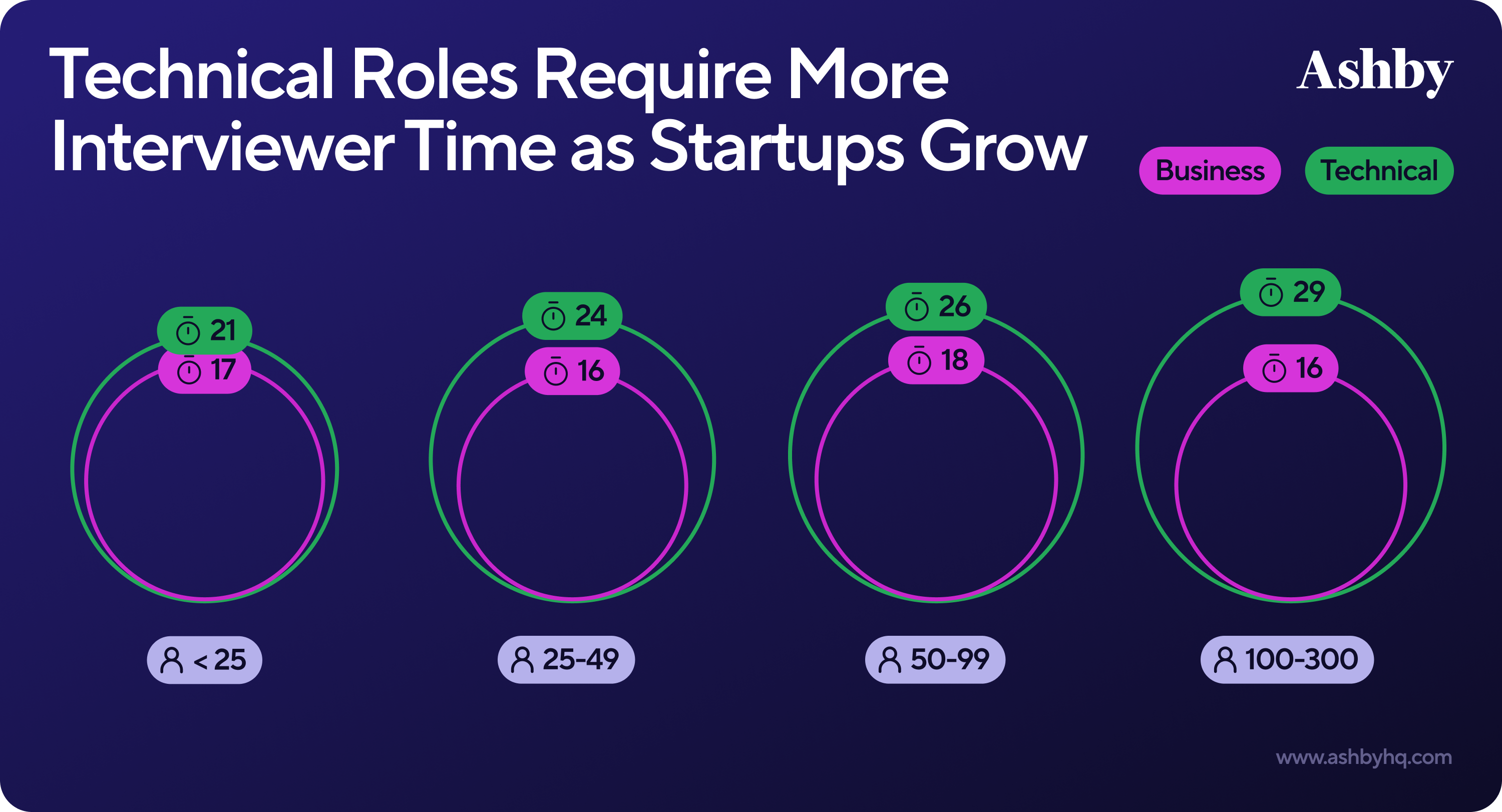
Whether it’s a founder, recruiter, or hiring manager conducting the interview, every hour of interview time comes at a cost. Here, we found that larger startups tend to have more interviewer hours per hire at ~29 hours. Note that because we are measuring time spent in an interview, these figures may not represent panels that involve take-home assignments or any work outside a scheduled interview time.
With that context in mind, we see that:
- Interviewer hours across all startup sizes is relatively flat for business roles but scales with size for technical roles
- Smaller startups (< 25) clock ~21 interviewer hours per technical hire while larger startups (100-300) clock ~29 interviewer hours per technical hire.
Candidate Interview Hours
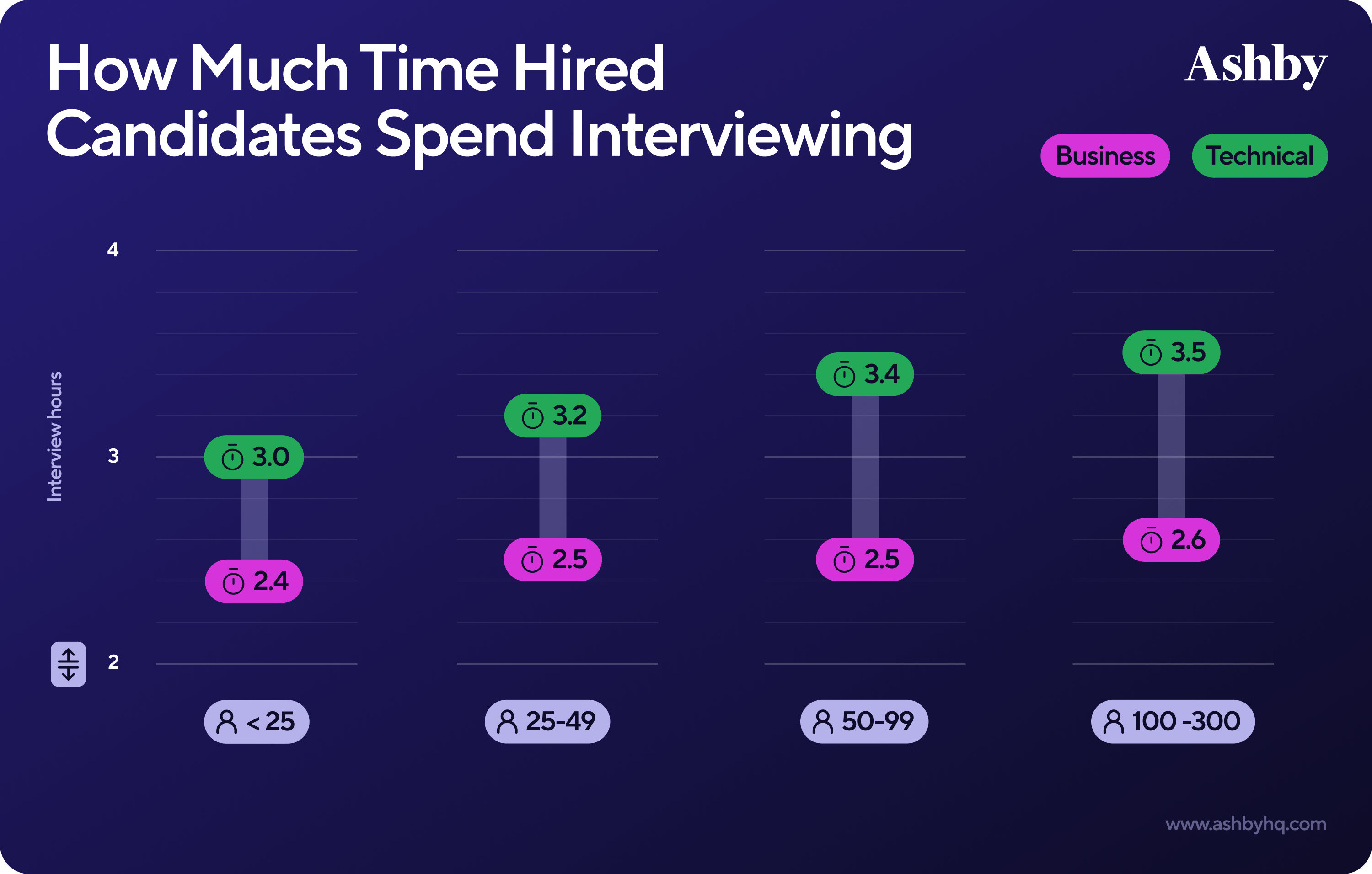
Let’s switch to the other side of the equation to observe how much time candidates are spending with startups before getting hired. Immediately, we found that a hired candidate at a startup spends between 2.5 to 3 hours interviewing. As a benchmark comparison to all company sizes, our 2025 Recruiter Productivity report shows the average candidate spends 2.5 to 3.5 hours in interviews.
Looking more closely, though, there’s a fair amount of variation with a difference of about two hours between the 25th and 75th percentile, and technical candidates tend to undergo a longer interview process than their counterparts. A reminder once more that these hours do not include take-home assignments and other work outside a scheduled interview time.
V. Offer Acceptance Rates
Applications are in, interviews are done, and offers are being made. As a reference point, when we analyzed all company sizes in our Offer Acceptance Rates report in 2024, we found a largely stable 81% OAR. When we segmented the data then, we didn’t find much variation in acceptance rates by company size. Analyzing startup-specific data again now, that storyline remains true as offer acceptance rates for startups hover around 80%.
Note: If you’re an Ashby startup customer, your benchmark may look different depending on how you’re looking at this data and how sophisticated your process is. We find that some smaller startups forgo certain steps in the process such as formal offer letters. For this analysis, we looked specifically at offer stage rates in Ashby.
Acceptance Rates for Remote Roles
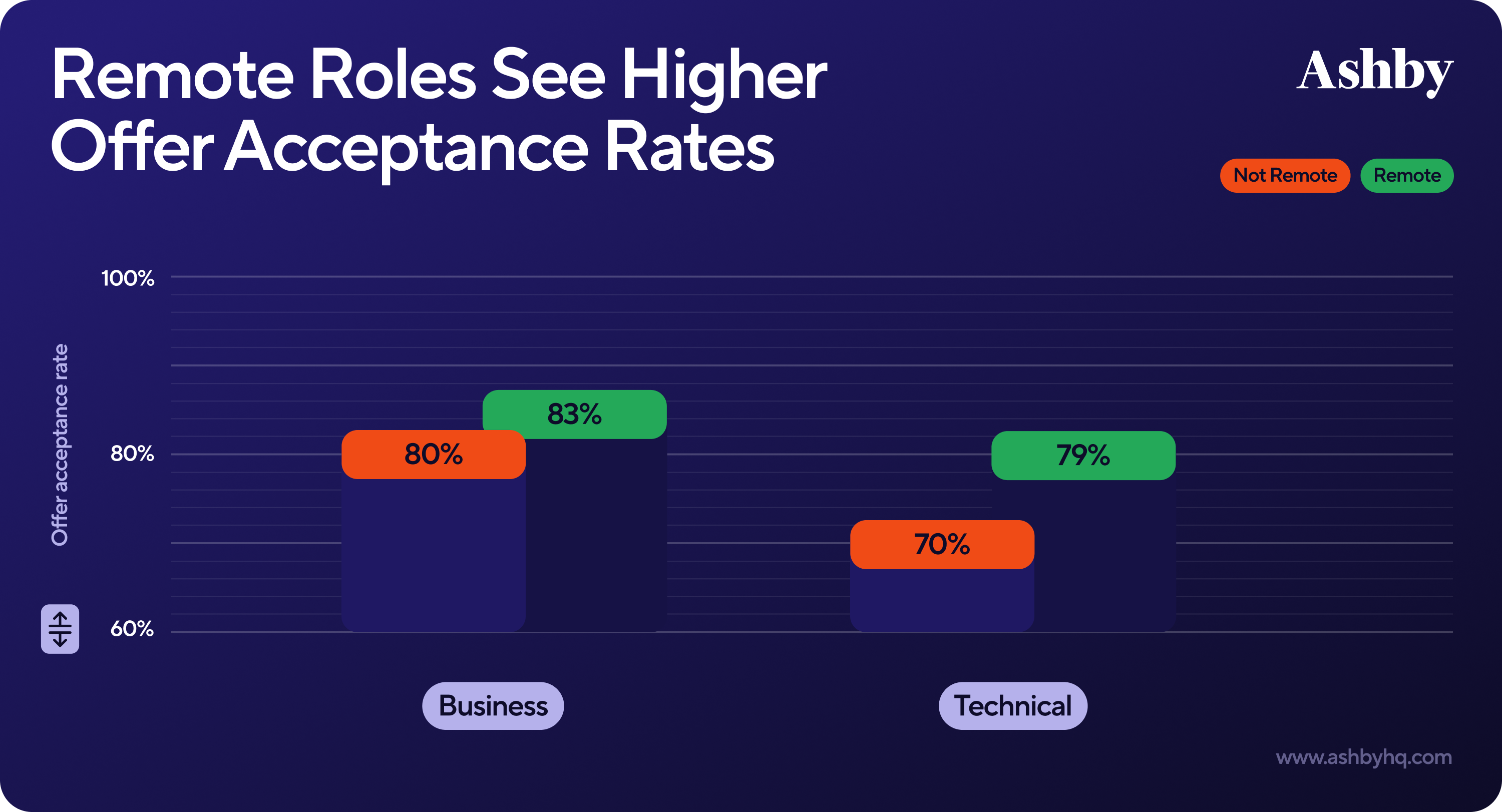
Earlier, we observed a material increase in inbound application volume for remote positions. Looking at how that flows through the hiring funnel, we also observe a 9% higher offer acceptance rate for remote roles over in-office roles. So remote not only offers a greater pool, but proves to be more attractive to candidates.
Breaking this out by function, we see the percentage is dragged in favor of remote positions by technical candidates. Specifically:
- Remote technical roles receive 13% higher offer acceptance rates
- Remote business roles receive 4% higher offer acceptance rates
Though it’s worth noting that at startups with fewer than 25 roles, technical roles see no difference in acceptance rates whether remote or in-office.
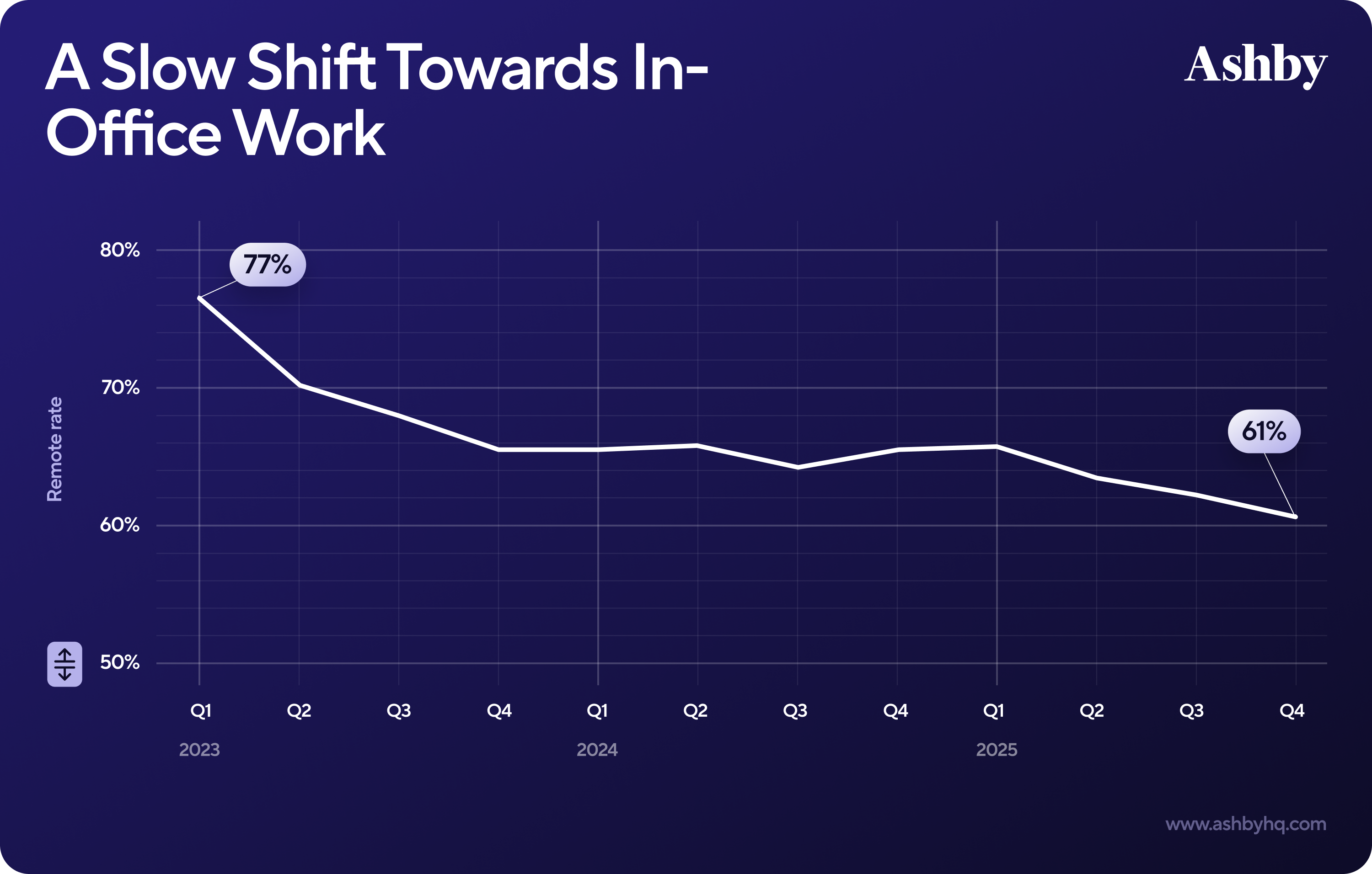
While both inbound application volume and offer acceptance rates favor remote roles, we wanted to see whether startups are offering remote work more frequently. Interestingly, the share of venture-backed startup jobs with remote options has slightly declined over the past two years, from ~80% in 2023 to ~60% in 2025.
VI. The Teams Behind Startup Hiring
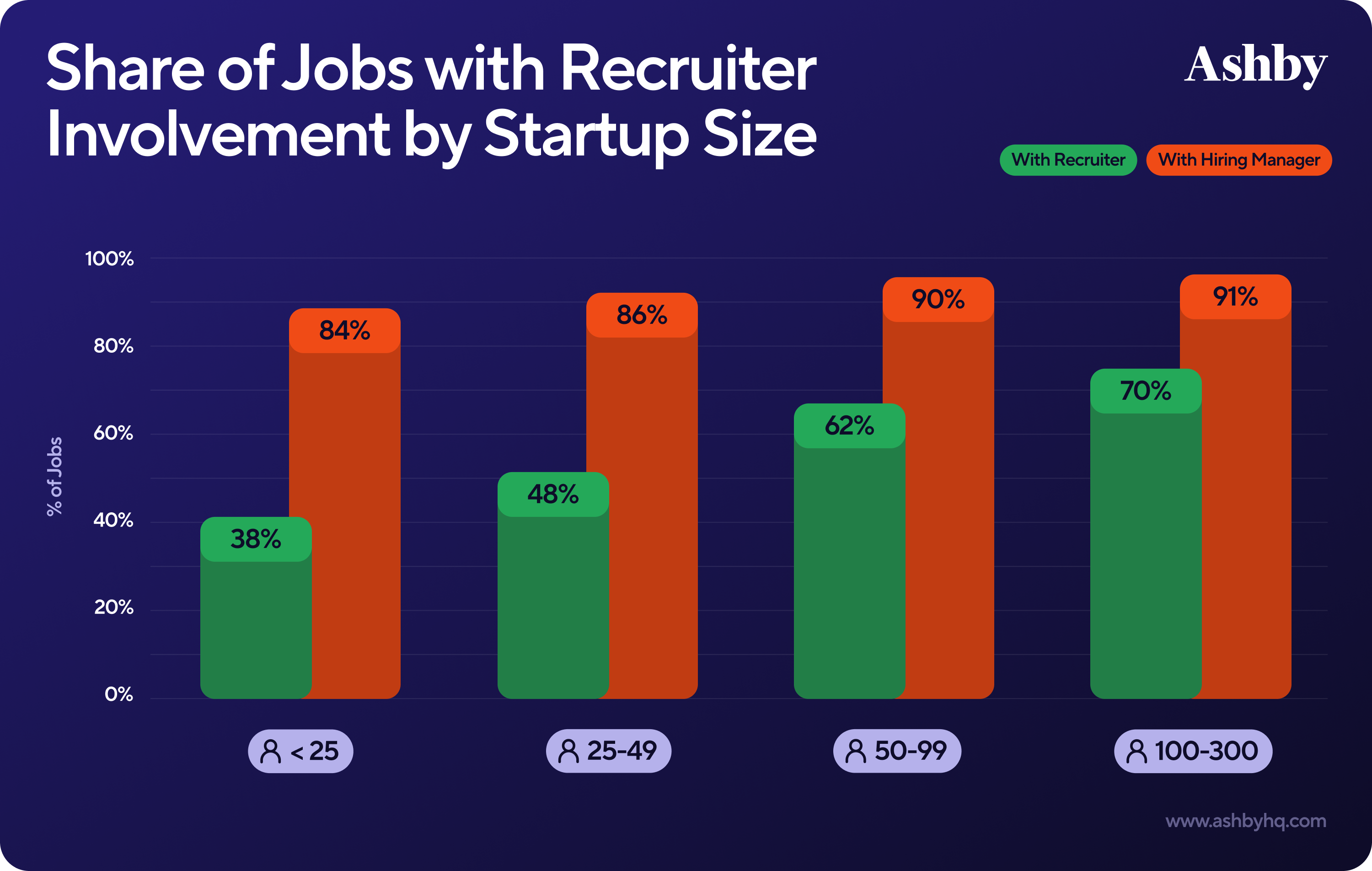
We’ll wrap this report by looking at the people and teams behind all this incredible work. Smaller startups may not have a designated TA team while larger startups are often solidifying their hiring process and may hire dedicated recruiters to manage pipelines for specific business units. Due to this high variance on how startup talent teams come to life, we look at this section of the data by what percentage of jobs with a hire in Ashby have a recruiter or hiring manager associated.
Across startup sizes, hiring managers unsurprisingly play a key role in hiring. As startups grow in size, the delta between the two shortens as more recruiters are hired to the team. It should be noted that just because a job does not have a recruiter assigned doesn’t mean they don’t benefit from a TA team creating the hiring architecture. Below, we will see that small startups that might not have an established hiring flow benefit the most from adding a recruiter to a job.
Time to Hire
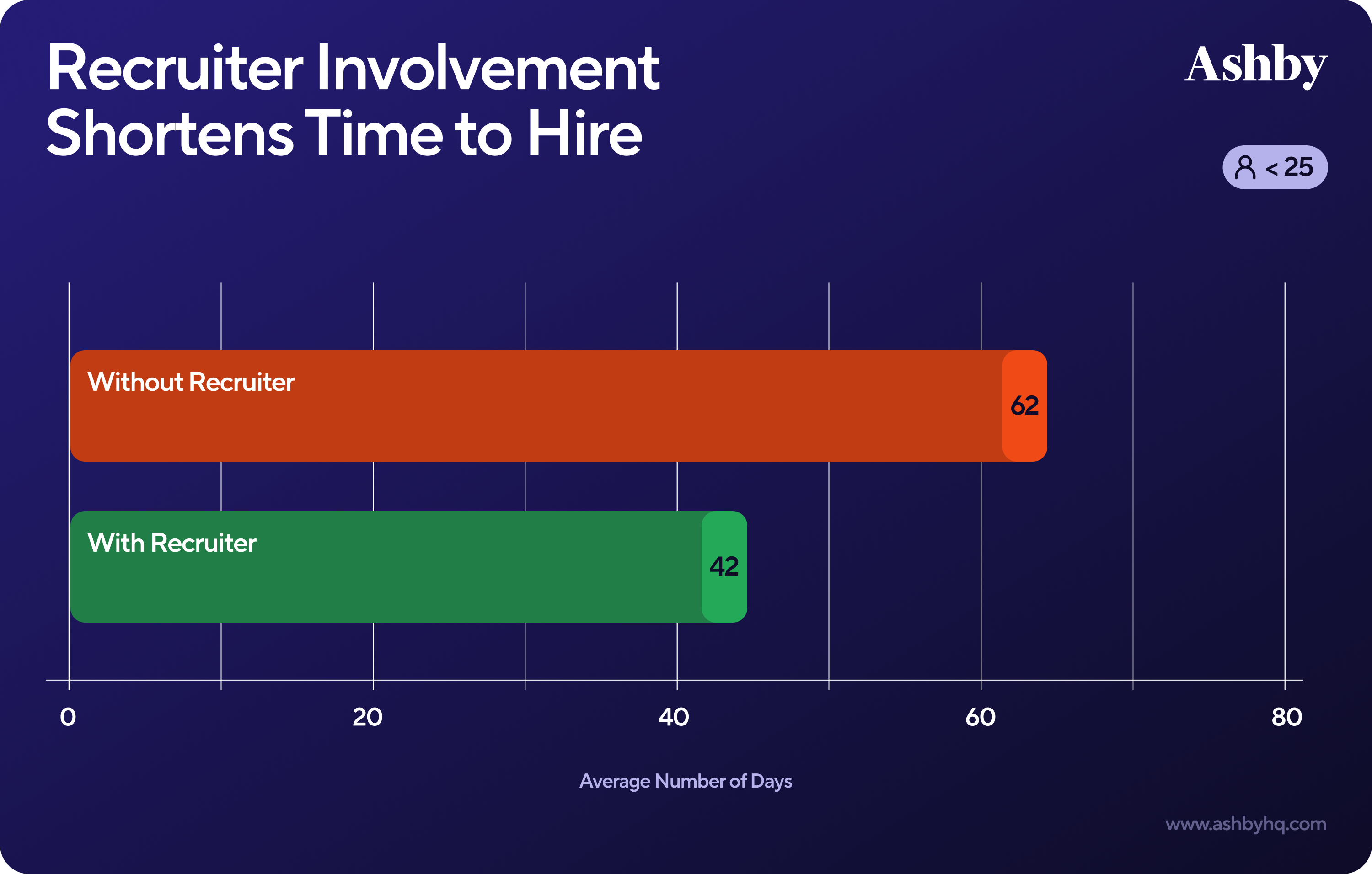
There’s a decent amount of disagreement around when recruiters should be hired within an organization, versus a hiring/founder-led model, relying on agencies, and so on. Our data spotlights the value of a talent team quite clearly:
- For smaller startups (<25 employees), time to hire drops by almost 30% when a recruiter is involved.
- For larger startups, jobs that have a recruiter involved consistently have a faster time to hire than jobs that do not have a recruiter involved, but the difference is not as striking. This is likely due to the process that the existing TA team has built, providing benefits to hiring efficiency even when a recruiter is not explicitly assigned to a job.
This data suggests that for startups looking to scale, investing in a talent professional earlier on can pay off.
Hiring Team Size
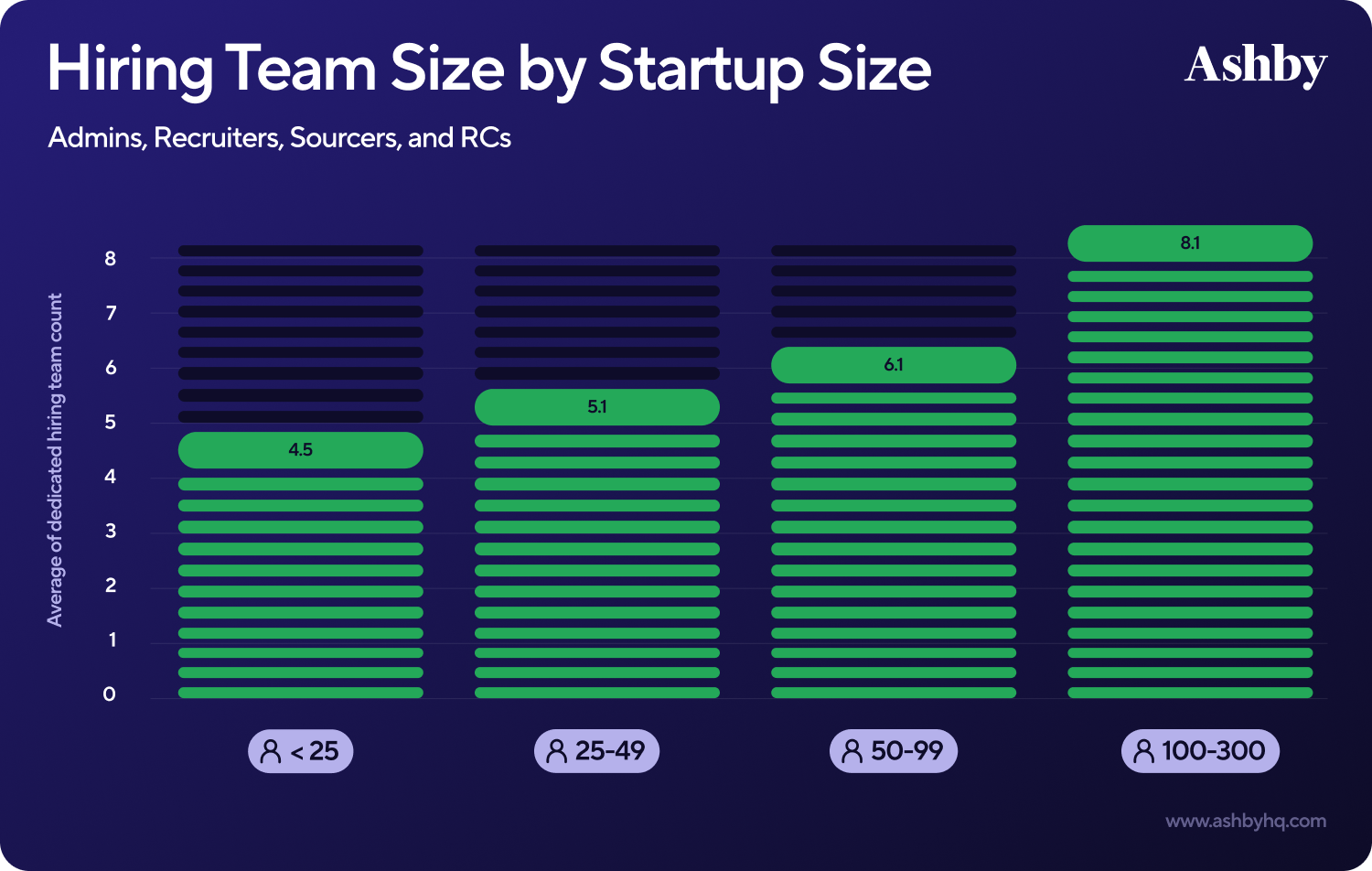
Again, the composition of a “hiring team” varies widely by startup. To better understand how hiring effort scales, we looked at how many individuals from a talent team are involved in hiring at each company size. This includes founders, recruiters, and sourcers, but excludes hiring managers. We immediately see that larger startups often have double the number of people involved from a talent team than smaller startups. As startups grow overall, the number of people involved in hiring increases steadily. The average number of talent team members involved in hiring:
- < 25 employees: 4.5 people
- 25–49 employees: ~5.1 people
- 50–99 employees: ~6.1 people
- 100–300 employees: ~8.1 people
Closing Thoughts
Startup hiring in 2025 was defined by scale and speed with more applications, more tooling, and more pressure to move efficiently without compromising quality. AI is no longer theoretical for startup talent teams; it’s already embedded across sourcing, screening, and coordination, helping teams manage volume and reclaim time. At the same time, remote roles continue to reshape candidate behavior, driving both higher application volume and stronger offer acceptance rates.
While the inputs to hiring have changed, the fundamentals remain consistent. Startups that invest earlier in recruiting support move faster, reduce interviewer load, and create more momentum across the hiring funnel. Even as company size, brand recognition, and hiring models vary widely, the data shows clear advantages for teams that pair thoughtful process design with the right technology.
This report aims to ground those decisions in real benchmarks from over 1,200 venture-backed startups. As hiring continues to evolve, we’ll remain deeply embedded in the startup ecosystem by learning alongside founders and talent leaders and sharing data that helps teams build strong, durable hiring foundations from day one.
To learn more about current industry trends, check out our prior Talent Trends Reports.
Other Reports
Talent Trends Report | Candidate Experience Surveys
Our analysis of 67.4K surveys requests sent and 11.9K survey responses received unveil valuable insights for recruiters designing Candidate Experience Surveys.

Quality of Hire | Talent Trends Report
73% of new hires exceed expectations, and first impressions rarely change. See what 35,000+ Quality of Hire scorecards reveal about what makes a great hire.
Subscribe for more talent trends and insights
We will be regularly releasing new reports around trends and insights we're seeing in our data and you will be the first to know.