Ashby Product Keynote
Ashby co-founders Benji Encz and Abhik Pramanik unveil the next generation of AI for recruiting at Ashby One 2026 in London. Highlights include Scheduled Agents, Career Page Builder, WhatsApp messaging, AI-assisted application review and report building, and more.
Speakers



Key Announcements
- WhatsApp Communication: adds WhatsApp as a candidate messaging channel alongside Ashby’s existing texting, for high-touch conversations throughout the hiring process.
- Scheduled Agents: lets a team set a recurring cadence, like a weekly pipeline recap or a Friday interview-calibration review, so an agent runs the review automatically and pauses only for a human to confirm the result.
- Career Page Builder: a visual, template-based editor for building a fully branded careers page and job board without needing a developer. Targeting launch in early 2027.
- Agentic Scheduling: an agent that finds interview times across candidate and interviewer availability, sends the availability request, and confirms the schedule, with a Copilot mode that pauses for human confirmation before each email goes out. Launching later this year.
- Ashby MCP: connects Ashby’s recruiting data to external AI tools like ChatGPT, Claude, and Cursor, respecting the same user permissions that apply inside Ashby.
- AI Notetaker Recording Sharing: lets a team share a full interview recording or a specific clipped moment directly with another Ashby user, including a link to the exact spot in the call.
- AI-Assisted Application Review: lets a team define any criteria for evaluating candidates, then automatically assesses each candidate against those criteria and returns an evaluation per criterion.
- AI-Assisted Report Builder: analyzes a generated report in Report Builder, flags patterns worth investigating, and surfaces related reports so a recruiter can dig into what’s driving a metric shift.
- EU data center: a dedicated data center for EU customers, planned for 2027.
Business Growth: more than 1,000 EMEA customers, with EMEA revenue up nearly 144% over the past year and now about 24% of Ashby’s global revenue. As of September 2026, 91% of Ashby customers use its AI features regularly, up from mostly one-off testing a year earlier.
Featured Customers: Stream, Legora, Lovable, Eleven Labs, Granola, Attio, Harvey, Confluent, Intercom, Oyster, Riveron, Sony Sports, Hiya, and Clay.
Session Overview
Ashby’s first London keynote covers how AI features Ashby has shipped over the past year are moving from novelty to daily habit for recruiting teams, and what the company is building next across product, community, and customer support.
CEO and Co-founder Benji Encz opens on what has shifted in talent acquisition, from the hyper-growth years through the efficiency era to today’s mix of high inbound volume and rising concern about candidate fraud.
VP of Engineering and Co-founder Abhik Pramanik covers three AI investments that reinforce one another: AI that works wherever the work happens, through Ashby Assistant inside the product and Ashby MCP outside it; AI that acts without waiting to be asked, previewed as Scheduled Agents; and AI that understands how one specific organization hires, drawing on Notetaker, application review, and AI Interviewer. He also walks through Ashby’s EU AI Act preparation, which covers disclosure, human review and override, traceability, candidate opt-out, and never training models on customer data.
EMEA Community Lead Willem Wijnans covers how Ashby’s in-person community, from breakfasts to Build-a-thons, gives talent leaders a place to compare notes in person, and previews upcoming Ashby Cafés planned for Amsterdam, Berlin, Paris, and Stockholm. Director of Product Support Laura Ashmore follows with how Customer Success, Support, RecOps, and Customer Education carry product change into practice, and why having the team embedded in Europe matters to European customers.
Knowledge Manager Abbye Eva closes with a day-in-the-life demo of a recruiter using Ashby Assistant, Ashby MCP, AI-assisted application review, candidate rediscovery, Agentic Scheduling, and Report Builder across a single Monday. She wraps up the keynote with the recently launched ability to share an AI Notetaker recording, useful for interview training, and two candidate experience releases: new WhatsApp messaging and a preview of the upcoming Career Page Builder.
Chapters
- (00:12) Customer montage and welcome to Ashby One London
- (05:12) EMEA growth and a dedicated EU data center for 2027
- (07:34) What is changing in talent acquisition
- (09:40) AI adoption, trust, and EU AI Act readiness
- (16:39) Ashby Assistant, Ashby MCP, and Scheduled Agents
- (27:04) Community, Ashby Cafes, and learning from peers
- (35:26) Customer Success, Support, and RecOps in EMEA
- (41:50) A day in the life demo, and where Ashby goes next
- (1:01:05) closing wrap-up
Q&A
Q: Which parts of hiring should stay with a human when a team adopts AI?
A: Calibrating talent, assessing quality, and building relationships with candidates stay with people, while AI absorbs the coordination, preparation, and admin work around them. Ashby designs its agents to prepare a recommendation and show the evidence behind it, leaving the recruiter and the hiring manager to decide whether to act on it.
Abhik Pramanik, VP of Engineering at Ashby: “Hiring humans will always require human connection and human judgment. Whether it’s calibrating talent, assessing quality, or building relationships with candidates, you are at the center of it, not a chat box or a machine. Instead, AI will shift your focus from administering your hiring process to sharpening it.” (13:03)
Q: What should you look at when a role has plenty of candidates but no hires?
A: Read the stage where candidates are stalling rather than the pipeline total. Candidates piled up at intro call point to recruiter capacity; candidates advancing to the hiring manager and then stopping point to a calibration problem, which sourcing more people will not fix. Ashby Assistant surfaces both reads from existing pipeline data.
Abbye Eva, Knowledge Manager at Ashby: “We have enough pipeline, we need more recruiter capacity. Customer Support manager has a calibration problem. Recruiters have advanced 14 candidates to the hiring manager, but only two have moved beyond that stage. Before sourcing more candidates, recruiters and hiring managers need to align on what a qualified candidate looks like.” (43:43)
Q: How do you make interview calibration a regular habit instead of a one-off?
A: Interview calibration becomes routine when the review runs on a schedule instead of waiting for someone to remember it. Ashby’s Scheduled Agents, previewed at Ashby One London, run a custom agent on a set cadence, so a brief flagging vague feedback, uncovered competencies, and missed follow-ups is waiting before the next week’s interviews.
Abhik Pramanik, VP of Engineering at Ashby: “To sum up the workflow, the agent reviews what happened, shows me what deserves attention, and helps me prepare the next step. With Scheduled Agents, interview calibration can become a part of your team’s regular rhythm. Instead of remembering to conduct another manual time-consuming review, you can start each week with a clear picture of what happened and ideas on what to do about it.” (22:39)
Q: How can recruiters use AI outside their ATS without exporting recruiting data?
A: An MCP connection lets an AI client read live ATS data in place rather than requiring an export. Ashby MCP links Ashby to ChatGPT, Claude, Cursor, and other MCP-compatible clients under the same user permissions that apply inside Ashby, so a board hiring plan can be compared against live pipeline data role by role.
Abbye Eva, Knowledge Manager at Ashby: “And in just a few moments, we’ve turned a static hiring plan into a clear view of where we’re on track and where the team needs to act. This is the value of MCP, recruiting context that can travel with me even when the conversation happens outside of Ashby, and the analysis can stay grounded in the permissions and live data.” (47:15)
Benji Encz (03:04):
Thank you very much. Good morning, everyone, and welcome to our very first Ashby One London. It's really awesome for you to spend this special day with us, and to see a lot of familiar faces, and then plenty of new ones as well. So earlier this year, we hosted the second Ashby One conference in San Francisco.
But from the beginning when we started this conference series, we knew we wanted to bring it to London at some point as well. And part of that is because EMEA has been a pretty essential region to us almost from day one. As a quick personal aside, I actually grew up in Germany, just outside of beautiful Stuttgart, which you can see on the screen.
But I left for California in 2013, and at the time I did that because it felt like the most consequential software companies were almost exclusively started in the US. And the California weather was not too bad either. But joking aside, needing to start a tech company in the US is no longer true in 2026.
Some of the most interesting software companies are being built right here in London, in Berlin, and across Europe. And many of you are building global companies from day one, and we actually grew in a very similar way. From the earliest days, we were globally distributed, and we had European engineering talent on the team that has been shaping the product.
So EMEA has always been a key part of our operating rhythm and our culture. And then our customer roots here, they run almost as deep. Willem, who many of you know, and he'll be on stage in just a bit, he was actually one of our earliest and most influential customers while he was at VanMoof, which is a Dutch company.
And there he implemented us in 2020, which is two full years ahead of our public launch. Very brave of him back in the day. And they were our only customer that had hundreds of employees on Ashby. And then later Willem joined us to help build our EMEA community and customer base. I love this story because it really resembles how we've always built Ashby, by staying really close to our users.
And then in this case, we had someone who really understood what ambitious talent teams needed, and then joined us to help accelerate our progress. And that's really why we are here today. This event, Ashby One, is a day with a community that has been shaping the product for many years. Now, with that, onto some numbers that I think are worth celebrating.
Over the last few years, our EMEA team has done an awesome job growing the business here, and we now serve over 1,000 EMEA customers.
And then ARR from EMEA customers has grown almost 144% in the last 12 months. And the EMEA customer base makes up 24% of our global revenue. As you can see in these numbers, it's a key market for us, and it's quickly accelerating. And we're continuing to invest here on all fronts. We're going to talk about that today.
But I have with that a first exciting announcement to make for this morning, and that is in 2027, we will be launching a dedicated EU data center.
A lot more information to come on that front in the next few months, but we're really excited for it. Now, growing our footprint in the region has allowed us to serve some amazing customers that are great examples of building global businesses from a home base in Europe. Lovable, Eleven Labs, Legora, Granola, Attio, to just name a few.
These companies and many of you in the room, you're examples of companies that operate globally at a much earlier stage in your growth. You're managing different markets, regulations, and hiring needs, and you have lean teams but ambitious hiring goals. In that way, some of the most ambitious EMEA teams, you're a concentrated example of a shift that we're seeing across TA teams globally.
And that brings us to the bigger question for today. What is changing in talent acquisition and why are the old categories of recruiting software no longer enough? That's going to be the thread for the keynote this morning. We're going to talk about how talent teams are adjusting to a period of real change, leaner teams, higher expectations, and new technology that is moving very quickly.
From there, we're going to go into the product. We're going to talk about how we think about AI, how the product has evolved recently, and why the shift from mere AI announcements to actual adoption matters so much. And then we'll talk about how we help teams adapt to that change, and that's both across customer success but also our community efforts here in EMEA and globally.
And then finally, we're going to bring it all together in what I think is a pretty epic end-to-end product demo that hopefully shows you what it looks like if a modern TA team operates in Ashby and has AI embedded in their real day-to-day recruiting workflows. And my hope is that you walk away from this with a clear sense of how we're building for this next phase of TA, both the product, but also the team and the community around it.
Let me start with what is changing in TA. So over the last few years, talent acquisition has gone through wave after wave of change. First was the hyper-growth period when everyone needed to hire at an incredible pace. Then came the efficiency era when you all had to do more with less. Then the focus shifted toward quality and talent density.
And then more recently, you've been dealing with another layer of complexity, high inbound volume, more noise, and rising concerns around candidate fraud. And we actually looked at this for the EMEA market specifically ahead of the conference to give you some numbers. And we've seen that over the last five years, the applications per hire have almost doubled.
And then on top of all of that, AI is now forcing you to rethink how your team operates. And for all of that, the role of TA has really elevated itself. Recruiting has become a much more strategic function, and we see the best teams are now building systems instead of just performing the work. And using data to shape how your companies grow, and that makes the role of TA a lot more impactful, but also raises the bar for TA professionals.
And with that, the needs for your systems change as well. Today, we need systems that help you move faster without giving up on quality, better data, more automation, and we're going to talk about this a lot today, a clear point of view on how AI should change your team's work. And that has really shaped how we've built Ashby over the last few years.
Talking about AI, we all know it has an incredible potential to eliminate a lot of the routine tasks that are part of complex recruiting cycles. But what is exciting to me is increasingly, AI is also able to help you hire better, not just more efficiently. But then there are also the parts that remain deeply human and are still critical: calibrating talent, assessing quality, and building trust with candidates.
To see how and where our customers are adopting our AI capabilities in practice, I'm going to hand it over to our co-founder and VP of Engineering, Abhik. Welcome to stage.
Abhik Pramanik (09:40):
Thanks, Benji. Very excited to be here. So over the last year, the conversation around AI has changed in a meaningful way. A year ago, almost every customer opened with the same question: "Does your product have AI?" Everyone could see the power of this technology, but not necessarily its application in their day-to-day, or their co-founder went on a three-day Claude bender and decided to mandate AI across the company.
Promise that wasn't me. Joking aside, the questions have shifted resoundingly to solving real problems. What should still be done by a recruiter? What should be automated? How should the team work differently? How do we introduce AI without disrupting what already works? And how do we keep quality high as more of the process runs on its own?
We see the same shift in how our customers use our AI features. A year ago, customers experimented with them, and today our features are becoming an integral part of their day-to-day. So much so that today 91% of Ashby customers use our AI features.
That is a significant change in a short period, and it's transformed how many of you and what many of you need from us. You are not asking for more AI simply to fulfill a company mandate driven by your co-founder's three-day Claude bender. You want AI you can use effectively. AI that understands how your hiring process works, respects how your teams already work, and helps you make better decisions without adding more steps.
Effective AI also means you shouldn't have to double-check your work because that doesn't save you any time, and that means trust is not optional in the AI products that you use. And so at Ashby, it's a foundational principle. For us, trustworthy AI means it has the right context, respects the permissions and security controls that you've put in place, keeps you in charge of important decisions, and fits into your existing workflow rather than requiring a brand-new one.
For many of you in the EU, trust also means compliance isn't an afterthought. We are proactively preparing for the EU AI Act, and that means we're building features with clear disclosure, human review and override, traceability, candidate opt-out support, and a policy of never using your data to train models.
Responsible AI also has to work within the real legal and operational complexities that exist today and in the future. So we've also invested in capabilities like regional disclosure rules and multi-region retention controls. We can also build trustworthy AI because of a philosophy we've held since before LLMs.
Your recruiting process should be encoded directly into the product, not scattered across documents, spreadsheets, or that brilliant recruiter who never writes anything down. Once your process is accurately captured in Ashby, you can automate more of it. You can measure it more consistently. You can give hiring managers the ability to self-serve without losing control, and you can improve the process itself instead of blindly moving candidates through it.
Ashby's AI accelerates that shift. Your team will move from manually executing every step of the process to designing the workflows, the guardrails, and the operating rhythms that let Ashby carry more of your work for you. But I don't think AI is going to replace recruiters. I sincerely believe that.
Hiring humans will always require human connection and human judgment. Whether it's calibrating talent, assessing quality, or building relationships with candidates, you are at the center of it, not a chat box or a machine. Instead, AI will shift your focus from administering your hiring process to sharpening it.
Teams that fully embrace this mentality will attract and convert the best talent over the coming years, and that means AI needs to stop being a flashy demo and be deeply integrated into your team's weekly routine. So let's hear from Anastasia Geller, Director of Talent Strategy at Stream, who is a perfect example of a customer deeply embedding AI into their hiring process to deliver a better candidate experience and a better quality of hire.
Anastasia Geller, Director of Talent Strategy at Stream (Video) (13:55):
The biggest value of AI that I see for recruitment teams is that it frees up the time for you to basically focus on what actually matters, is people. I'm Anastasia Geller, and I'm Director of Talent Strategy at Stream. So at Stream, we're doing tooling for developers. We're doing APIs and open source as the case for social apps to build chat functionality, feeds, AI moderation, and video.
The biggest excitement that our team, including our executive team, had when we were about to implement Ashby was the AI application review feature. So for us, the highest value of that was that we could prioritize the candidates who had the highest chance of this match and this success, which did cut our time to hire as well, which did increase our quality of hire, which is also, by the way, the metric that we were not able to measure confidently before Ashby.
I think the value that we get out of AI Application Review feature in Ashby is that we can also look at things that are not that obvious. For example, in engineering for us, it really matters that people did have experience of handling high traffic, high volume at scale. Now, when recruiters don't spend time on reviewing and filtering these kind of applications, they can spend the time sourcing, which brings the most value to the type of hiring we do at Stream.
Our hiring became faster on average by 15 to 20 days per role. The quality of hire, we like to track it quarter over quarter. You can just see this nice spiking line that is very nice to observe, which again is a very hard metric to track because it's super subjective usually. From the very beginning, we were super excited about how reporting functionality works in Ashby.
With our previous ATS, we used to have a separate tool on top of that, that helps us visualize this data and work with it. You can now just ask an agent within the Ashby with your plain language, and it will give you the answer. So our customer success team does make sure that we do keep up, so if there is a number of new AI functions that were released that maybe we missed.
What I am curious to try out in future with Ashby is AI interviewing. While the initial reaction I myself had as a recruiter was like, "No, you cannot take this first human touch out of the equation with the candidates," what actually often happens is that you just never get to know the human behind the resume.
If I feel like it can give us an opportunity to learn more about the people that we have in the pipeline, because ultimately this is what makes great recruiters great, is how good they are at building the relationships.
Abhik Pramanik (16:39):
Thank you, Anastasia, and thank you for being with us here today. Now let me show you three places we are investing to make this deep integration of AI even more possible. First, we're building AI to meet you where your work happens. Sometimes that's inside Ashby, sometimes it isn't. When it is, use our Ashby Assistant.
You can compare candidates before a debrief, understand pipeline health, draft outreach, answer product questions, take action without jumping between pages. You can do it all. But recruiting doesn't always happen entirely inside your ATS. You may want to compare a hiring plan in a strategy document with your open roles in Ashby.
You may need recruiting metrics in slides for a board update, or you may want to check a candidate's feedback against your CEO's intelligence test. Benji. That is why we built Ashby MCP. It lets you securely connect Ashby to ChatGPT, Claude, Cursor, and any other MCP-compatible client. And it respects the same user permissions that exist inside Ashby.
To us, the distinction is simple. If the task starts and ends in Ashby, use our assistant. If it's part of a larger problem you're solving across multiple systems, use our MCP. Ashby should be useful wherever your work happens, and we don't assume or require that your team work in one interface. Second, Ashby is becoming more proactive, not just reactive.
Most AI tools today need you to ask the question. They present a chat box and await your command, and that is useful, but as AI does more of your work for you, you shouldn't have to babysit it. Your team repeats the same work week after week, day after day. Every Monday, someone has to prepare the pipeline recap.
Someone has to draft a hiring manager update. Someone has to notice that a candidate has been waiting too long for feedback. While AI can make that work faster, it should also do it without you asking, and that is where AI removes a lot of toil and creates real leverage. Today, we're excited to give a preview of Scheduled Agents, and this will launch later this month.
Until now, our agents responded when you asked them to do something. Scheduled Agents work on your team's cadence. You can have a pipeline recap ready before the Monday sync, a hiring manager update drafted every Friday, a recurring report that flags candidates that don't meet your CEO's intelligence test.
That one's for you, Benji. You define the workflow, the schedule, and the conditions for when a human should step in, and the agent keeps the rest moving. Now let's take a look at scheduled agents in more depth. Despite how important interview calibration is, it's a one-off process that your team often doesn't get the time to do.
Ashby customers have started to address this problem with custom agents. At Ashby One SF, Michaela from Supabase designed an interview performance evaluator for their bar raiser interview. Jason from SEON uses agents to identify high-risk questions, evaluate interviewer consistency, and uncover missed opportunities in transcripts.
But these agents still require you and your team to remember to use them. Now, scheduled agents turn this kind of review into a recurring workflow. First, it starts with custom agents. I've already created one called the Interview Calibration Coach, and that reviews a wealth of information of a candidate already inside Ashby.
So that's application forms, recent interview feedback, interview details and transcripts, a lot of stuff. And I can tell it exactly what to look for, competencies that weren't covered, vague feedback, missed follow-ups, or recurring patterns across interviews. But notice I'm not asking the agent to score interviewers or make hiring decisions, but to identify where the existing process may be breaking down. With scheduled agents, I'll schedule it to run every Friday afternoon, so the first pass now happens automatically with results sent over email and Slack.
And I'll set it to do it over Slack. And a coaching brief will be ready before next week's interviews without anyone lifting a finger. So what comes back isn't a simple score or a summary on sample data. The agent reviews all interviews, surfaces the ones that need attention, and flags potential recurring patterns.
Each finding gives me the context, the supporting evidence, and the specific next step. The citations let me see exactly why something surfaced and review the underlying interview or feedback myself. Notice the agent flagged that the feedback for David lacked clear calibration language, supporting evidence, and a connection to the competencies we're evaluating. And rather than accepting that conclusion at face value, I can review the original feedback and see exactly what the agent was responding to.
That's important because this isn't meant to be a black box judgment. The agent points me towards the evidence, but I can examine it and decide whether I agree with its interpretation. Anika's in the room with us today. I promise her real feedback is not like this. It's pretty atrocious. Now navigating back to the Ashby Assistant, the agent can help me prepare my next step.
That might be a coaching note to an interviewer, an update to a future interview briefing, or a recurring pattern I want to address in interview training. For example, it can turn this finding into a short note asking interviewers to connect their recommendations to specific evidence and the competency being addressed.
The agent prepares a recommendation, but I still decide whether to use it and what action to take.
To sum up the workflow, the agent reviews what happened, shows me what deserves attention, and helps me prepare the next step. With Scheduled Agents, interview calibration can become a part of your team's regular rhythm. Instead of remembering to conduct another manual time-consuming review, you can start each week with a clear picture of what happened and ideas on what to do about it.
We're so excited to see what you're going to build with these new tech capabilities. We've already seen a lot of fun stuff be built with Custom Agents. We launched that back in May, and since then, customers are moving quickly from experimentation to real use. This quote from Jason at SEON reinforces the speed and volume of agent creation. But what is exciting about this example isn't the tokenmaxxing or agent maxing, if that's a thing, but the way these agents have become a part of how teams on Ashby operate.
Your recruiter and hiring manager still own the decisions, but AI takes more of the coordination, the preparation, and admin work off their plates. That is the direction for agents in Ashby, moving from reaction to proactive support, with you putting control of the moments that require a human. So Ashby Analytics is also evolving in the same direction.
Even with great reporting, someone still has to know what questions to ask. Over time, our AI will help teams surface the patterns that truly deserve attention. Unusual conversion rates, roles behaving differently from company norms, or recurring friction throughout the process. That doesn't replace RecOps.
It underscores the importance of strong RecOps teams, because they define the context that makes AI trustworthy and useful. Finally, Ashby has built and continues to build AI that truly understands how you hire. AI's superhuman strength is that in seconds it can parse, cross-reference, and summarize information that would take hours for a human to do.
But if that information is missing or presented incorrectly, AI becomes less useful and often unreliable. For AI to take on more work in your hiring process, it needs more of your hiring data presented in the right context. Our platform already captures much of this data today, and you can start using it effectively across many of the products we've launched over the past year.
Our Notetaker captures important interactions between candidates and interviewers and is accessible by all our agents. And AI-Assisted Application Review and Talent Discovery take your existing candidate data, including where candidates succeeded and where they fell short, and empower your teams to find candidates already interested in your company.
And we're just getting started. With our AI Interviewer, we are exploring how AI can conduct structured parts of the interview process while staying grounded in the requirements and competencies established by your team. Intakes will capture the results of your team's calibration exercises and make them available to all AI features in Ashby.
And there's much more to come. But if you take a step back, these three investments reinforce one another. First, AI should work wherever you work, and that is why we built Ashby Assistant as well as the Ashby MCP. Second, AI should increasingly work without waiting to be asked. Scheduled agents and proactive analytics are just the start.
And finally, AI should understand how your organization actually hires, the roles you are filling, the process you have designed, the conversations you have had, the standards your team has established. But excellent AI features alone do not create adoption. Teams also need to see how their peers are putting AI into practice.
Our next speaker will share how our EMEA community is helping talent leaders learn from one another. He's a person I was about to say needs no introduction to you all until I checked, and with that Dutch directness, he said he only knows about 65% of you. So you may know him, you may not.
It's a coin flip. Let's welcome Willem onto the stage.
Willem Wijnans (27:04):
Thanks, Abhik. It's really me. Our designer, Menno, clothed me today, so I have clothes that are not Ashby branded. Great. Abhik just spent his whole talk on what we're building. I get to talk about what engineering can't ship: community. Because when the landscape changes this quickly, software alone isn't enough.
Teams need peers who are working through the same problems and need a place to compare what good actually looks like, and that's the role we want the Ashby community to play. Before Ashby, I spent 15 years in talent, recruiter, lead, head of, the whole journey. So when I started running the Ashby community in Europe, I had one rule: only host a calibre of events that I would have made time for when I was still an operator.
What I wanted was a room that was actually curated, so I filled those breakfast and dinners up with 70% of our customers anyways. Not great for pipeline, sorry Mike, VP Sales. But I wanted to learn from the people that were actually in the room, and I wanted you all to feel heard because I was rarely heard by the software I bought when I was in your shoes.
And fast-forward to today, that is still my one rule. And honestly, I believe the hardest part of our job isn't really the hiring itself. It's building the rapport. It's building, making the case internally, the budgets, the fact that hiring in Berlin works nothing like hiring in London, and no vendor keynote is going to change that for you, including this one.
But there's usually someone in the room two seats away who already has, and that's why I care so much who's in the room because there's a type of person that buys Ashby. They're ambitious about our craft. They really want to see the data, and they want to build something better than whatever they inherited.
And most importantly, we're all humble enough to assume that there's somebody in the room that already worked out the bits that we're stuck on. And if that's you, you'll get a lot out of our community. Here are some of the specifics on how we think about community events. We think about every detail down to the seating.
If you're a first time Head of Talent, I want you to sit next to somebody who's doing it for the third time. Put these kind of groups together and the conversation gets practical really quickly. And the best moments have actually been when we stop talking and we hand over the mic over to you.
So I'm not sure if... I don't see, I thought I would see everybody, but Ryan from Genomics, walking a room through basically the workflows that he built and later went on to host a Show and Tell at their offices. Or Laura Holcombe from RecOps Collective, who I remember four years ago was really nervous about starting her own business, and behold today she has her own thriving RecOps practice helping many customers get up to speed at Ashby.
Or Bennet, who I do see, nice, from DeepL, coming all the way from Cologne to a breakfast in Amsterdam, and then going off and starting his little side huddle with the people he met there, and he's sitting next to one actually, so that's really good to see. And Dasha from Supabase, who came from Zurich to a breakfast we hosted in Berlin and showcasing her RecOps dashboards, which I ended up spending hours on beaming all those dashboards to our customers.
And maybe one of my favorites of the day, Iraj here on the front row at Accurx, who first presented at a Breakfast and Learn, then he did a Show and Tell in Dublin and in London, and I'm super proud of him, super proud of you to be on stage today on this very main stage. Woo! Yeah.
And this really symbolizes the whole point. The most valuable part about building in talent is actually building it together. Let's take a look on what that actually looks like.
I'll take you back to early 2022. The world was pretty much still virtual, and I started doing these dinners back when really no one was doing them. And while I really love great conversation, I also think that we need to do some practicalities, and we all need to move our work forward. So we started evolving these series to more education and more learning, whether over our breakfast or at our Ashby Cafe pop-ups or during our Ashby One Build-a-thons, but we're hosting one today as well.
And over the past four years, the questions in these rooms have really changed. People are rarely asking me for which feature is coming, but they're more thinking about, what is the process? How do I redesign the workflow? How do I train the team? How do I keep quality high while the work is changing underneath us?
And typically, these aren't questions that we as a vendor answer well. These are questions your peers answer well. So I'm really, really excited to announce that over the next year, I'm teaming up with Kayla Ricketts, who's the emcee on this stage, to bring the Ashby Cafes to all over Europe.
So we already have Amsterdam, Berlin, Paris, and Stockholm in planning, and hopefully many more will follow.
And both Kayla and I are always looking for people to share their work on stage with us because we like being on stage, obviously. But you all tell the story way, way better than we ever could because you guys are the ones actually shipping it today. So if you have a great body of work to share, and you want to join me or Kayla on one of our European city trips, please do reach out to me or Kayla directly.
We've flown a lot of our customers around already, and I keep just being bullish on this and getting the budget from Benji. If you're interested in being one of our speakers at one of our events, you can also scan this QR code and share your details with me. And lastly, these trips where we go on also is where we learn the most.
So I was in Stockholm, crazy cold, with Rick, one of our brilliant CSMs, and we were visiting Legora. And Matthias, their VP People, said something to me that really struck a chord. He said, "Willem, we bought a Ferrari, but we're driving it like a Volvo." Which, coming from a Swedish company, is obviously quite the admission.
Legora went live with Ashby in 2025 and grew explosively. By the time they'd finished implementing Ashby, the company they'd configured it for wasn't really existing anymore. So Rick and I proposed a full rebuild, not because they'd lost faith in our platform, but because they really wanted to rebuild the whole recruiting operation around it, properly this time.
And that's really the pattern that I see with most of the EMEA teams that are quickly growing. The trust is there. What they need is a little bit of extra love to get there. And that's where we, as community people, run out of road. We can plant the idea, but we can't implement it. And for that, I hand the mic over to Laura, who's going to talk a little bit more about that.
Laura Ashmore (35:26):
Thank you, Willem. I'm Laura, Director of Product Support here at Ashby. As Willem shared, community creates the space for TA teams to push each other to be more strategic. The role of customer success is to take all of these ideas and everything Ashby can do and apply them in practice. We've spoken today about the scope of AI and how it's already changed how we operate.
This means the scope of customer success has expanded too. And like any significant change, it comes with a period of change management. This is where Customer Success becomes especially important, particularly because many of our customers, they're not just running their existing process on Ashby.
They're using Ashby to improve the process itself, to integrate it with other systems, and ultimately build a stronger foundation for hiring. We've already heard from Anastasia at Stream on how our team supports hers in staying ahead of AI adoptions. Let's now turn to Fritz Singer, VP of Talent Acquisition at Legora, for why having our team embedded here in Europe becomes a further differentiator.
Fritz Singer, VP of Talent Acquisition at Legora (Video) (36:34):
The interaction that we have with Ashby customer success team has been great from the start. Before my time, the team flew out to Stockholm to help with a one-week implementation, and they were integral in those early months. Hi, I'm Fritz Singer, VP of Talent Acquisition at Legora. Legora is a legal AI company.
Our previous ATS was not scaling with us, and the complexity of the business was only continuing to grow, and we needed a partner and an ATS that was going to help us in terms of the product's capabilities, but also the scalability that we needed. Ashby allows you to build for the business that you're in.
The customization, everything from the job templates and the process to the experience with stakeholders and hiring teams or even how we interact with candidates, can and should look different. And so I think the customization that Ashby provides helps us to think a bit more intentional as to the decisions that we're making, and that's also why I've appreciated the Customer Success team who can help to guide at each point of those decisions, so that there's not the wrong decision that might have downstream implications.
And the other thing that I love about the interaction is the local time zone. We have Rick who has weekly calls with us or my Talent Ops consultant to make sure that we're overhauling the system in the right way, rather than having to wait six or nine hours for East or West Coast of the US to get online.
I think what most European TA leaders in the past have been exposed to is US ATSs that are built from the US, scaled from the US, and sometimes have other regions as an afterthought. Whereas I think Ashby knows the complexity of the region and understands that it needs to be built in a different way.
Having an all-in-one solution is a lot more efficient and effective than bolting on multiple solutions, and that Ashby will continue to innovate as we continue to innovate as a business, and that we can be alongside on that journey.
Laura Ashmore (38:36):
You can hear more from him during our Hiring Excellence panel later today. One of the pieces that stood out to me when I joined Ashby was the level at which all teams understood the product, to the point I even began to trust the sales team. But this is an essential ingredient for Customer Success because fast product innovation only matters if teams can actually adopt it.
Product and industry expertise runs deep throughout our CS org, and you'll see this show up across the full range of support we offer. Firstly, CSMs who are not only invested in your success but who deeply understand how your recruiting process is changing. And close to my own heart, efficient, high-quality support when something's blocking your work.
Our team is made up of both deeply technical and TA backgrounds that complement each other to continuously bring you the best solutions. Our Support team have successfully resolved over 40,000 customer queries this year to date, and they've introduced a quality team to ensure that we're continuously providing a standout experience as we scale.
We've added 13 exceptional new Support hires in EMEA alone in that same timeframe. Something unique about Ashby is our RecOps team, which is made up of TA professionals turned consultants who are there to layer additional expertise into more complex workflows. This year to date, we facilitated over 400 quarterly connects with our customers and have educated over 1,000 recruiting leaders on deep RecOps topics through our webinar series.
And finally, our Customer Education team who teach customers to fish by showing what's possible from the outset and how to get there. Recent courses launched include Analytics 102 and AI Features in Practice. And in the past year, we've added 12 new courses with an average customer rating of 4.7, and that is out of 5.
Our CS org helps the recruiting team trust AI, adopt automation, or connect Ashby deeply into the rest of their systems. We are all used to dealing with more regional complexity here in EMEA. For customers, this translates to multi-country hiring, distributed teams, and everyone's favorite, compliance requirements.
Not to mention, all of this is done through lean teams that need systems and guidance to scale well, and this matters even more here in EMEA. So when we talk about Ashby's commitment to the region, we don't just mean more product or more sales coverage. We mean the expertise, the education, and importantly, the partnership behind it.
We've talked about how the market's changing, how Ashby is building for it, and how community and customer success support teams through that change. Now Abbye is going to show you what it looks like in practice. You'll see a modern TA team using Ashby. Over to you, Abbye.
Abbye Eva (41:50):
Thanks, Laura. Hello, I'm Abbye, and I'm on our Knowledge Management team. That means I spend my time helping customers understand Ashby's capabilities. As you've probably noticed, we've launched a lot of new capabilities over the last few quarters, and we have a few exciting new ones to share with you today.
As we've discussed throughout the keynote, many of our biggest releases needed to be adopted alongside a bigger behavior change of how your team operates. For this section, we're wanting to give you a glimpse of what the day-in-the-life experience looks like for a TA team that leverages many of our most recent product updates.
So today, I'm a recruiter, and I'll be taking you through some of my workflows around hiring for some priority roles. So let's jump in. So picture this. It's Monday morning, I have an oat flat white in hand, and I'm getting ready for the weekly hiring sync. Instead of opening five tabs and piecing together updates manually, I start with Ashby Assistant.
So to start the day, I can run a prepared agent in Ashby Assistant and get briefed on what is happening across my open roles, get a snapshot of the job pipeline, and a summary of what needs attention. So I'll run my pipeline action planner agent, the workflow I use every Monday to prepare for my weekly hiring meeting.
And this week I'm focusing on my support-related roles, so I'll tag the agent and say, "Run agent," and let the agent do its work, calling the tools it needs. And in less than a minute we get our results. And this surfaces three different stories to me that we'll run through just now. So for Customer Success Manager, 21 of 25 candidates are sitting in Intro Call.
We have enough pipeline, we need more recruiter capacity. Customer Support manager has a calibration problem. Recruiters have advanced 14 candidates to the hiring manager, but only two have moved beyond that stage. Before sourcing more candidates, recruiters and hiring managers need to align on what a qualified candidate looks like. Oh, Analytics Support Manager is working well.
Candidates are progressing through later stages. Two are at Offer, and we've made two recent hires. Now I know where to add capacity, where to recalibrate the team, and where no intervention is needed. So let's give the agent a little bit of feedback. So can you update my agent to include a 10-item checklist at the end of the output?
So I'll send that off, and after it loads, I'll essentially get a preview of the proposed updates to this agent, and then with one click, just like that, this update is saved for future chats. In one centralized place, Ashby Assistant surfaces what needs attention and recommends where to focus next using the recruiting context already in Ashby.
And I want to use the chance to remind everyone here that all Ashby agents are also available directly from within Slack. So simply start a conversation with the Ashby app and instruct Ashby to use a specific agent, and voilà, you'll get the answer directly in Slack. You can also take actions directly from here, for example, emailing or advancing candidates.
But now back to my pipeline review. So now that I know where the active pipeline needs my attention, which is that we have a bottleneck in the early stages of some of our support roles, I want to zoom out and compare it with the hiring plan we shared with the board. That comparison will show whether our live pipelines can support the plan and where we need to start sourcing.
I use the Ashby MCP so I can bring the right recruiting context into an external conversation without manually exporting Ashby data. So I take a sip of water, not another coffee. Hydration does matter. Then I open Claude, the AI tool I use outside of Ashby. So I'll upload the hiring plan. There we go.
I've uploaded the hiring plan we shared with the board into Claude, and I'll say, "Compare this Q3 hiring plan against current Ashby data. Which roles are on plan, at risk, or behind? Explain the main pipeline signal for each and recommend one action." I've hit send, and with Ashby MCP enabled, Claude can read the plan, pull the latest recruiting data, and connect the two data sources role by role.
We'll see how we're tracking with a few weeks left in the quarter, and our response has started to come in. Lovely. Analytics support is on plan with five hires against a target of four and two more candidates at offer. The team can now decide whether to over-hire or shift capacity to the other roles. Customer Support is at risk.
There is good volume, but 19 are stuck at intro call and only two have made it past the hiring manager. We do need to ensure alignment between the recruiter and the hiring manager on the ideal candidate profile, since candidates just aren't making it past. And Customer Success is marked as behind.
There are zero hires against a target of five. We need to add screening and scheduling capacity. And in just a few moments, we've turned a static hiring plan into a clear view of where we're on track and where the team needs to act. This is the value of MCP, recruiting context that can travel with me even when the conversation happens outside of Ashby, and the analysis can stay grounded in the permissions and live data.
So after a delicious and nutritious snack, I'm feeling ready for app review. I've already aligned with the hiring managers on what they're looking for in our Customer Support Manager roles. So now I can move into how we use AI to get a stronger signal on both new and existing candidates. So I'll open the Customer Support Manager job and head to application review, where eight candidates are waiting.
Based on inputs from the hiring managers, I've defined the criteria for what we're looking for, and Ashby has evaluated each candidate against those criteria. So I've clicked review eight applications, and I'll move into bulk application review. And here I can see that evaluation alongside the candidate's full profile.
We're looking for technical support experience, email and live chat support, and incident response ownership. So Aisha here has support experience and has email and live chat support. Her resume doesn't establish explicit incident response ownership, but when I click the dropdown, you can see that she has adjacent experience.
The strongest signals are there, so I'll move her forward. Then to expand the pool, I'll open rediscovery and revisit candidates that we've already met. So under silver medalists, we see candidates who were archived after reaching active stages that have strong ratings. So we'll start with Marcus.
Marcus, oh, meets all of our criteria. He previously received a four on feedback, so I'll re-engage him. From here, I can consider Marcus for this role, add him to a project, or personalize my outreach using our previous context. I'm still making the final decision. Ashby simply helps me focus on the strongest evidence faster.
Whether candidates are new to the funnel or already part of our recruiting history, Ashby helps teams act on the strongest signals and carry forward the context they've already created. After a stroll outside and a lovely light lunch, the work shifts from evaluating applications to keeping the process moving.
A candidate, Jordan Lee, based in London, has advanced to a panel interview for the Support role, which is great news. Her interviewers are based in London, Berlin, and New York. Coordinating busy calendars across three time zones is arguably much less exciting. But that is where Agentic Scheduling comes in.
So we're launching Agentic Scheduling later this year to take on more of the coordination around interviews.
So in this preview, we'll show you how they'll help find the right time, keep candidates and interviewers informed, and send follow-ups automatically when something is still outstanding. So pull up a candidate here. Let's say our candidate, Jordan, has moved forward into the panel interview stage. I've already configured a scheduling agent in Copilot mode for this stage, so I now see the option to run the scheduling agent.
The agent references my interview plan to lay out the rough constraints for the scheduling and make sure it has all the details it needs. It then creates a unique candidate availability link and inserts this link into the email template that I've configured for this step in my interview plan. Since I have the agent running in Copilot mode, it will wait for me to confirm before it sends the availability request email, keeping me in the loop on the process and giving me a chance to make any edits.
Once the candidate has submitted their availability, the agent automatically creates a proposal for the interview schedule. It cross-references candidate availability against the interviewer's availability and ensures we are meeting the requirements of the interview plan. It then presents me with ranked scheduling options.
Again, since I have this in Copilot mode, the agent now waits for me to confirm the schedule before sending. So when I confirm, the agent sends confirmation emails and gets the interviews on the calendar, and I just scheduled three interviewers across three time zones in just a few clicks. This is the direction we're taking scheduling.
Less calendar coordination, fewer follow-ups, and a smoother experience for both candidates and interviewers. I get more time back for the work that requires my judgment, like building relationships with candidates and partnering with hiring managers. And this brings me back to our pipeline health. I want to dig into some of the insights I got earlier from Ashby Assistant and MCP.
I remember that we were a bit concerned about pass-through and time to hire, and I want to make sure that we get ahead for Q3, and we don't fall behind on our hiring goals. So I'll head into Report Builder, and in case you have used this feature in the past, we have launched some major improvements in the past week.
So what we're going to do is we're going to click Let's chat to open up a conversation with the Reporting Assistant, and I'll type in, "Time to hire reports for the last six months grouped by department, please." Yeah. We say please. We don't forget our manners. And once the report is generated, I can review it and make adjustments by changing the filters or groupings.
And for more complex reports, I can use the AI report interpretation feature and click Explain report. Perfect. So we just open up interpretation, click Explain reports, and this will generate a summary and some key insights as well. So to dig in deeper with this, we can also explore related reports too.
So we'll see some additional ones of these as we load the insights and the related reports. So once I see these populate, essentially Ashby will suggest reports that help me investigate further. So we'll see options like time to hire by trend by department, and this would allow me to understand whether this quarter reflects a longer-term pattern or a recent shift.
Related reports and AI interpretations help me move from spotting a trend to understanding what exactly is causing it. Last month, we launched the functionality of sharing AI Notetaker recordings so you can collaborate in AI Notetaker. Let's say I had an interviewer who did a particularly great job asking a question, and I want to use it for further interview training.
We're going to open up a recording of an interview with Mumdie Richie, and there are a few ways to share a clip. The first is the share button above the transcript, and from here, I can immediately see any Ashby user who has access to the recording, and I can also share it directly with them. I have elevated access, which allows me to share the call and then grant access to additional users.
So I'll search for Alexander Payne, click Continue. I can add a short message like, "Sharing the recording of the interview I mentioned last week," and then click Share and send. So below the video recording, you'll also see a scissors icon, and I can use this to share a snippet. So another way to do this is you can highlight a spot in the timeline.
So we've got the scissors just there. Perfect. We've got the timeline as well. You can click share this clip once you've selected the timeline, and then enter your user. And from here, I'll send it to Jane Ward. And what this essentially does is it sends a hyperlink directly to the spot in the call. I can also include a note here as well.
So I'll pop that in, and then we'll switch over to email shortly so we can see what it looks like in the receiving user's inbox. Perfect. So they can click the link, and it will take them directly to the specific spot in the recording that you highlighted. So now I can quickly bring others into the decision-making process after interviews without exporting files, worrying about whether they have the right access or permissions, or leaving Ashby.
Taking a step back, you can see that the day-to-day in a modern TA team using Ashby can look entirely different than it did a couple of years back. As to Abhik's point earlier, these aren't just shiny demos. These are AI capabilities that can change how your team operates at every stage of the funnel. Now, we also talked about where human judgment remains important, and a big part of that is selling candidates and getting them excited about joining your team.
To that end, supporting a great candidate experience has always been really important to us, and today we have two new announcements to make on that front. So the first is that we're announcing the release of WhatsApp communication in Ashby. I know.
So we launched Texting a while back, and WhatsApp gives teams another way to have high-touch conversations with candidates throughout the process using the channel that many candidates already use every single day. So as you'll recall, we scheduled Jordan Lee here for a panel interview, and we're working on scheduling her onsite.
I want to use WhatsApp to nudge her for her availability. So I navigate to the WhatsApp tab and click the plus sign, so then I can start with a message template. Because Jordan hasn't replied to our message yet, Meta rules limit us in this scenario to templates that aren't marketing or sales related. So I'll select Fill out availability request, and then I can send the message.
And I'm going to magically toggle over to my WhatsApp so you can see how it shows up. The candidate responds on their phone writing, "Awesome, I've submitted my availability. Thank you." Stunning. And the sent messages and the candidate's replies all come back into the same conversation, so I have one place to keep track of the exchange and follow up.
I can also get notified of new replies by email or Slack based on my preferences and reply directly from the notification thread. This is especially useful for those moments where a short, timely message can make the process feel more personal. Confirming an interview, answering a question, sharing an update, or staying connected between stages.
Candidate communication doesn't begin when someone enters the interview process. It starts at the top of the funnel, where the first impression a candidate has of your company. So we're also excited to share a preview of our Custom Career Page Builder, which we plan to launch in the coming months.
So this is where we can create a career page that reflects our company and gives candidates a clearer sense of what it's like to work here. So first, let's look at the career page experience candidates see today. It's probably familiar to you, but now I'm going to show you how quickly we can transform it.
So back in Ashby's theme settings, I'll select page builder to open the new career page builder. And then when I choose Add section, I'm presented with some really intuitive templates that make it easy to start building right away. I'll add a new quote testimonial section for a quote from an employee.
Editing content is just as straightforward. The visual what-you-see-is-what-you-get editor lets me update copy directly and see exactly how it will appear. I'll add in a clean, easy-to-navigate job board, and from here, once I've got that all set up, I'll click preview, which takes me to the live career page.
And in just a few steps, we've created a cohesive branded career site that tells a much richer story about Atlas Foods. And that's a preview of Ashby's new Career Page Builder. Oh, no, feel free.
The result is a career site that feels more connected to the recruiting process and makes it easier for candidates to understand who we are, what we're building, and where they might fit. And that brings us to the end of our demo. I hope this day in the life example illustrates how Ashby's AI tools can help increase hiring efficiency, improve how your team makes hiring decisions, and surface data to help refine your processes.
Ashby is also continually investing in areas that remain critical in a post-AI era, such as candidate experience, to help your company stand out in a competitive market and attract great talent. And with that, I'll pass it on back to Benji to wrap us up. Thank you.
Benji Encz (1:01:05):
Awesome. Thanks a lot, Abbye. And as you called out in the demo, I'd say the way that a modern TA team can operate in Ashby looks really unrecognizable to a team of just a couple years back. And what is really interesting to me is how we got here, because when we started Ashby pre-AI, we already cared really deeply about automation.
But at the time, it felt like we were a bit ahead of the market. We often talked to teams that mostly wanted to schedule all their interviews manually instead of using our booking links. We've clearly come a really long way since then. And I think a big part of that is interaction of recruiting operations, which planted that seed.
But then AI has really supercharged that change. And a lot of TA teams now are builders themselves, and that is a direction that we always wanted to take the product and we thought TA tooling should evolve. So we're super excited to help drive it, both for the product you hopefully saw today, but also our investment in customer success, community, and customer education that goes along with managing all that change and adopting all these new tools.
Days like today are an awesome opportunity to get started. Here at Ashby One, we have a RecOps stage. There you're going to see practical day-to-day ways in which teams are adopting all of these new features in Ashby. Then Ashby Labs gives an opportunity to talk directly with our team. One of the highlights, our Build-a-thon later today, gives you a chance to build alongside other people here in this room who are really talented and get your hands-on experience with AI and Ashby.
Beyond the structured programming, we often find that the organic connections that you're going to make throughout the day are at least as valuable, being able to hear another team approach the problem, compare notes, and then bring these learnings back home to your own TA organization. Because ultimately, that's what makes Ashby One special: it brings a lot of the most ambitious TA teams together in a single room.
So we're very excited to make that happen for the EMEA community here today in London. Thanks again for being part of the very first edition.
Recommended Sessions
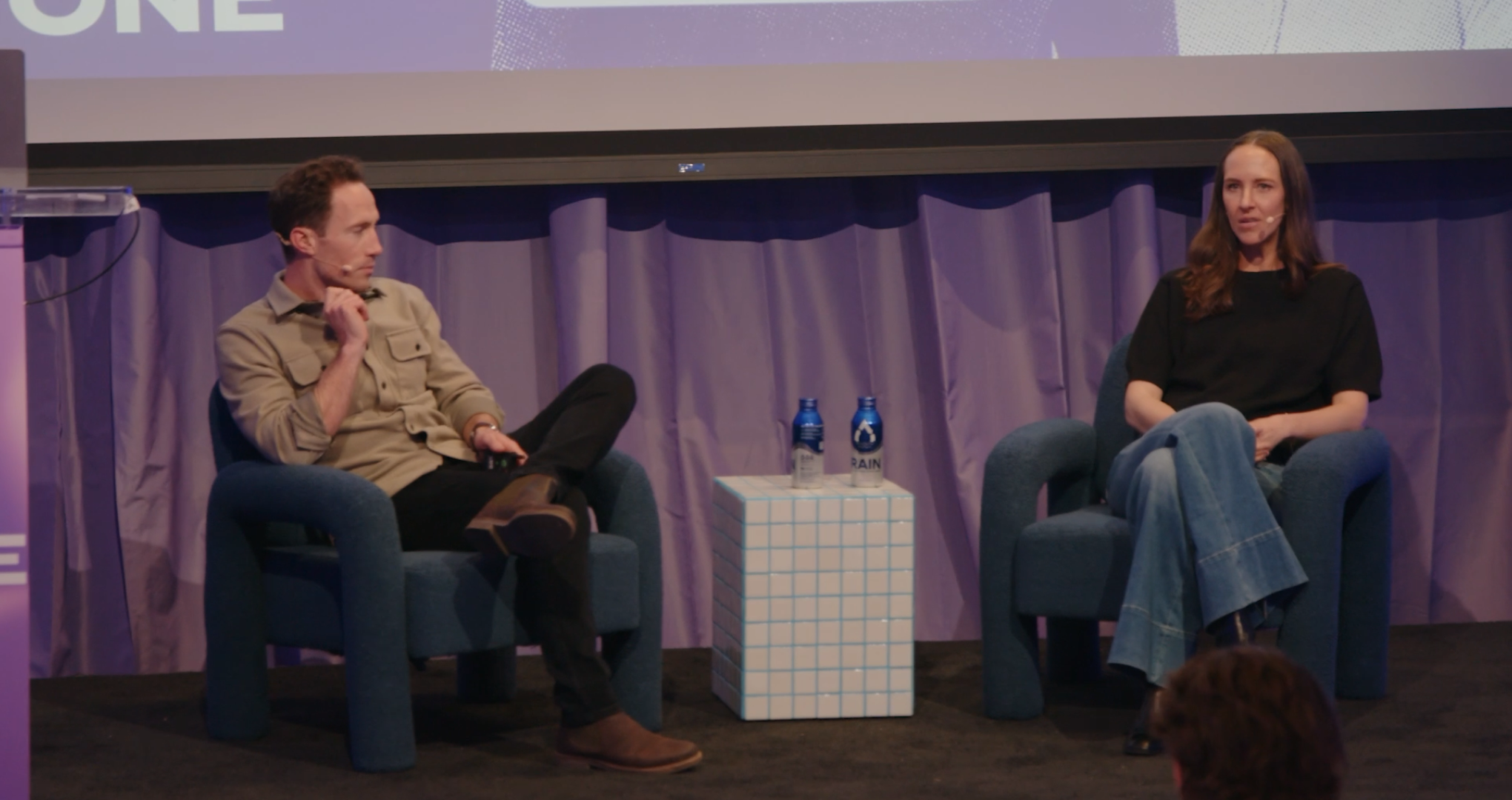
AI Across the Hiring Lifecycle
See how Ashby's AI tools work together across sourcing, scheduling, interviewing, and reporting to keep hiring moving. Learn where AI removes manual work and where human judgment still drives the final call.
View session
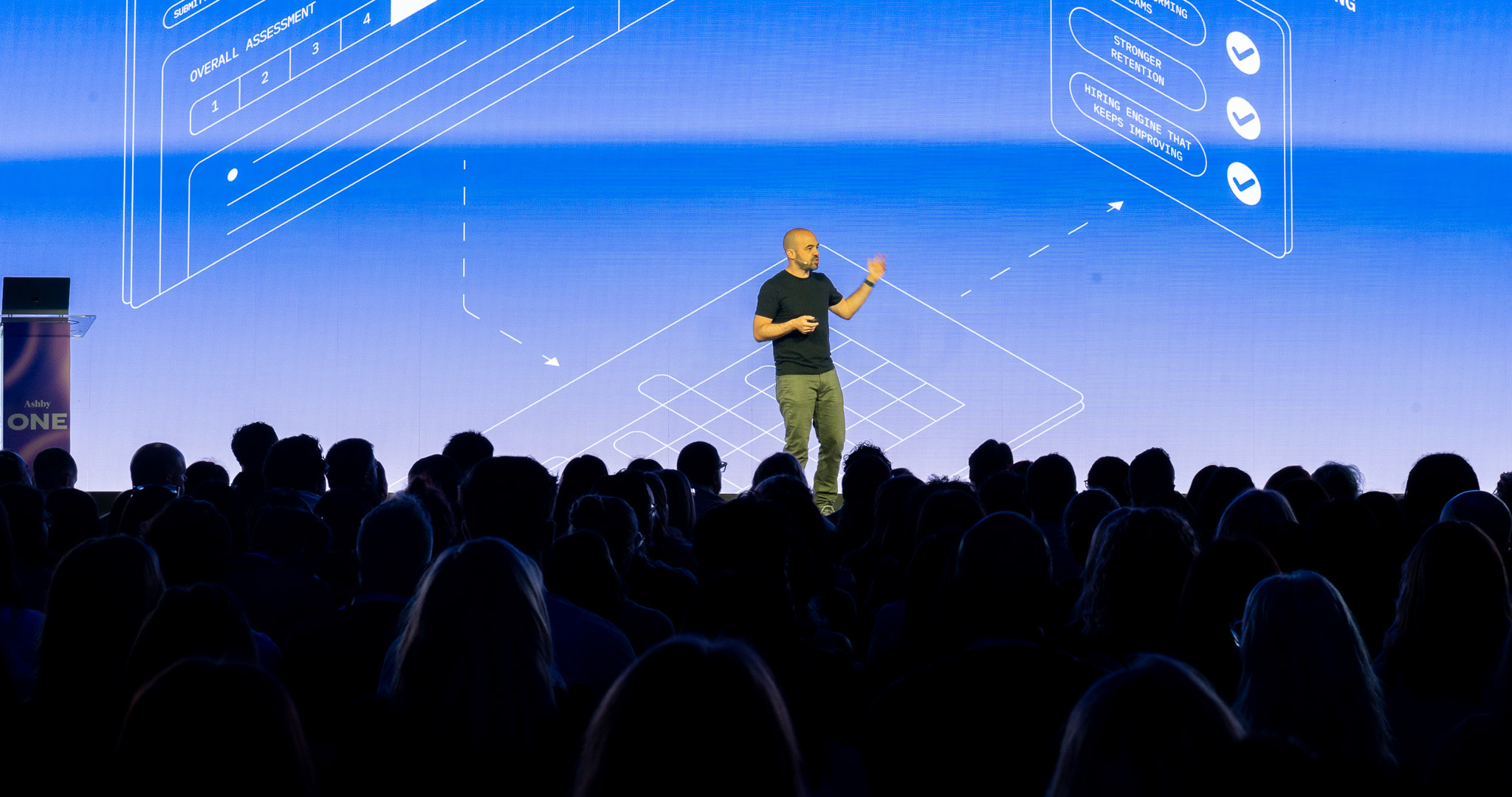
Ashby One Product Keynote - 2026 San Francisco
Ashby co-founders Benji Encz and Abhik Pramanik kick off Ashby One San Francisco with a look at our latest launches, the next generation of AI at Ashby, and where we're headed next. Highlights include the announcement of Ashby Assistant + Custom Agents, our upcoming AI Interviewer, and the People Workflows product built to handle post-hire workflows like onboarding.
View session