Ashby One Product Keynote - 2026 San Francisco
Ashby co-founders Benji Encz and Abhik Pramanik kick off Ashby One San Francisco with a look at our latest launches, the next generation of AI at Ashby, and where we're headed next. Highlights include the announcement of Ashby Assistant + Custom Agents, our upcoming AI Interviewer, and the People Workflows product built to handle post-hire workflows like onboarding.
Speakers






Quick Summary: Ashby One 2026 Keynote
Event: Ashby One, Ashby's second annual conference Location: San Francisco
Key Announcements:
- AI Talent Rediscovery – available immediately on Plus and Enterprise plans
- Ashby Assistant – cross-product AI chat, available in beta (free during beta)
- Custom Agents – shared and personal AI agents, available in beta
- Ashby MCP Server – launching in a few weeks
- Scheduling Agents – preview, rolling out later this year
- AI Interviewer (via Talent Llama acquisition) – private beta with waitlist
- First Acquisition: Talent Llama (closed late 2025)
- Intakes – launching later this year
- People Workflows add-on – early access for new hire onboarding
Business Growth: 4,400+ customers (up from 2,400). Startup segment +118%, mid-market +140%, enterprise +125% YoY.
Featured Customers: Hiya, Confluent, Clay, Kong, Zapier, UiPath, Lemonade, Snowflake, Cursor, Granola, Lovable
Transcript
Note: transcript is auto-generated, there may be typos.
[00:00:00] Thank you. Thank you so much. Welcome everyone. We're super excited to be back here in San Francisco for our second Ashby One conference. I also want to extend a warm welcome to anyone who's been waiting on the live feed for the last 10 minutes. Sorry there were a lot more countdowns than we had planned, but last year we had an internet outage like five minutes before the Q&A started. So there's something happening every year, but I'm glad we're here and are able to kick things off now.
Now, speaking of last year, it was our first conference and it really exceeded all of our expectations, both in the energy that everyone brought to the event, but also in the demand. And so this year we more than doubled the capacity and we have almost 700 people in the room here this morning, which is just pretty incredible.
[00:00:49] Now, days like today really feel like a dream come true when you start building a company. When we set out to build Ashby, the goal was to build a product, build a company that gets people excited and come out for days like today. So it makes it really special. So this is the moment for the applause, but thank you so much for your support.
[00:01:08] So this is our second conference, but it's actually our fourth keynote. And that tradition dates back all the way to 2022 when we first launched Ashby to the public. And I actually had to look this up, but it was about 2 months before ChatGPT launched. Feels like a very, very different era, but we've since maintained that tradition and we've used it to make major product announcements and also give you an idea of what is ahead on the roadmap. And we're continuing that tradition today and it is a really packed keynote, so I'm really excited to finally get into it.
But I'm not going to get into spoilers just yet. Beyond what we're sharing today, there's something else that I think is worth acknowledging, and that is a feeling of new in our day-to-day work lives. New technologies, new possibilities, new expectations. I think a lot of what we're doing today at work is feeling different again thanks to all that change. We're aiming to make Ashby a tool that can evolve with you and make sure that you remain highly relevant. And that is not just the product, but it's also the team that we're building and the community we're building around it. And so for the fourth keynote today, I want to give you a bit of a behind-the-scenes look at how we're building Ashby to better support you. Definitely going to talk a lot about new features that we're announcing. We're going to talk about everything we're doing with AI. And towards the end of the keynote, we have a few really exciting announcements. But my larger hope for today is that you walk away getting a better sense of how we're building Ashby as a company to support you, not just for all this change that's happening in this moment, but also in the future.
[00:02:33] How much has Ashby grown in the past year? To start that behind-the-scenes look, I want to give a quick update on the growth of our business. When I was on stage here almost exactly a year ago, we announced that we are serving 2,400 customers. Today, that number has grown to over 4,400. Thank you.
[00:02:54] And what is most exciting to me personally is that growth is coming from every single segment that we're serving. So we usually don't talk about our revenue growth numbers, but we're going to get into these here. Over the last 12 months, our startup segment has grown by 118%. Mid-market has grown by 140%. And enterprise has grown by 125%. Growth across all of these segments at our scale is really not possible without advocacy from all of you. So one more time, a huge thanks.
[00:03:24] And at the same time as we've grown revenue and grown customers, we've also made big investments in our team. And I really emphasize two teams in particular, and that is customer success and our engineering, product and design teams. These are the core of how we operate and they make sure that we can maintain amazing customer experiences even as we scale, and to further increase our product velocity. A lot of what you hopefully can see in the keynote in just a second. And this year the goal is to almost double both of these teams again. But we're also doing that while being what we call "frustratingly patient" at hiring. It's one of our operating principles. And it's as frustrating as it sounds, but it is a key part of how we maintain the quality bar of the team even as we're growing rapidly.
[00:04:04] And then in addition to team, we're also rolling out new programs that we invested in over the last year. We have Ashby Customer Experts, which is a new program we started that brings customers together across cities in North America for peer-to-peer learning. We rolled out Ashby Academy for on-demand learning, 24/7 support, and our Ashby Experts program which allows people in community to get certified in Ashby and support implementations. Now, some of you in the room have been really early customers of Ashby. So you may remember when support was mostly my co-founder Abhik and me, which is also 24/7, but not the scalable kind. So I'm proud how far we've come with that.
[00:04:41] And now with that, I'm excited to finally dive into the core of the keynote. Here's what you can expect. First, I'm going to invite Abhik up onto the stage. He's my co-founder. He also leads our engineering team. He's going to give you a bit of a behind-the-scenes look at how we build product at Ashby. Then we're going to talk about how we're serving customers ranging from early stage startups to public enterprises, and how we think that makes the product as a whole better for every individual user. Then we'll get into the dedicated AI section. And finally, we have some exciting announcements about some things we've been working on behind the scenes to close us out. For now, I'll be back in a little bit. Let's get started and invite Abhik up onto the stage. Here we go.
[00:05:32] Thanks, Benji. Hello and welcome again to Ashby One. I'm Abhik, our co-founder and VP of engineering. So one thing that's really important to Benji and I is that you are excellent at what you do. And that means for us building the highest standard of tooling for you all. So we've built our vision, our platform, our team to deliver innovation and ingenuity day in and day out. And I want to talk a little bit about how we do that today.
In the past, we've talked about our high-level principles, our 10-year product vision, our continuous feedback loop with customers, and our quick responses to market and technology shifts. We also talked about how we make these principles a reality by continuously improving every area of the product.
[00:06:23] How many features has Ashby shipped in the last year? I'm proud to say we continue to deliver on that promise. In the last 12 months, we've delivered over 130 core features and new improvements. This means you're seeing a meaningful change in Ashby at least every 3 days.
[00:06:45] Today I want to cover three more components that play a major part in delivering the highest standard of tooling. First, how we organize our product teams. Second, the Ashby platform on which every feature is built. And three, our design partner program.
Let's start with how we organize R&D. Our product and engineering teams map to core parts of your recruiting workflow: sourcing and CRM, scheduling, core ATS, enterprise, and analytics. This means each part of our all-in-one offering is getting constant attention, and you're seeing a stream of improvements and new features. As we've grown, we've also stayed nimble, and how we work closely resembles how Benji and I used to work together when it was just the two of us. Engineers own features end to end. They're not stuck in meetings, and they're not waiting on people to ship. That means we're constantly delivering value to you.
[00:07:42] While we gain a lot from being deliberate about how we work, we also amplify those gains by building on top of a shared platform. This platform consists of building blocks that we can snap into every feature to give you the power and usability that you've come to expect from Ashby. These building blocks also have a familiar interface so that you can easily map your workflows from one to another. Our data and reporting engine ensures that every workflow can be used with our robust analytics features. Our workflow automation engine enables your team to configure and run many Ashby features in the background, like scheduling activities and sourcing sequences. Our customization layer empowers your team to configure every feature to closely model how you actually work. Our unified design system ensures that every new feature has great UX and is familiar, increasing adoption across your team. Finally, and more recently, we're embedding AI in every product area with our AI agent layer. This ensures our AI features are powerful and customizable, but also compliant. All of these building blocks help us deliver features at a rapid pace with consistency that feels familiar even when we ship something new.
[00:09:07] Lastly, we partner closely with many of you on new features through our design partner program. Zapier, Confluent, UiPath are just a few examples in the room here today. And these design partners help shape and guide what we ultimately release to you. It's through this partnership that we're able to invoke strong feelings for our product. Megan's a great example. She's been recruiting for 10-plus years and never worked in an ATS that feels this intuitive. So Benji and I started Ashby because we struggled with TA software ourselves as hiring managers and we wanted to build something better. And it's so rewarding to hear this type of feedback because it feels like we're on that path. Whether it's partnering with our customers, a conversation with your customer success manager, or a support ticket, your partnership is a big part of where we are today and where we're going tomorrow. So thank you again.
[00:10:07] What is Ashby's candidate fraud detection feature? So let's wrap up this section with two key examples to see how our principles work in harmony together. In September, we launched the first ATS-native fraud detection system. The engineer who worked on this feature has been working in sourcing and CRM for over two years. So their intimate familiarity with the product enabled them to move fast and build a solution before anyone else in the market. We also worked closely with our customers in our design partner program to develop a solution that wasn't disruptive to candidates, kept you in control of decision-making, and even impressed your security teams. When our design partners had specific reporting needs, we shipped changes in just days due to our reporting building blocks. And we don't just release something big like this and move on. We continue to make improvements and we've shipped things like bulk and manual fraud checks, more reporting functionality, and API access.
[00:11:02] What is the Ashby AI Notetaker? Now let's take a look at another marquee example from last fall, our AI notetaker. There are companies entirely focused on this space, and today I want to talk about how we moved from announcing this at Ashby One last May to public beta in just a couple of months. First, through a tight design partner program, we fleshed out what truly matters to our customers from a TA lens and focused exclusively on that. Then, a 5-year veteran engineer of our scheduling team worked on this feature. Her expertise allowed us to seamlessly integrate with all your scheduling features, refine edge cases, and deliver a solution purpose-built for you. The AI in AI notetaking came from leveraging our AI building blocks. And this allowed us to use a transcript in the candidate assistant as well as automatically filling out feedback forms. We've also continued to improve the AI notetaker since launch: different transcript formats to work with, easier administration across your users, consent management. If you haven't taken a look at AI notetaker in Ashby, now is a great time to take a look.
[00:12:09] Okay, so we've looked at how we approach building products and our team, and we've walked through a couple of examples. Now, let's hear from some of our customers about how AI notetaker and candidate fraud detection has impacted their daily work in Ashby.
[00:12:30] My name is Jordan. I am the manager of global talent acquisition at Hiya. We are the leaders in AI for voice security. The AI notetaker has been great. It has really kept us accountable, not only our team but also our candidates accountable. And so the notetaker is that single source of truth. Like I mentioned earlier, I have a team that's global and there's a time zone difference. And when I'm in meetings with finance and they're like, "When is this role going to close? How much is our top candidate going to cost us? What do we actually project in terms of start date?" I can actually go into the AI assistant and query all of the different interviews that we've done. Sometimes you just want to temp check yourself. You have an inkling or a feeling that something wasn't right in that interview, and so you can actually ask the assistant, am I biased, or is there evidence from the interview that actually maps back to some of the concerns that I have about this candidate?
[00:13:28] Candidate fraud is a really interesting problem because it's a new frontier for talent acquisition to be facing, and it's a problem that everyone has, but not everyone knows that they have it. My name is Chiarra. I'm the head of talent operations and strategy at Confluent. We are a data streaming company built on Apache Kafka. I've been having conversations with our security team about the problem of candidate fraud and how we were going to address it and be less reactionary and more proactive about it. And as those conversations were happening, it was almost like Ashby was in the room because they launched Ashby candidate fraud detection. We saw that before we had turned on Ashby candidate fraud detection, about 20% of the candidates who had been rejected as fraudulent had talked to people at Confluent before we rejected them. And after we turned on Ashby candidate fraud detection, that number was cut in half. Generally engineering roles, customer success roles—that's where we thought we had a lot of fraudulent candidates. And when we turned on Ashby candidate fraud detection and then we ran reports on where we were actually getting those fraudulent applicants, it confirmed everything that we had felt. And so it was really great to be able to put data behind that and educate both our recruiting team and the business on where they can kind of expect to see that come up because we had candidate fraud detection, and then we used Ashby Analytics.
[00:14:58] Huge thanks to Jordan and Chiarra for sharing their stories. So these frameworks and philosophies have served us well, but what does this mean at a higher level? Why does this matter to you? Well, this past year, AI has dominated the headlines and mindshare. And whether you're a small startup or a public company, there's no question that AI is going to have a meaningful impact in how we all work. But our approach to building our product and our team will help you navigate this new landscape. And that means we'll be building a product that keeps up with the pace of technological change and delivers powerful, accessible, compliant features.
[00:15:36] This is why we invest so much thought in how we build our products. And hopefully by now you have a clear sense of how our philosophy shapes your experience with Ashby. I'm going to hand it off to Morgan, one of our implementation leads, to talk about how we support companies from small startups to large enterprises and how servicing both ends of that spectrum pushes the entire product forward.
[00:16:13] Thank you, Abhik. My name is Morgan and I'm the manager of strategic implementations here at Ashby. That means over the last four years, I've had the pleasure of helping many of you go live. I'm excited to share a number of product updates with you that highlight how we think about supporting customers from startups to the enterprise.
[00:16:32] Does Ashby serve startups or enterprises? So, as software users ourselves, we know it can sometimes feel like an impossible trade-off when finding and using a tool to power your entire recruiting process. You might have felt like this at some point. At Ashby, we don't see building for startups and enterprise as a trade-off. We see it as leverage. Insights from one side sharpen the other. And we stay deliberate to ensure that these different audiences are always pulling each other forward. By building for enterprise, we can ensure we onboard large, complex customers while showing earlier stage customers what's possible as they grow with us. By building for startups, we help create a strong talent foundation at the earliest stages while building a best-in-class UX that ends up benefiting Ashby users at any company scale.
[00:17:21] Let's take a look at a few UX improvements to core functionality in Ashby, starting with our mobile experience. We've made many smaller updates to Ashby's mobile experience over the last 12 months, but our biggest recent feature additions are adding support for bulk application review on mobile, a redesigned candidate profile, and the ability to view take-home submissions. Mobile's been a major focus for us, and you'll continue to see significant progress here.
[00:17:50] For this next recap, we're going to do a quick tour of a number of UX improvements that users of Ashby will encounter on a daily basis. For that, we're going to jump into the product for a quick demo.
[00:18:04] A few months back, we introduced a new jobs dashboard. This dashboard makes it much easier to view job information at a glance. Color coding shows candidate current statuses and you can see projected hires per role.
[00:18:23] Now let's jump into one of our most frequently used views, the candidate profile. Since this page gets so much use, even small UX improvements have a noticeable impact. Now we can see one of my favorite additions, emoji reactions. They're super fun, but they're also incredibly useful, letting you confirm, acknowledge, or show appreciation instantly. No extra message needed.
[00:18:49] Next up, we brought automation and visibility to candidate scheduling reminders to help drive faster bookings. This helps track and automate reminders for candidates to submit their availability or direct booking. It's perfect for busy startups and pairs really nicely with another improvement we made earlier in the year, which internally had the highly technical name of "prettier booking links." This lets you use custom text for substitution tokens in emails. Instead of long URLs with IDs, you can have something like this.
[00:19:23] Next, for our AI notetaker users, which are becoming more and more of you each week, we made some UX improvements for viewing your recordings directly from this candidate view. This gives you a pop-up video player with full access to the transcript, notes, and the AI assistant. These are some of my favorite updates because they reflect the real day-to-day workflows we're paying close attention to.
[00:19:50] What are Ashby's Universal Booking Links? To wrap up, I'm really excited about this one. This is a look at what's launching this summer, and it's one of our most requested features for fast-moving teams. And let's just say I've heard this one come up quite a few times. Universal booking links. Universal booking links let you have a personal link and let you schedule time with anyone without tying it to a job or an interview stage. And because it's still happening through Ashby, you keep everything—the scheduling experience, the context, AI notetaker details, and the ability to connect it to a job later. This is especially helpful for meeting outside of the interview structure process, whether it's a quick call with a passive candidate or a prep call before a big interview.
[00:20:42] We have a lot of announcements and previews coming up later in the keynote that we know startups will love, especially with new ways of working in Slack. Now, let's hear from Danielle Poreh over at Clay on how they've leveraged Ashby as a fast-growing startup.
[00:20:56] Clay is growing really fast. We were around like 80 people last year. We're now in the 300s and we'll end the year probably closer to 600. My name is Danielle Poreh. Most people call me Depot. I work at Clay. Ashby's platform really reshaped a lot of the way I look at recruiting operations because of how it's structured. It's incredibly unbundled. And so the deeper I got into Ashby, the more I realized I can do a ton of different things within this system. And I just knew that at every layer that I wanted to query data, I'd be able to for this workflow. It was kind of like a compounding of knowledge, I guess. So, we just had really good dashboards on day one. And so, we had visibility into the data. And when you're scaling, you're talking like hundreds of interviews a week. This isn't small change of what you're trying to observe. So, when we switched to the public booking links, I think we've shaved off a few minutes per interview for the recruiters. When you're doing that at the scale that we are, we're talking 100, 200, you're talking like orders of magnitude of time. I think Ashby really helps us maintain our hiring bar and also is really in line with the spirit of how we hire, which is deeply rooted in curiosity, but also in how we architect every single individualized interview loop to make it customized if need be for that specific role. It means that Ashby can work around how we do hiring and not the other way around. We're growing so much right now, doubling our head talent this year. And Ashby is powering all of that. I mean, from soup to nuts, every single role from sourcing all the way down to offers.
[00:22:40] Which startups use Ashby? It's validating that Ashby has become the default choice for fast-growing startups. We just saw Clay in action and they're joined by startups like Cursor, Granola, Lovable, and many more in building their talent acquisition foundations on Ashby.
[00:23:01] Which enterprises use Ashby? What might surprise some people is we've also been serving enterprise customers at significant scale for years. And over the last 12 months, we've really doubled down on our investment here. Our analytics, our deep customization make us a natural fit at scale. Companies like Lemonade, UiPath, Confluent, and Snowflake all run on Ashby. Over the last few months, we've made a large amount of product improvements for our largest and fastest-growing customers. Let's jump into these now.
[00:23:27] What HCM systems does Ashby integrate with? First, HCM integrations. Our Workday integration has been a longstanding standout with enterprise customers. It requires no custom work, yet it's highly customizable. That means customers get live faster than ever with a self-served connection that they maintain on their own. Last year, we expanded HCM integrations to cover UKG and ADP. This year, we're in the final stages of finishing Dayforce, SAP, and Oracle integrations, with general availability for these coming this summer. We took our time here because we wanted to launch robust versions built and maintained by Ashby. No shortcuts and no third-party integration platforms. With these additions, we're significantly expanding the enterprise customers that we can serve.
[00:24:12] What are Ashby Formula Fields? Next, let's move on to a feature we released recently: formula fields. I promise this is more exciting than your high school math class. Formula fields build on top of the already very powerful reporting capabilities in Ashby, but let you express fully custom formulas to calculate values. One of the most popular use cases for this feature is calculating things like percentage-based bonuses directly on offers. But on our enterprise plan, we allow for fully custom calculations on all objects. Let's see an example of one of these formulas.
[00:24:50] Here we're looking at a compensation report for recent hires. If we look closer at this compa-ratio column, we can see formula fields in action. Under the hood, this comp ratio field is using a custom formula by taking the salary from the offer and dividing it by the midpoint of the compensation range. In my data, I see a few examples here where we're in range, below, or above our expected midpoint. To build a field like compa-ratio, we can head over to the new formula editor. Here we can see how to construct formula fields that you can pull into any report, filter on, sort by, and so on. You have access to a formula builder you can use with various Ashby fields like salary and compensation range along with functions like min, max, mean, date diff, and so on. You'll also notice some other formula fields I've created here like this custom "time to hire onboarded" formula where we're using the date a candidate applied and getting the difference in days of their offer start date. Once I've created these calculated fields, I can reuse them across all of Ashby, whether that's an automation, alerts, or approval workflows. This is the type of enterprise customization that compounds across our all-in-one platform.
[00:26:24] Rounding out our enterprise section, two features in the final stages of our design partner program slated to release this summer. These really define our commitment to this segment: comprehensive audit logs and permission profiles. Audit logs let you see how records have changed over time. Whether it's an approval completing or a job posting being changed, you can see what happened, who did it, and when. And permission profiles are a system for managing user access at scale. These let you define reusable sets of permissions and automatically assign them to users. Update everything in one place and changes will apply to everyone.
[00:27:08] So that's a look at how we're building Ashby to scale from startups to the enterprise. Every improvement we make for one side strengthens the other. This allows us to deliver a product that truly grows with you no matter where you are on that journey. For the remainder of the keynote, we'll be focused on some of our largest new product bets. And to kick us off there, I will hand over to Max and Anika to share what the next generation of AI in Ashby will look like.
[00:27:54] Hello everyone. I'm Anika, a product manager here at Ashby, and I'm joined by Max, one of the engineers spearheading a lot of the exciting product work we're going to talk about today. So guys, I'm not sure if you've heard, but AI is kind of having a moment right now. We've always viewed Ashby as a powerful tool to help eliminate or automate much of the busy work in recruiting to help you free up your time so you could focus on the highest value activities. Since we added the first AI features to Ashby in 2023, models have become a lot more powerful and we've continued to explore new ways to apply them to key workflows in the product. At the same time, we also need to ensure everyone involved in your hiring process, from your legal team to your candidates, is comfortable with implementing this new technology.
[00:28:40] What percentage of top AI startups use Ashby? This approach is working well and it's showing up in the data as well. Each year, Forbes releases a list of the top 50 AI startups that are privately held. And 70% of this list of leaders in AI innovation have chosen Ashby to help grow their organizations. This is up from 50% last year. We also hear it. Thank you. We also hear it in the reactions from customers directly. Here's Alice highlighting her most powerful AI use cases that go across interviews, structuring feedback, and helping reduce the burden of admin.
[00:29:21] We've made great strides over the last few years to embed AI across every layer of the hiring process. As you heard earlier, the breadth and depth of Ashby makes it the perfect infrastructure for AI workloads. We also understand though that AI without proper and responsible guardrails in place makes it difficult to adopt. And that is why we as a team spend as much time ensuring proper governance as we do on actually building the features themselves. And that foundation leads us to today.
[00:29:54] In this section, we are going to cover a number of major and new upcoming releases that are going to help define the next generation of AI at Ashby. And we're starting with the official announcement of AI Talent Rediscovery for in-ATS sourcing.
[00:30:16] So for this release, Max is going to take us through a demo.
[00:30:21] What is Ashby's AI Talent Rediscovery? All right. So what I can do here is kick off a search across our existing candidate records in Ashby. What's nice is you can create a search from scratch, link it to a job, or create a new one from a job. These options make starting your rediscovery just a few clicks. For now, I'm going to link an existing job, which will tell the criteria we care about when our rediscovery. Once I give the search a title, I'm ready to kick it off.
[00:30:50] Now the scan using the link here like SaaS experience, go-to-market strategy, attention to detail, and more. It's also going to consider signals like feedback scores, resumes, source, and past interview progression, leveraging data that's already available in Ashby.
[00:31:12] Once this completes, you're going to see a few different buckets for your results like warm leads, silver medalists, high-fit candidates, and a few others, starting with the warm leads bucket. Warm leads are candidates we haven't communicated with yet, but have made their way into our talent pool. Next, we have silver medalists that have applied to roles previously that weren't hired, but made it to a significant stage in the previous interview process. We'll surface here at a quick glance folks who meet a large percentage of the criteria for AI Talent Rediscovery, bringing the most relevant information front and center so you can quickly take action.
[00:32:13] On the left, click for details along with the candidate's resume, recent application. On the right side, in the review tab, I have a next step where I can take action by considering the candidate for a job, adding them to a project, or even kicking off an email sequence as a next step. If I want, I can also use our AI candidate assistant to ask questions and get additional context from AI notetaker transcripts, emails, feedback, notes, and more.
[00:32:54] AI Talent Rediscovery is a high-leverage tool for finding candidates across the wealth of data already living in Ashby. It will become available in your accounts after the keynote ends across Plus and Enterprise plans, and it'll start consuming your existing bank of AI credits.
[00:33:13] What is the Ashby Assistant? In last year's keynote, we also introduced an AI chat interface that existed across every candidate profile that makes it easy to ask questions or search information across all of a candidate's data. This includes emails and notes all the way to AI-transcribed conversations. The response to this feature was great, but we also quickly started hearing from customers about just how much they wanted to be able to ask Ashby questions that go beyond a single candidate. Starting today, we're making that possible. I'm very excited to introduce the Ashby Assistant—candidates, jobs, interviews, and more, just by chatting with Ashby. All right, let's jump into a live demo.
[00:33:57] So you can access the Ashby Assistant from the top menu. Just hit Ashby AI to get started. Now, as we mentioned, what's special about our new assistant is that it can access data across the entire Ashby product. Let's see it in action and ask for an in-depth pipeline update. We're trying to get a sense here for who's trending towards the offer stage across all of our product engineer roles. Normally, this would require someone on the recruiting team to pull together reports and data points from different sources in Ashby. Now, with the assistant, I can use AI for that type of request. So here I'm going to ask for a pipeline update on this role. We want to know things like candidate sentiment, current status in the process, and any concerns they've raised.
[00:34:39] Now, the Assistant pulls data points across your account. It's going to filter across the right jobs, inspect candidate profiles, search through transcripts, emails, notes, etc. And after a few seconds, it comes back with a clear and actionable pipeline update. Here I can see we have three candidates that are trending towards a hire. Looks like one candidate, Emma here, is at the offer stage and it sounds like she's considering a competing offer.
[00:35:06] What's great about the Ashby Assistant is I can take action on Emma, so I'm going to send her a personalized offer congrats email. Something like this where I'm asking for a brief email and to highlight any aspects she liked about the team and some reference feedback in the email as well. Within a few seconds, we have a fully drafted email ready to go. Any action you can take from the Ashby Assistant, but I'm actually happy with it, so I'm going to confirm and get it sent. As soon as it's sent, I immediately see a quick confirmation from the assistant that everything worked out. And now the email was successfully sent.
[00:35:52] What are Ashby Custom Agents? We don't want to have to add these prompts over and over again. So we've essentially—you know, we know prompts can get quite lengthy—built a way to save these prompts and use them alongside the Ashby Assistant in your conversations, and the assistant will use them as agents.
[00:36:34] Shared agents are great for things that should be standardized across your organization. Personal agents are useful for your own productivity enhancements, like capturing your own style for communicating over email. Let's set one up now by hitting the button. Here you'll be presented with the option of creating an agent from scratch or using one of our templates as the starting point. These templates give you an idea of the different kinds of use cases you can use the assistant for. More on that in a second. For now, I'm going to pick the candidate debrief template.
[00:37:02] This agent will be a chat agent, but as you can see here, we're also working on support for time and trigger-based agents. Once I'm done, I can save the agent and it immediately becomes ready for use by me and the broader team.
[00:37:26] There's so much more to cover here, and we'll dive deeper into this feature in Ashby's today and in the coming weeks. But for now, I want to close out with one more exciting update for the Ashby Assistant and agents. We understand that many of our users don't spend their entire day in Ashby. They might sometimes need to answer important questions on the go. So in addition to making the assistant available within Ashby, we're also making it available from within our Slack app.
[00:37:57] Can Ashby be used in Slack? Using the assistant in Slack, we'll create a new conversation and allow you to ask questions and take action in just the same way you would in the web app. To see this, let's use the debrief agent we just created, but from Slack. I know I have one debrief coming up later this afternoon and I have a lot of back-to-back meetings before then. So I'll quickly jump to the Ashby app in Slack and say, "Using the debrief agent, can you brief me on Simon Patel?"
[00:38:25] Now you can see the assistant's going to start working on this request and it's indicated directly in Slack. Once it's done, we can take a look at the response. Here we have a detailed briefing in exactly the format that we'd specified within our debrief agent. And yes, we did ask the agent to talk like a pirate and use a lot of emojis.
[00:38:50] While we won't be able to cover all of the use cases today, we've also added support for what we expect to be the most common use cases for non-power users of Ashby. For example, you can now also submit feedback forms and referrals simply by working with the Ashby Assistant in Slack.
[00:39:11] It's probably an understatement to say that we're incredibly excited about making our powerful Ashby product more accessible for casual users. The releases we just walked through chip away at both of those goals. Thank you, Max. Ashby Assistant and custom agents are available today in beta. Once the keynote ends, you can get started by enabling them in the opt-in section of your admin settings. During the beta period, both of these features are going to be completely free to try. Once we get out of the beta period, the Ashby Assistant and custom agents will start consuming your existing allotment of AI credits.
[00:39:49] What is the Ashby MCP Server? The AI Assistant and the custom agents we just looked at are great for putting AI to work directly in Ashby, but we understand that many of you are also using third-party agent tools and platforms. We've always built Ashby to be open and interoperable, and in the past that has mostly meant investing in our APIs. That brings us to our next announcement, which for those of you paying close attention, Benji actually hinted at this a few weeks ago with a well-placed side-eye emoji and a tease to an eager group of builders in our community. That's right, folks. In a few weeks, we are going to be launching Ashby's MCP server.
[00:40:44] For those of you in the audience who are not familiar with MCPs yet, you could think of them as APIs for AI tooling. It makes it possible for tools like Claude or ChatGPT to interact with Ashby, supporting a lot of the amazing workflows we just saw in the demo, but directly in your favorite AI tools. Our APIs and soon MCP server will also make it much easier for you to build custom in-house tooling on top of Ashby. So whether you're building custom agents or connecting third-party AI tooling with Ashby, we want you guys to find Ashby to be an open ecosystem for any use case.
[00:41:19] What are Ashby Scheduling Agents? At the same time, we also believe that we should be offering bespoke first-party agents for core recruiting workflows. This is what our next two announcements are going to be focused on. Now, as Abhik mentioned earlier, we are seeing AI tools become more and more powerful, allowing us to build features that take on larger tasks more autonomously. And if you've been an Ashby customer for a while, you would know that we've always had a big emphasis on scheduling automations. To date, we've offered tools that allow you to automatically build complex schedules, replace interviewers when they decline, send scheduling reminders, and more. However, all of these automations have existed at the individual task level.
[00:42:06] Today, we are taking that a step further and we are going to give you a preview of scheduling agents at Ashby. Scheduling agents will tie together all of the existing automations you already rely on in Ashby. But more importantly, they'll be able to take full responsibility for getting a candidate scheduled from start to finish. Let's take a look at how this will all work in practice.
[00:42:31] Here we have a candidate who's ready to move to the site. We'll move the candidate forward and the availability request creates the email and prepares to send it automatically. You'll notice here that we're currently in autopilot mode. We can also switch to a co-pilot mode for human-in-the-loop workflows. Once the email is sent, the agent is going to start monitoring for a response. What's really nice is that the agent shows you exactly what it's planning to do so you know what to expect. For example, here we can see that it's already planning reminders in case the request gets lost in the candidate's inbox.
[00:43:23] Once the candidate's available, based on the settings in your interview planner—pools, calendar availability, interviewer limits, conflicts, and more—it can find the best scheduling option to choose. Since we're here, we'll give it a nudge to finish up.
[00:43:53] From here we can see that the agent will take care of all the details. Calendar invites, confirmation emails, Slack channel, etc. All exactly how you've configured. Once the interviews are scheduled, the agent goes back into monitoring mode. It's going to keep an eye on RSVP responses and any unexpected changes. For example, if an interviewer declines, it can find a replacement. Or if someone takes too long to confirm, it can remind them directly in Slack.
[00:44:19] For this demo, let's see here. The agent's going to detect the email, interpret what the candidate's asking for, and automatically write a response immediately. It understands and jumps into action so that you don't need to.
[00:44:42] All right. Now, you might be thinking, there's a lot happening here. How can I stay on top of everything? Well, the interviews dashboard gives you a real-time bird's-eye view so you can see what's in progress, what needs attention, and where you might want to step in. You can jump into any schedule to see what the agent's doing or take over at any time.
[00:45:15] So, as you can see, we didn't reinvent the wheel on scheduling in Ashby. All the powerful automations and customization options are still there. The difference is now the agent will be able to run the process for you. That frees up your team to focus a lot less on logistics and a lot more on delivering exceptional candidate experiences. Over the coming months, we'll be working closely with a group of design partners to help further refine the experience. Scheduling is one of our product areas where "mostly works" is not good enough. So we're going to take the time to harden the experience before we roll it out to all of our enterprise and advanced scheduling add-on customers later this year.
[00:45:58] Now, let's move on to the last item of our AI segment. In the spirit of sharing more about how we operate as a company, we want to share some insights about our own hiring process and what has really changed over the last year. I'm super excited to invite Anna Hall, one of our talent acquisition managers at Ashby, to the stage.
[00:46:34] Thank you, Anika and Max. As you might expect, we aim to be at the forefront of modern tools and experimentation with our own recruiting process. Our business has grown substantially over the last year, and we faced significant hiring goals across a number of roles, especially on our growing customer support team. Notably, that meant that we needed to hire APAC team members without having a recruiter present in the region, and the time zone challenges that come with that. This led us to explore AI interviewer tools to supplement the capacity on our own team.
[00:47:11] Will Ducey, who many of you know on our RecOps team, surveyed the market, and I'll be the first to admit that I was pretty hesitant to adopt this. Many of you may feel the same way when you hear the term "AI interviewing." Both the talent team and Benji were skeptical about the potential impact on candidate experience, but then we were positively surprised after seeing the demos in action. The vendor we ultimately selected had created an experience that received consistent positive ratings from candidates.
[00:47:50] It's also important to note that we didn't require all candidates for these roles to start with an AI interview. Instead, they submitted a regular application, which we reviewed. For the candidates that we moved forward, we offered a choice between scheduling an intro call with our recruiting team or an AI interview at a time that was convenient for them. And for these roles, we saw about 36% of candidates opt for the AI interview. We reviewed all of the AI interview results on our team, and for the candidates that we advanced, we just scheduled a quick logistics chat before moving them into the assessment stage.
[00:48:26] This approach worked really well for us, but it also gave us time to experiment with a new tactic. We took applicants who would have historically been passed on, and we gave them the chance to showcase themselves through an AI interview instead. We've been calling this our "short list initiative" internally, and it's already yielded real results. We've recently extended three offers to candidates who came through that path.
[00:48:52] After these learnings and exposure to the technology, Benji and Abhik started paying close attention to the space. So with this context in mind, I'd like to invite Benji back on stage alongside a special guest.
[00:49:20] Thank you, Anna. Awesome. So we just shared a little bit about how we've been experimenting with AI in our own hiring process. And now I'd like to invite up a special guest. He's the co-founder of a product called Talent Llama, which we're using internally. And it's Adam Stocker.
[00:49:44] What was Ashby's first acquisition? Okay, so quick story time. When I first met Adam and he pitched me on Talent Llama's AI interviewer, I was pretty skeptical. But as Anna showed, the product actually started showing up in our own recruiting process. And once I saw the product in action, I changed my mind really quickly. A few things stood out, but I also got to know Adam and Ben better as a team. So Ben is Adam's co-founder, and as we spent time with them, a few things really stood out. They understood the space really deeply. They cared about the product, and customers love the product. And so at some point all these things started to click, and I felt like that team and product should probably be part of Ashby. So today we're announcing our very first acquisition. Talent Llama is now part of the Ashby team.
[00:50:25] Love the dramatic effect. We were skeptical if this would land well or not. So thank you. Now notably, that transaction actually closed in late 2025. So before I hand it over to Adam in just a second, I want to spend a minute talking about how we think about acquisitions at Ashby in general. First, we care really deeply about building all of our products on the same platform foundation for the reasons that Abhik shared earlier today. So while we have acquired the Talent Llama team quietly and a while back, they've actually been rebuilding their product on the Ashby platform. And second, we focus really heavily on strong early-stage teams. Everyone has to meet the talent bar and be excited to be part of Ashby long-term. And Talent Llama is an amazing example on both of these counts. So we're super excited to have them part of the team. And I'm going to hand the stage over to you, Adam.
[00:51:12] All right. Thanks so much, Benji. On behalf of the entire Talent Llama team, I just want to say we're absolutely thrilled to join the Ashby crew. It's a bit surreal standing up here if we think about where this all started. So about a year ago, my co-founder Ben and I had zero intention of selling the company. We were heads down building in the middle of raising a C round. We were talking to some large public companies. And then we started working with Ashby. What started as a simple integration partnership turned into a much bigger conversation. So the more time we spent with the team, a few things became impossible to ignore.
[00:51:55] First, as you've already seen today, the product just genuinely wowed us. The quality, the pace of shipping, the obsession with details. I had never seen anything like it in my 20 years of working in SaaS. The other thing was the people. So every person we met is smart, humble, and genuinely passionate about helping people hire effectively. And we have not yet met a single jerk, which is also the first time in 20 years of working in SaaS that I've encountered that.
[00:52:29] And last but not least, the vision. So Ashby isn't just content being an ATS. They are building a generational platform to help all of you hire. So if you add all that up, Ben and I came to the same conclusion. Everything that we were setting out to build at Talent Llama could happen here just faster, bigger, and with an extraordinary team alongside us.
[00:52:57] But there was just one detail we didn't see coming. So Ashby, as it turns out, has a strict no-mascot policy, which is really awkward when your company's named after one. So as of today, the llama is officially retired. And if you spot any llama Easter eggs in the product, just please report them to Benji immediately and make sure you tell them that Adam definitely didn't put it there.
[00:53:18] Okay, so llamas aside, let's get to the actual reason I'm up here. Since quietly joining the Ashby product team a few months back, we've rebuilt our entire AI interviewer within Ashby's platform. So let's take a look at what we've been up to.
[00:53:40] How does Ashby's AI Interviewer work? All right. So just to give you an overview, we're going to cover a few of the main areas of the AI interviewer. First, how to set up an AI interview. Second, just the candidate experience and what it's like to take an AI interview. And finally, how to evaluate results within the platform. So by the end, I hope you'll see how this product will help you reach more candidates, surface better signals faster, and reduce interview load for some of your roles. So let's jump in.
[00:54:12] We'll start with a quick run-through of the backend setup. So every AI interviewer is built around an outline. This is the blueprint that drives the entire conversation. So you can build an outline from scratch or generate one from a job posting. The outline is organized into customizable sections. So this example starts by welcoming the candidate and confirming how to pronounce their name. Then we have a minimum qualification section, another for core competencies, and a final wrap-up. Within each section, you'll add topics. So each topic becomes its own mini-conversation in the interview. Let's take a look at the types of topics we support out of the box.
[00:54:50] So as you might expect, we offer basic topics like criteria, which are pass/fail checkpoints, or open-ended topics, which give you a qualitative analysis of the candidate. But the real power of AI interviewing comes from competency topics. So these are skill-based questions that deliver the clearest signal about the candidate's fit for the role. You'll define what a strong answer looks like and set a probe depth, which gives you control over how hard the system will push back on vague responses. From there, Ashby will generate scoring bands with key signals and sample answers across a full range of responses. These bands are then used by the AI to evaluate the candidate. We'll see an example of this in a moment. Our flexible outline structure makes it easy to control what the AI asks and how it evaluates, keeping the actual conversation natural and adaptive.
[00:55:44] Once you're satisfied with the outline, the next step is to add it to your hiring workflow. So let's jump over to the interview plan screen. You'll see here I've already added an AI interview to this interview plan for the SDR role. When configuring the activity, you'll select the AI interviewer that you want to use. An invitation will go out via email, and we'll give you one to start so you have something to look at. And then there's a few other options to select, such as who's going to review the results. You can set up a feedback form, which you're probably used to as well. And I've also turned on automation here. So that means when a candidate moves into this stage, they will automatically be invited to take their interview. There's no manual scheduling, no coordinator overhead. It's really fully automated.
[00:56:40] And then here's just a quick example of what the email would look like. So you'll see it includes a direct link, and the candidate simply clicks the link and they're taken to the interview. There's no app to download, no account to create. This interview would be available to the candidate 24/7 to take on their time from desktop or mobile.
[00:56:59] So let's see what this looks like from the candidate perspective. Once they click that link, the candidate lands on a clean, guided onboarding screen. They're greeted with a welcome message, an optional video from your recruiter or hiring manager, and from there, just a few quick tips on how the conversation works, T&C acceptance, a request for microphone access, and they're ready to go. Let's watch one of these interviews in action.
[00:57:29] "Hi, welcome to the interview for the sales development rep role at Nortech. This will take about 15 minutes. We'll start with some quick qualifying questions, then move on to your experience with core SDR skills, and you'll have a chance to ask about the job and team. Are you ready to get started?"
"Yeah, let's do it."
"Just to make sure I'm saying your name right. Should I call you Benjamin or do you prefer something else?"
"Actually, call me Ben."
[00:57:53] So interviews can be stressful. One of our core design principles was to make this feel as low-stress, pleasant, and friendly as possible. Notice the small things. The AI asks what name the candidate prefers. It explicitly invites clarifying questions. The tone is warm and not clinical. So our goal is to keep this experience as human as possible and nothing like the robotic Q&A scripted AI interviews that candidates have understandably come to dread. Let's continue on with the interview.
[00:58:25] "All right, Ben, what's your target annual salary for this role?"
"So that really depends. Can you give me some more information about the commission and benefits?"
"Here's a quick overview. Base salary ranges from $65,000 to $85,000 plus 10% commission. Benefits include full medical, dental, and vision, a 401k with match, unlimited PTO, and equity. With that in mind, what's your target annual base salary?"
"Okay, so in that case, I would be okay with $75,000."
[00:58:56] So hopefully everyone just saw what happened there. The candidate asked a completely reasonable question. They wanted more context before giving their salary expectations. And the AI doesn't deflect. It didn't say, "I can't answer that." It didn't just repeat the question again. It gave a clear, accurate answer, pulled directly from the role's details, and then smoothly returned back to the original question. So that's only possible because the AI interviewer has the full context of the role right inside Ashby.
[00:59:26] Let's switch gears and talk about core SDR skills. Starting with cold outreach.
"Ben, in your roles at ZoomInfo and Pipeline Partners, you managed high-volume outbound prospecting using Salesforce and other CRMs. Can you walk me through step by step how you tracked and followed up with prospects using a CRM? I'm looking for a real-world example from your recent experience."
"Yeah, so in general, I would just use Salesforce and log my calls and then I would make sure I would follow up with people."
"Thanks for that, Ben. Can you give me a more detailed example? For instance, how did you segment your leads, update lead stages, and actually schedule those follow-ups in Salesforce? What specific process did you use to prioritize who to reach out to next?"
[01:00:09] So this is one of the most powerful things about the AI interviewer and really the foundation of what we built Talent Llama on top of. Instead of accepting a vague answer like the one Ben gave there and moving on, it's going to probe for specifics just like a great human interviewer would. So every candidate gets the same rigorous skill vetting, and as mentioned when we set things up, you can control how hard or soft the AI pushes back.
[01:00:34] You'll also notice how fast and natural this conversation feels. So there's no awkward pauses or buttons to submit your answers. We've built on top of the latest real-time voice models so candidates can just speak without touching their mouse or keyboard. Not only do our customers get industry-leading voice performance, but you can also customize the voice and the pace of the AI interviewer to match your brand and the tone of the role. By the end, your candidates should feel respected. And even if they don't make it through to the next stage in the process, that's good for you and that's the right thing to do.
[01:01:12] So now let's flip over to the recruiter side. Once a candidate finishes their interview, this is what you'll see. It's a complete picture of how they did, including the full audio of the conversation. The evaluation tab brings everything together. You'll get an overall summary of the candidate's responses, including key strengths and gaps, and you'll also see a summary of the signals from competency topics included in your interview. Underneath we have a per-topic breakdown where each topic includes an evaluation and, depending on the type, additional insights into how the candidate performed.
[01:01:53] Criteria topics are marked as met or not met, and each open-ended question provides a summary of the response. For competency topics, you'll be shown where the candidate landed in the scoring bands accompanied by detailed reasoning with ways to improve. You'll see a few excerpts that support that analysis as well. So you're not going to be guessing how the AI came up with their assessment. It's all right here.
[01:02:19] Next is the AI candidate assistant tab. This is your co-pilot for reviewing candidates. Ask it to draft an email inviting the candidate to the next round and include some areas of the interview where they did well. Or if you want, you can ask for the candidate's two best quotes from their interview. The assistant has both the evaluation and the transcript information in context along with the candidate's full profile, email communication, recruiter notes, and more.
[01:02:48] Finally, we have the transcript tab. This gives you the complete conversation, every word, timestamped and searchable. You can read through the dialogue or listen to the actual audio synced right to the text.
[01:03:00] So that's how we review a single candidate. But of course, you're rarely reviewing just one. You're working through an entire pipeline. So let's zoom out and see how this scales.
[01:03:14] Here is the AI interview results table. Every candidate who's completed an interview and is ready for your review. You can filter, scan, and sort results at a glance and quickly get a feel for how the pipeline is shaping up. From here, one click drops you into the bulk review workflow. So for those of you who are used to app review in Ashby, this will feel very familiar. You're moving through candidates one at a time with their AI interview results, application, and resume all in front of you, and you're making advance or reject decisions with the same context you'd typically get from a live interview. You can also submit feedback through the feedback form that we set up from the interview plan. I can't stress enough how great this is to have this feature native to Ashby. Your AI interview results sit right alongside everything else you're using to evaluate a candidate, and it feeds into the same actions that power the rest of your pipeline.
[01:04:07] So what we saw here today is really just the foundation. But underneath there's a lot more, such as things like versioned outlines, compliance and opt-out management, cheating detection, and full dashboard and reporting support. And every bit of it is native to Ashby. So this isn't just a bolt-on. It's not a third-party integration. It's the AI interviewer your ATS was always supposed to have.
[01:04:30] So this story started back when Ben and I realized that the Ashby team understands recruiting better than anyone. And that's why the first iteration of AI Interviewer is everything we built at Talent Llama taken further than we could have on our own. Sharper, more thoughtful, and more deeply integrated than anything else on the market. And it's only been 3 months. I can't wait to get this into your hands and keep building alongside a team and a customer base that pushes to make it better every day. Thanks so much, Benji. Back to you.
[01:05:13] Okay, thank you so much, Adam. Now, AI Interviewer is in our private beta waitlist program. So you can scan a QR code if you want to get on there, and then in the coming weeks, we'll be inviting people off the waitlist on a rolling basis. Now, I'm really excited about having the AI interviewer available directly in Ashby. And we do understand that, similar to us, many of you may be skeptical, or you may not have roles that are a great fit for AI interviewing. But by having it natively in the product, we hope we make it much easier to experiment with this new technology. And that's exactly the same way that we got started. So really looking forward to that.
[01:05:48] What are the three pillars of Ashby's AI philosophy? So AI Interviewer in itself is a huge milestone. But if you take this whole section we just talked about together, you can see our overall AI philosophy emerge, and it consists of three main pillars. One, we want to support customization by power users in our product through custom agents and the Ashby Assistant that you saw. Then we also want to participate in an open ecosystem by supporting MCP and third-party agents. But lastly, we also want to offer excellent first-party agents for recruiting workflows that are really core to how you do your work. And that is scheduling and interviewing. And all these areas we showed you today really just mark the beginning of things we plan to invest a lot more in over the next few years. And we've been able to use them internally. We get early access and it really reshaped a lot of our own hiring processes. So I'm really excited to get them into your hands.
[01:06:33] And now we're almost at the end. We have one more major announcement and one more major segment. And for that, I'd like to bring Melissa and Jacob on the stage. And they're going to talk about how Ashby is expanding both pre- and post-hire.
[01:07:02] Well, thanks so much, Benji, for that exciting set of updates. But wait, we've got more. We're really excited to share some major product sneak peeks with you today. My name is Melissa and I'm on the Ashby product team.
[01:07:14] And I'm Jacob. And I recognize many of you here in the room today. I was actually our first go-to-market hire at Ashby. In fact, for those of you who signed up before September 2022, there's a very good chance I was the man behind the curtain granting access to super-exclusive Club Ashby. Anyone remember this mysterious landing page? Fun fact, we had 500 customers before we even had a real website. Not going to lie, sometimes I miss those old stealth days, which is part of why it's been so fun working in the shadows on this project we're about to tell you about.
[01:07:49] Kidding aside, our goal has been to build a comprehensive recruiting and talent platform able to capture all your key workflows in a single place. This is how we landed on our original thesis of building an all-in-one recruiting product. But from day one, we knew that there were additional gaps that we would need to cover eventually that go beyond our original core product and expand the surface area of where Ashby can help you in your talent life cycle. Last year, we highlighted our quality of hire features as a first step in this direction. Today we have two new major announcements to make, and we will start with a preview of bringing your intake process directly into Ashby.
[01:08:34] What is Ashby Intakes? Now before we continue, we should highlight that this first feature is still in active development and it's going to launch later this year. We rarely pre-announce features that are early in development, but Ashby One is one of our major exceptions. As you all know, intake is a critical part of the hiring process. It ensures early alignment on ideal candidate profiles, and early alignment prevents a bunch of issues like bad candidate experiences and hours wasted interviewing the wrong candidates. Traditionally, this workflow has been sitting entirely outside of your day-to-day recruiting tools. You may be using live conversations or something like Google Docs to run the process and capture critical details. With our approach to intakes, we will be bringing all of that directly into Ashby. Having this data live in Ashby in a structured format means that we can use it to power downstream automations and AI features.
[01:09:27] Going into this, we knew that building a strong intake product is a tall order. We're competing with collaboration tools that all of you, and especially all your hiring managers, are deeply familiar with. We knew that we needed to offer both a lot of parity with existing tools as well as compelling reasons to bring them into Ashby.
[01:09:46] Now, we want to show you what we're working toward by bringing intakes into Ashby later this year. You already know what a strong intake process looks like. Recruiters are acting as consultants, notetakers. Hiring teams are aligned early, and what starts as a simple set of requirements gets translated into a clear interview plan and clear success criteria. Simple in theory, but really hard to do consistently.
[01:10:12] With intakes in Ashby, our goal is to make that first step much easier. Teams will be able to capture intake inputs in a structured manner. This reduces back-and-forth and ensures early alignment from the start. Now, that input could come through forms and surveys. It could come through conversational AI. And it can include supporting context from documents and materials your team already uses every day. So instead of recreating context from scratch, you can bring it into a format that Ashby can actually use downstream.
[01:10:44] And once that context lives in Ashby, it can start working for you. It can help create job descriptions, shape AI evaluation criteria, populate fields like compensation details, and even help generate interview plans. That saves time of course, but the bigger benefit is that it creates this shared source of context in the place where hiring is actually happening. When intake lives somewhere else, you have to rely on the manual translation layer between that kickoff conversation and the system that your team lives in every day. Bringing this into Ashby will reduce that gap.
[01:11:15] The other key part of intake is collaboration. This is not just a recruiter workflow. It involves hiring managers, WOps, and sometimes interviewers as well. Intakes in Ashby will be designed to support that collaboration directly. The outcome of this work is much bigger than a smoother kickoff. You get a connected picture from intake to interview setup to candidate evaluation to quality of hire, all inside of your ATS. And the more of that process lives in Ashby, the closer you get to connecting your recruiting decisions and hiring practices to actual performance on the job. We are super excited to bring the intake process into Ashby. Stay tuned for updates over the coming months.
[01:12:08] We just saw how intakes will make it possible to capture an important workflow in Ashby that lives earlier in the hiring process than we typically cover. Now, we're going to switch gears and take a look at what happens at the other end of the process after someone has been successfully hired. We launched quality of hire in Ashby because we believe there's a significant gap for many recruiting orgs after new hires start, and that is actually measuring the success of the hiring processes that we put so much effort into. This becomes even more important as we continue to experiment and tweak the hiring process with new tools like AI Interviewer while also helping you navigate changing talent profiles like we just saw with intake forms. We see quality of hire as an important guardrail that ensures you're aligned on everything shifting in pre-hire requirements and how your practices evolve with new technology like AI during the hiring process.
[01:13:01] But there's another force at play here. In talking to our customers over the years, we've discovered another significant gap. We have all had a strong focus on building an amazing and efficient hiring process. But usually there's a steep drop-off in maturity for what happens after offer accepted. For example, I've heard about new hires who were kept highly engaged by their recruiters, but then they got their offer letter and they heard hardly anything from their new employer until their start date. This example is just one of many that hammers home the point. Hiring is supported by well-defined processes and powerful tools. New hire onboarding usually is not.
[01:13:38] What is Ashby People Workflows? Going forward though, Ashby is going to help close that gap. Today, I'm excited to introduce our new People Workflows add-on with a core focus on helping you handle new hire onboarding. We've been quietly developing this new module over the last year and we've signed up over 25 early access design partners. While the primary use case we support today will be new hire onboarding, soon customers will be able to deploy sophisticated people workflow automations across the employee life cycle. Let's jump into Ashby to take a closer look.
[01:14:08] People Workflows automates the coordination of stakeholders, information, and actions for employee life cycle moments. So your team can focus on people instead of managing the process. Let's start in Ashby's recruiting product. When an offer is signed, new employees sync over to People Workflows, ready to be enrolled in your custom journeys. The core is a custom workflow builder that lets you design your employee life cycle processes up front. Once built, you simply let workflows run and monitor progress.
[01:14:45] Let's take a closer look at the workflow builder using new hire onboarding as an example. For new hire onboarding, workflow steps trigger automatically when the offer is signed or relative to the start date. And in terms of what you can put into a workflow, this goes way beyond a simple checklist. Steps can include task assignment, communications, data collection, direct integrations, and we are even building automated scheduling. This flexibility means that you can automate the entire onboarding process in People Workflows, reclaiming the time that you used to spend on manual work. Let's use some concrete examples to illustrate the types of things you can do.
[01:15:16] A common first step is to confirm some key new hire information. Here we have a new hire profile completion survey set up to send 2 days after they're hired. The survey is fully customizable, and once the responses are received, they become usable data in Ashby. In this case, we're automatically forwarding the responses to the people ops team. This means less manual handoff and less room for error.
[01:15:40] Another common step is the background check. When an offer is signed, your workflow can automatically initiate a third-party background check through our direct integrations. And here's where it gets really powerful. Downstream steps like IT provisioning can be gated on a clean result. These will only fire if the background check returns as passed and if we have the info we need from the new hire profile completion survey. If the background check fails, people ops gets an automatic notification and downstream tasks will stay on hold. With these dependencies and filters, your workflow acts as a built-in guardrail for security and compliance.
[01:16:17] People Workflows is also great for automating new hire communications to continue the high-touch experience that began with recruiting. Here, a welcome email goes directly from the hiring manager on day one. No more reminding yourself to remind them to send it. Emails can go to the new hire's personal or work email or even switch over automatically once the work email is assigned. You can also add branches into workflows to handle variations like regional differences. So here, US employees get the US handbook and UK employees get theirs using the same flexible filtering logic you already know from the rest of Ashby.
[01:16:56] Once the workflow is live, simply enroll new hires automatically or manually. If you choose to review before enrolling the new hire, you can not only adjust the information that's transferring over if needed, but you can even tweak the workflow for this specific new hire without impacting anyone else. Then let the workflow run and handle the rest.
[01:17:21] With everything on autopilot, your role shifts from triage to oversight. From the People Workflows homepage, you can see where every new hire is in the process and any blockers that need attention. And of course, there's reporting where you can go deeper into things like workflow enrollment stats and stakeholder engagement. And from the new hire side, all of this feels seamless with a welcome portal where everything they need is laid out clearly. And right now, we're adding a fully customizable page builder experience on the admin side, so the end result looks clean and branded.
[01:17:58] Thanks, Jacob. Having worked so hard on this project and so closely, it feels really great to finally be able to share all the details publicly today. The impact on the onboarding experience for our new customers has been awesome to see. Now, we're going to hear from Randy Gans, director of global talent operations at Kong and People Workflows design partner for the last four months. She'll talk a little bit about her experience with these new Ashby capabilities.
[01:18:28] The pre-boarding experience prior to implementing the Ashby People Workflows was super manual. Everything was an email that went to an inbox that went to a ticket that went to an individual who had to push a button. Really, People Workflows allowed us to kind of combine all of that. It was a major efficiency gain. My name is Randy Gans and I am the director of talent operations at Kong. Kong is a leader in the AI connectivity and API management space. It really has been an opportunity for us to increase visibility between teams. It's allowed us to see our data a little bit more clearly. It's allowed us to take that information and better design our processes. It allows us to communicate better with our hiring managers. It's really helping us scale because it is taking a lot of the manual work off of our plates and allowing us to seamlessly move through the recruiting life cycle.
[01:19:24] The most important thing for my team to deliver would be a seamless and positive candidate experience, mainly because we are their first point of reference for the company. And so having a recruiting function that really holds your hand all the way through makes an impact on the candidate, and hopefully gives them the impression of who Kong is and why they'd want to come work here, what it would feel like to be here, a sense of our culture. For instance, we've shipped the laptop. The candidate gets an email that says, "The laptop has been shipped. Here's your tracking number." So it just increases the communication out to the candidate so they can feel more comfortable.
[01:20:07] We continuously push the edge at Kong because we are a pre-IPO who is scaling as fast as we are, and we're utilizing modern technology in what we do. I think Ashby as a whole offers flexibility but also helps us stay in line with when we need to be compliant. The collaboration with the Ashby product team as we've been implementing the People Workflows has been phenomenal. We have been really, really happy with our decision with Ashby. I don't even think we've scratched the surface of what we can utilize the tool for, and I'm really excited for what's coming out. We love the tool. We're really happy with it.
[01:20:58] Honestly, I think it's really incredible for both of us to hear the impact that this tool has had on Kong's team. People Workflows will continue to be in early access for the next few months. If you are interested in this add-on, you can scan this QR code to sign up for the waitlist as we roll out to more customers, or you can reach out to your Ashby customer success manager directly. You'll see a lot of near-term improvements to the People Workflows add-on as we approach a broader release. And if you just can't wait, you can sign up to talk to us today during Ashby Labs. And with all of that, let's hand it back to Benji to close us out.
[01:21:44] Okay, there was a lot of stuff to cover. We actually last night had the idea that next year we probably need like a one-pager so you can keep track of all the things that are released now and coming soon, etc. But our team can help with that. I hope you have seen that we are continuing to invest really heavily in the core product. That's where our main focus is, but we are also expanding both pre- and post-hire. And importantly, that's not just to support more of your overall talent strategy, but it's also the foundation for actually building a sustainable company in the space.
[01:22:07] Now, many of you have been in TA for quite some time, and you've probably seen a lot of TA tech companies struggle to remain independent over time. They may get acquired by private equity or a larger HCM platform, and then product innovation and customer experience can really suffer. And so our goal at Ashby has always been very different. Our goal is to build a generational company that continues to innovate as it grows. And as part of that, we have to invest in these new products. But at the same time, we're also fully committed to building excellent products in every area that we do enter. And so we're not trying to build this product that's very broad but very shallow. And we do that as Abhik showed, for investing in our engineering team but also building on this shared platform that allows us to move faster.
[01:22:48] And now the keynote today was really focused on all of our bigger releases. Another thing that hasn't changed is that we continue to pay attention to all the small details that matter to your day-to-day use of Ashby. We're continuing to invest in CS and community to hear all of your feedback and be able to action it quickly. So I think what has made Ashby special to date and what will continue to make it special in the future is how directly your feedback shapes what we build every single day.
[01:23:17] So coming back to today, again, we talked about a lot of stuff. So we have Ashby Labs here, which is an amazing opportunity to talk directly to our product and go-to-market teams. If you're remote, our CSMs will be equipped with all the information you need as well. And to close things out, I want to give you one last big thank you. It's an incredibly special day for us. It would not be possible without you. So thanks so much for coming out here for supporting us and being with us and building this amazing company. Thank you.
Recommended Sessions
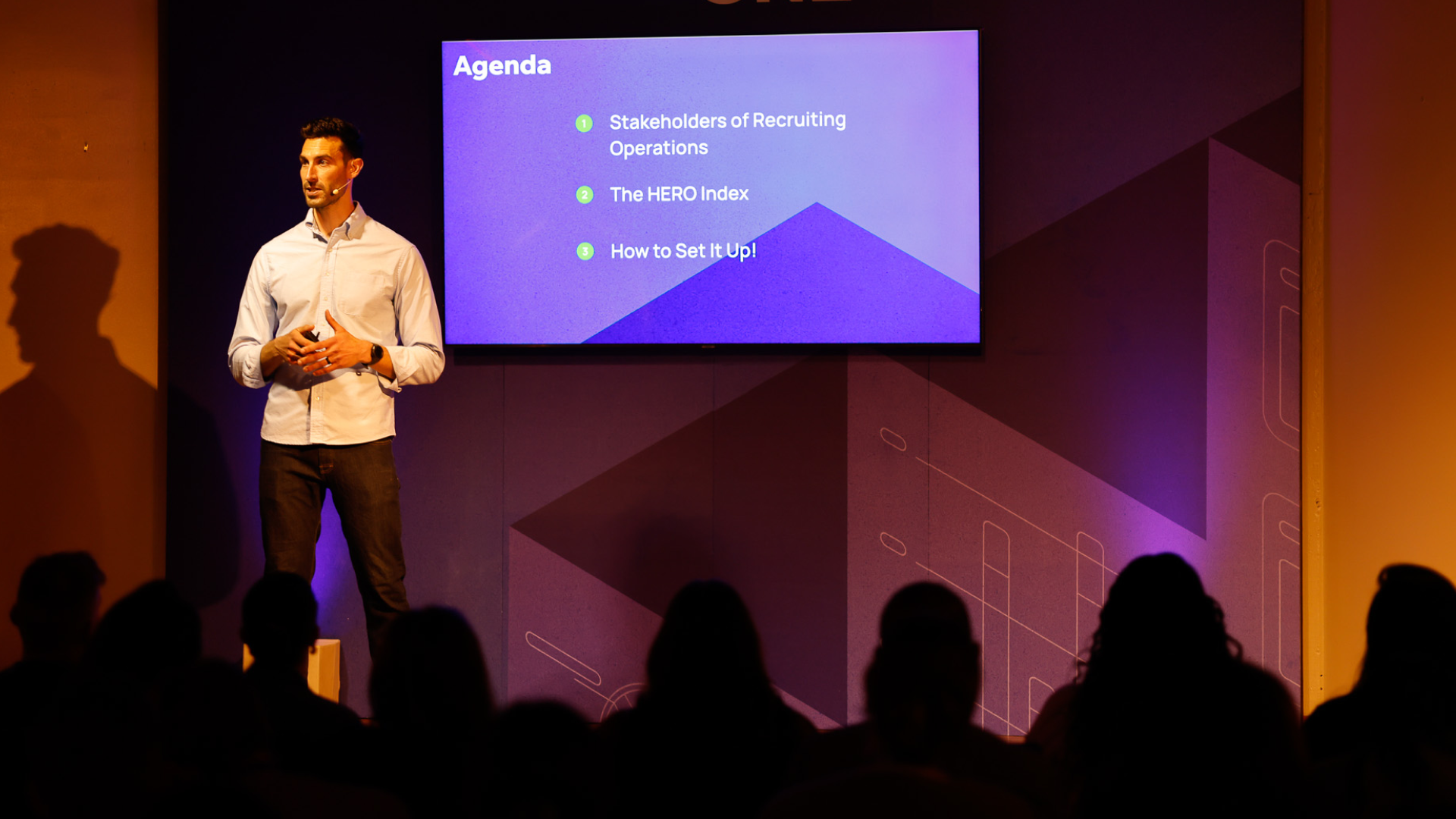
Running RecOps as a System
Will Ducey, Head of Recruiting Ops at Ashby, introduces the HERO Index framework for aligning recruiting metrics with stakeholder needs. Learn how to prove the strategic value of TA with evergreen metrics that drive clarity, impact, and continuous improvement.
View session
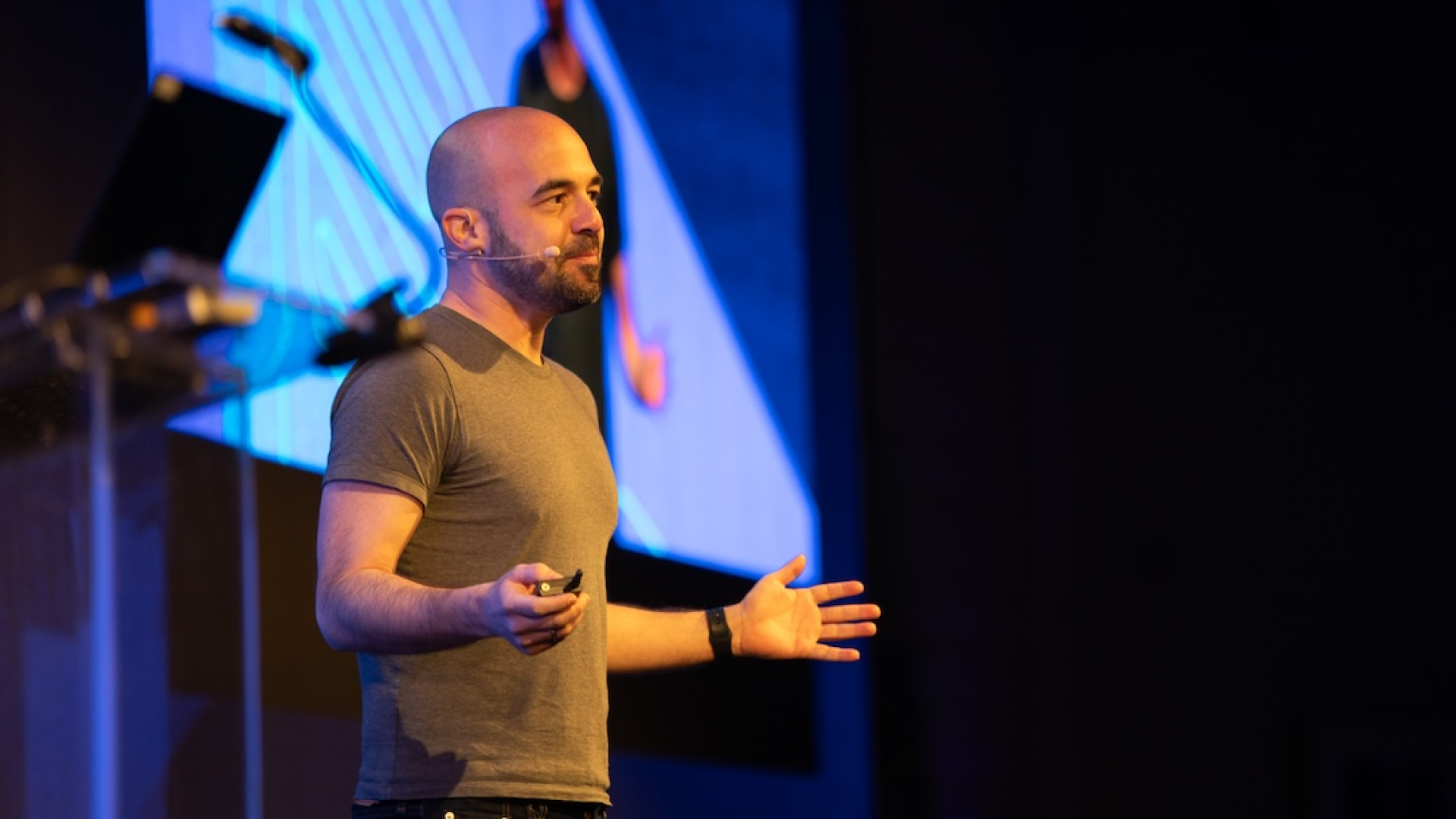
2025 Ashby One Product Keynote
Ashby co-founders Benji Encz and Abhik Pramanik lead the Ashby One product keynote, unveiling our latest releases and sharing what’s next for the all-in-one recruiting platform.
View session