AI Outbound Sourcing with Ashby & Juicebox
Juicebox co-founder and CEO David Paffenholz demonstrates how Juicebox's AI sourcing agents turn an Ashby job description into a ranked candidate search, flag net-new candidates against your ATS, and sync outreach back into Ashby automatically.
Speaker

Key Takeaways
- Sourced candidates make up a small share of total applications but a disproportionately large share of hires on average, and companies that lean hardest into outbound sourcing have pushed that share to 30 to 50 percent of hires, or in Starbridge's case, past ninety percent.
- Large language models let AI sourcing tools read a full candidate profile and reason about fit the way a human recruiter would, instead of only ranking candidates against a static scoring model the way earlier ML-based tools did.
- Pairing manual search with autonomous sourcing agents surfaces a combined candidate list that's different from what either approach turns up alone, since agents can work a role continuously while a recruiter or sourcer still works it by hand.
- Automatically syncing sourced candidates back into the ATS, including contact details and outreach history, keeps the ATS as a team's single source of truth instead of letting outreach activity live only inside a separate sourcing tool.
- Teams with a heavier outbound mix tend to move candidates through the pipeline faster than inbound-heavy teams. Separately, teams that free up sourcing time often reinvest it in deeper talent mapping or more candidate conversations rather than in sourcing still more candidates.
Session Overview
Sourced candidates make up only a small share of total applications, but they produce a disproportionate share of hires, and the gap widens the more a team invests in outbound. David Paffenholz, co-founder and CEO of Juicebox, walks through why that gap exists and how Juicebox's AI sourcing platform, integrated with Ashby, closes it without requiring a team to staff up on manual sourcing.
Manual sourcing is slow because a recruiter has to review each profile by hand and judge fit case by case, and the AI sourcing tools that came before large language models could only rank candidates against a static scoring model. Juicebox's platform reads a full candidate profile the way a person would, researches context on a candidate, and assesses fit against a mix of hard filters (job title, location, skills) and a ranked set of criteria pulled from the job description.
The demo starts from an Ashby job description and shows how Juicebox splits it into those filters and criteria, surfaces which matches already exist in Ashby so a team can focus on net-new candidates instead of people they've already engaged, and builds a personalized outreach sequence that pulls in the role's Ashby application link automatically. Paffenholz also shows auto-export, which syncs every profile a team interacts with in Juicebox, saved, emailed, or responded to, back into Ashby with full contact and outreach history, so the ATS stays the single source of truth even when sourcing happens elsewhere.
The second half turns to Juicebox's autonomous agents, which run searches for a role continuously once calibrated, surfacing new batches of candidates daily alongside whatever a recruiter finds manually. Paffenholz points to Starbridge, which has pushed outbound past ninety percent of hires and leans into a systems-based approach the team calls talent engineering, running dozens of agents in parallel across open roles.
He closes with three questions for teams to take home: what share of hires currently comes from outbound, how quickly outbound candidates move through the pipeline compared to inbound, and what a team would do with the time freed up if sourcing got meaningfully faster.
Chapters
- (00:00) Why outbound sourcing matters, and the data behind it
- (02:05) Why AI sourcing was hard to build before large language models
- (03:52) Juicebox's three capabilities: search, insights, and outreach
- (05:13) Demo: turning an Ashby job description into a Juicebox search
- (07:24) Demo: filtering to net-new candidates and building an outreach sequence
- (10:19) Auto-exporting sourced candidates back into Ashby
- (12:09) How autonomous sourcing agents work alongside manual search
- (12:59) Talent engineering at Starbridge, and three questions to take home
Q&A
Q: How much can AI sourcing actually move the share of hires that come from outbound?
A: Sourced candidates make up under five percent of total applications but already account for roughly sixteen percent of hires on average, and Juicebox has seen customers push that share past ninety percent, as Starbridge has with a systems-based "talent engineering" approach to outbound.
David Paffenholz, Co-founder & CEO at Juicebox: "In some of these cases, we see over half of roles hired through outbound. In some cases, like with Starbridge, over ninety percent of roles being filled through outbound." (12:59)
Q: How do you make sure AI sourcing surfaces new candidates instead of people already in your pipeline?
A: Juicebox's integration with Ashby flags which candidates in a search already exist in the ATS, showing their stage and last applied date, so a recruiter can filter a search down to net-new candidates and skip people the team has already engaged.
David Paffenholz, Co-founder & CEO at Juicebox: "I can either focus on just those ATS matches, or I can only focus on net-new candidates, so people that are not yet in my ATS and make sure that I'm sourcing candidates we haven't had any interaction with." (07:24)
Q: How do autonomous sourcing agents work alongside a recruiter's own manual search?
A: Juicebox's agents run continuously once calibrated on a role, surfacing a new batch of candidate profiles every day for a recruiter or sourcer to review, and can reach out autonomously as well; because agents and manual search share the same platform, a recruiter always knows whether an agent has already contacted a given candidate.
David Paffenholz, Co-founder & CEO at Juicebox: "Agents will go out, find that initial batch of profiles, be ready for review by the recruiter or sourcer working on the role, and can ultimately reach out to those profiles autonomously as well. Because it's all happening in the same platform, your manual search and your agents are not conflicting with one another. If you're finding a profile manually, you know if the agent has already reached out and vice versa." (12:28-12:34)
Q: How do you keep your ATS as the source of truth when sourcing happens in an outside tool?
A: Auto-export syncs every candidate a team interacts with in Juicebox, saved, emailed, or that responds positively, back into Ashby automatically, along with full profile details, contact information, and outreach history, so a team's hiring data stays consolidated in Ashby even when the sourcing itself happens elsewhere.
David Paffenholz, Co-founder & CEO at Juicebox: "With auto-export, we can ensure that all the profiles that are found in Juicebox are automatically exported back into that ATS, ensuring that we have that data consistency and are still using the ATS as our source of truth. And so any profile that you have saved, emailed, or gotten an interested response on in Juicebox is going to automatically sync back into your Ashby instance, including the full profile details, their contact information, and that outreach history which Ashby pulls in from there." (11:07)
Q: What does "talent engineering" mean for a sourcing-heavy recruiting team?
A: Talent engineering treats sourcing as a systems problem rather than pure manual search, running many sourcing agents in parallel across open roles, sometimes twenty or thirty at once, either managed by individual recruiters or by a dedicated talent engineer overseeing all of them, as Starbridge has done to fill most of its roles through outbound.
David Paffenholz, Co-founder & CEO at Juicebox: "We think of it as using a systems process to find talent rather than pure search. And so one way of doing that is by setting up a bunch of different agents for a number of different roles. So think twenty agents, thirty agents, even more, running in parallel to fill those roles." (13:42)
David Paffenholz (00:00)
Thank you for having me. Hi, everyone. Super excited for the session today. We're going to be talking sourcing and how sourcing works amazing with Juicebox plus Ashby. To start off, I'll do a quick intro. I'm David, I'm co-founder of Juicebox. We're an AI recruiting platform. Really what we're focused on is your top of funnel.
So can we help you find better candidates and plug them into your pipeline? Today we'll be talking about why outbound matters. We'll hop into a live product demo exploring how Juicebox and Ashby work together, including some of our newest features on personalization. And then from there, we'll have a few kind of questions that you can take away with you and think about how you want to construct your outbound funnel in the future.
So with that, we'll hop right in, and we'll just do a quick recap of that agenda, why solve outbound, how we can use that workflow, and how AI agents can help with that as well. So Ashby publishes some really amazing data. I believe this is actually from one of Ashby's talent reports. Sourced candidates make up a disproportionate share of hires.
So on the left-hand side, we see the breakup of applications. Only four point eight percent of candidate applications are sourced, the far majority being inbound. But they make up around sixteen percent of hires. Now, this is across a pretty large sample set. What we see with some of our customers who are really leaning into their sourcing motion is that they can see thirty, forty, fifty percent of hires made through sourced candidates, especially when the company is in a rapid growth phase and really focused on maintaining that quality bar for talent, but also really rapidly scaling their team.
So if it's clearly a solution that we should be considering, why isn't everyone doing outbound today? And why is now a time that you can actually invest in outbound? So first, manual search is pretty tricky. We've probably all used LinkedIn Recruiter. We've all manually gone through thousands of profiles.
I know I have. And we then still spend time reviewing each of those profiles, assessing in our head, is this a good fit for the role, before we start engaging them. A lot of the actual engagement we do is also manual, so be that individual outreach, even when using a sequencing solution where we're adding in profiles one by one.
There's been this category of AI sourcing for a while, but it was actually really hard to build an AI sourcing solution before LLMs. What that really meant was an ML-based solution. And so platforms were ranking lists of candidates, and it was really a better form of a potential ranking algorithm.
What we can do now with LLMs is a lot more akin to what we do when actually looking at a profile. We can read the full profile, we can research more context on that candidate, and we can make a more in-depth assessment of whether or not that profile is actually a good fit for the role in a largely autonomous way.
Now, the third part that's also highlighted on our slide is around outreach and why one-off emails are tricky. Now, since you're all in this room, I hope many of you are already using Ashby. Ashby fortunately has some pretty good email sequencing built in. But for anyone that's not yet using Ashby, we also have some pretty good email sequencing in Juicebox, depending on the workflow that you're after.
So let's do a quick overview of what Juicebox offers today, the core platform and how AI agents add on to that. So Juicebox is split into three main capabilities. First, search. Can we help you find the right person? Can we use a combination of hard filters, think job titles, locations, and more, with a set of criteria which we use to assess and rank those profiles to find you a net better profile to source from?
Second, what data can we present you? Talent insights. What is the market map of the role that you're looking for? And then finally, outreach to engage those profiles. Now, that workflow can be done in two ways, depending on the role that you're working on, either by the recruiter or sourcer or by an AI agent that is operating autonomously for that role and finding a new batch of profiles every day.
In fact, we recommend a hybrid approach where you deploy both agents and manually work on those roles as well, because those two different strategies will net you a combined different list than you would if you're just investing in one of them. And so then to complete the picture and tie that into Ashby, we'll see that actually results in quite a neat funnel in this graphic from sourcing to outreach to then tracking interviews and getting to offer stage within Ashby.
So I'll pause here and hop into the demo to see what that workflow looks like live and how the two platforms play together and interact with one another.
So we're starting off in Juicebox in our search interface. As mentioned, that's where the majority of Juicebox interactions start. We can either start off with a prompt, or if we have our ATS connected, we'll just open up this job description field. Can either paste it in or just select it directly from Ashby.
And so I have a backend engineer role that I'm working on. I'm just going to select that in here and automatically pull in that job description to get started. Let's click Save and Search and see what Juicebox does for us. We'll start off by reading that inputted job description and splitting it into two different categories of search and assessment.
What are hard filters that we know every candidate will have? In this case, they should have a software engineering job title or similar. They should be located in San Francisco and some additional parts of the profile, such as company tags or skills that were inferred from the job description. And so in here, we'll actually see that there's some specific skill criteria mentioned, like Node.js or using OpenSearch.
The second thing that Juicebox does is set a list of criteria. How can we assess these profiles and actually figure out who is the best possible fit? And so we'll see the first two criteria are generated directly from that job description from Ashby. In this case, having built something from scratch and having experience with AWS.
But Juicebox also remembers criteria that I have manually added in previous searches and will tailor my criteria for me based on that. And so we'll see that with that small brain icon where Juicebox memory remembers what I did in previous searches and suggests we apply those same criteria to this search as well.
I like these criteria, so I'll go ahead and start with that and click Run Search. And so within just a few seconds, we'll see our total pool assessed and ranked based on those criteria that we set initially. We'll also notice this Ashby icon at the top, and we'll quickly see of sixteen thousand potential matches, three hundred already exist in my ATS.
And I can either focus on just those ATS matches, and so in this case, narrow that pool down to those three hundred, including details like the last stage they went through, when they last applied, and more, or just easily open them up in Ashby. Or I can only focus on net new candidates, so people that are not yet in my ATS and make sure that I'm sourcing candidates we haven't had any interaction with.
So let's say I like these first three profiles. We'll select those three from here and add them directly into an email sequence. Traditionally, these are pre-built, but what we'll do with Juicebox is we'll just click Create a Sequence and have Juicebox generate this for us using AI. Now, this actually still ties into that Ashby integration because Juicebox knows what role I'm applying for, can actually insert that application link into the email sequence autonomously, and remember some details around Juicebox as a company and why someone might want to work at Juicebox.
I can also input my Ashby scheduling URL or any other scheduling software I'm using and have it generate the sequence for me. Just like the criteria, sequence generation remembers your edits and remembers your previous sequences. So depending on your style or the way you write emails, sequences will adjust based on that as well.
We'll see it write out this email in real time, and then we'll get a bit of a preview for what it put together here. Backend engineer at Juicebox. A brief pitch on why they might want to work at Juicebox, and that link to my Ashby application URL right here. In this case, I have a couple follow-up steps included in that email too, and I can fully customize that based on what I'm looking for. Let's click Save and have Juicebox put together that personalized outreach for our three candidates.
Again, taking those three, we know they're not yet in Ashby. We've put together a custom sequence based on the job description and memory, and now we'll see the personalized messaging for all three of them and can still make any last manual edits that we want to before we add to sequence and start reaching out.
Now, in this case, we only did it with three profiles, but we can do the same workflow with dozens, if not hundreds of profiles at any given point in time. With that, I'll pause on the demo and hop back into the slides to briefly recap this flow that we went through. So we started with a search from an Ashby job description, in this case, using the backend engineer role.
We then knew which candidates were already in Ashby, indicated by that Ashby URL on the right-hand side, and can quickly see what stage are they at, to what extent have they already gone through that flow. And finally, only focus on net new profiles rather than profiles that we already have interacted with in the past.
Finally, we built the email sequence, including the personalization from the job description and the role that we were working on. And now there's one final feature that we didn't show in the live demo because it's a little bit less exciting to demo, but the underlying functionality is quite powerful too, which is our auto-export for those candidates back into Ashby.
One of the biggest struggles we see with implementation of recruiting software, specifically on the sourcing side, is having uniformity across the team. Are people actually using the same sourcing tools, or are people still using a combination, maybe searching on LinkedIn, maybe searching on Juicebox, maybe doing some other sourcing?
With auto-export, we can ensure that all the profiles that are found in Juicebox are automatically exported back into that ATS, ensuring that we have that data consistency and are still using the ATS as our source of truth. And so any profile that you have saved, emailed, or gotten an interested response on in Juicebox is going to automatically sync back into your Ashby instance, including the full profile details, their contact information, and that outreach history which Ashby pulls in from there.
We see a few of these different settings. In this case, we've selected our most popular one, which is exporting after a positive interested response. But you can even export every single profile that has been shortlisted or every profile immediately after you've added them to the sequence. As a reminder, Juicebox sources over eight hundred and fifty million candidate profiles, and so all of that profile data is at your fingertips and ready to be synced back into the ATS.
So, so far we've talked through what the manual version of this workflow looks like. We go from search to evaluating profiles to reaching out to them and exporting. That same workflow is also possible with agents, and that's what Juicebox agents are designed to do. You start off with a brief calibration where you describe who you're looking for, like we did in the prompt, but the agent will ask you questions back trying to get a deeper understanding of the role, a bit like interacting with a recruiter or a sourcer who's really trying to understand the role that you're looking for.
From there, agents will go out, find that initial batch of profiles, and be ready for review by the recruiter or sourcer working on the role, and can ultimately reach out to those profiles autonomously as well. Because it's all happening in the same platform, your manual search and your agents are not conflicting with one another.
If you're finding a profile manually, you know if the agent has already reached out and vice versa.
A lot of teams are already using this workflow today. I've selected a few particularly outbound-heavy teams that are really focused on sourcing for their recruiting motion. In some of these cases, we see over half of roles hired through outbound. In some cases, like with Starbridge, over ninety percent of roles being filled through outbound.
We see this being particularly strong for companies that are still developing their talent brand, where inbound applications may not be as strong. There's a greater dependency on that outbound, but they still want to maintain a really high bar for the talent that they're finding. One more piece that I'd like to highlight on Starbridge, our centerpiece case study here, is they've really leaned into this concept of talent engineering.
Talent engineering, what does that mean? We think of it as using a systems process to find talent rather than pure search. And so one way of doing that is by setting up a bunch of different agents for a number of different roles. So think twenty agents, thirty agents, even more, running in parallel to fill those roles.
And we've seen two different approaches. One is that each sourcer or recruiter sets up those agents individually, or the team has a designated talent engineer whose job is to manage all of those agents across all roles. So sourcers and recruiters are still focused on those individual roles instead.
With that, there's a couple questions I want to leave the group with. First, what percentage of your hires are coming from outbound sourcing today? We saw some stats in the beginning of what averages look like, be that around sixteen or seventeen percent. We see companies that have over fifty percent, or in Starbridge's case, ninety percent.
And so in case you don't know that number off the top of your head, double-checking where that is. And then related to that, what is the speed at which those candidates move through your pipeline? And so often what we see for teams that are focused on inbound instead is that timelines tend to be longer versus teams that are more heavy on outbound tend to have a faster recruiting process in general as well.
And so finally, if you were able to reduce your sourcing time by fifty percent, and I think fifty percent is somewhat conservative, you might be able to go beyond that, what can you do with that extra time and capacity? To give a bit of a flavor of what we've seen other teams do is everything from going more in-depth to mapping the talent that they're going after, so really investing into insights, the data that's behind each search, or investing more into candidate conversations and the amount of time that's being able to be spent with each of those candidates.
We think AI first outbound recruiting is possible today. LLMs have unlocked that for us. Our mission at Juicebox is to make that product and workflow accessible to everyone. And so if you'd like to learn more or try out Juicebox for your teams, please either stop by our booth, we have a juice bar outside, and a bunch of friendly Juicebox team members around there too.
Or head to our website and we're happy to set up a more proper demo from there as well.
Recommended Sessions

AI Across the Hiring Lifecycle
Liz Wagner, who leads Talent Operations and Programs at Vanta, walks through how her team configured Ashby's AI-assisted application review and turned on candidate fraud detection after a fraudulent hire slipped through screening.
View session
Designing for AI Impact in Talent
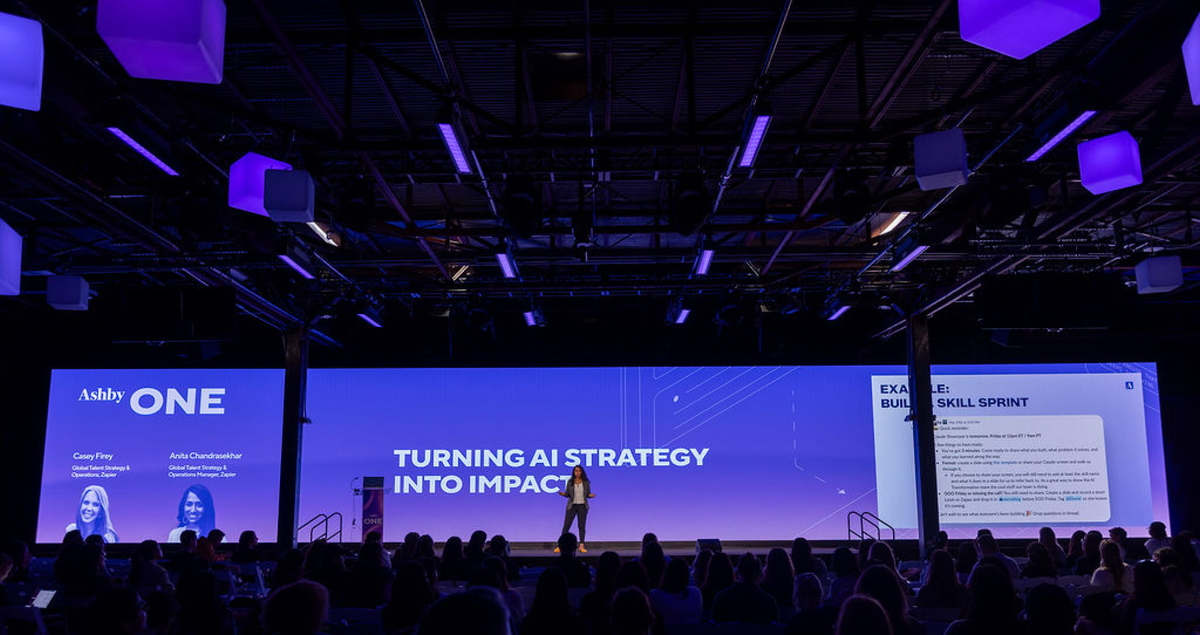
Anita Chandrasekhar and Casey Firey of Zapier's talent strategy and operations team show how they operationalize AI adoption: a hub-and-spoke model that puts an AI transformation manager in every department, a framework for measuring impact across quality, efficiency, and experience, and three case studies covering hiring workflows, reference checks, and resume fraud.
View session