Background Checks Without Bottlenecks
Checkr's Amit Fernandes shows how Ashby and Checkr connect background checks directly to the hiring workflow, so recruiting teams get automatic status updates, verified identity at the start of the process, and a hiring decision as soon as results are back, without leaving Ashby.
Speaker

Key Takeaways
- Hiring processes are built for speed and scale, and catching fraud was never part of that original design. Checkr's Amit Fernandes says recruiters are trained to move candidates through the pipeline as fast as possible, so fraud prevention has to be added deliberately rather than assumed.
- Checkr ties its identity verification to scale. After more than a decade in business, the company runs roughly two million background checks a day and has seen more than two hundred seventy million people, which Amit Fernandes says is what lets Checkr build a fuller picture of who someone actually is.
- Fraud risk doesn't end once someone is hired, since a person's identity, behavior, and outside commitments can change well after the background check clears. Checkr's Amit Fernandes points to continuous monitoring and the rise of undisclosed moonlighting as reasons employers are starting to treat identity and trust as an ongoing signal throughout someone's employment.
- Fraud prevention works best as a continuous layer that runs the length of the hiring process. Checkr's Trust Layer verifies identity at sourcing, re-checks credentials and employment history during screening, flags forged documents like fake pay stubs or transcripts, and keeps monitoring after someone starts.
- Every disconnected handoff between hiring systems, from the ATS to video interviews to onboarding, is a place fraud can slip through unnoticed. Checkr's Amit Fernandes recommends mapping those handoffs first, then connecting background checks directly into the ATS, which is what Ashby and Checkr's integration does for shared customers.
Session Overview
Most hiring processes run through four to six disconnected systems, from the ATS to video interviews to onboarding, and none of them were built to catch fraud. Checkr's Amit Fernandes, Senior Director of Product Management, explains why that gap exists and how Checkr's integration with Ashby closes it, moving candidates from application to background check to start date without adding new handoffs.
Fernandes opens with the trust problem underneath the technology: only thirty-one percent of CHROs feel confident they can catch fraud in hiring, even as AI lets fraudsters mass-produce fake resumes and applications. He frames it as a strategy gap more than a tooling gap, since recruiting was designed to move candidates quickly, not to interrogate whether they are who they claim to be.
Identity fraud tends to take one of three shapes in his telling: synthetic identities built from scratch, manipulated documents like fake driver's licenses, and proxy candidates who interview as one person and start the job as someone else. Checkr's Trust Layer counters each stage with identity verification: a validated ID checked against DMV records, a liveness check, and device fingerprinting, all tied to the same identity as it moves through the background check and I-9.
On the Ashby side, ordering a background check happens inside the candidate record itself: a recruiter selects a package, Checkr runs identity verification and the check in the background, and every status update, criminal, employment, and education, feeds back into Ashby automatically. Fernandes says this removes the swivel chair between systems entirely, and that most checks clear in under an hour, letting recruiters make a hiring decision the moment results land instead of waiting on a separate tool.
Chapters
- (00:02) Welcome, and why Ashby and Checkr partner
- (01:19) The fraud confidence gap among CHROs
- (02:47) Why disconnected hiring systems create fraud risk
- (04:48) Checkr's Trust Layer across the hiring lifecycle
- (06:30) Checkr's scale and building a full identity picture
- (07:56) Three patterns of identity fraud and how IDV stops them
- (10:02) Inside the Ashby and Checkr integration
- (12:38) Three takeaways and where to find Checkr at Ashby One
Q&A
Q: How long does a background check take?
A: Most background checks finish in under an hour. Checkr's Amit Fernandes, Senior Director of Product Management, says more than eighty percent close within that window, with the share climbing higher across a full day. Ashby's integration with Checkr pushes every status update back automatically, so a hiring decision can happen as soon as results land.
Amit Fernandes, Senior Director, Product Management at Checkr: "Our background checks largely turn around in, I think, over eighty percent in less than an hour. And if you expand that to a day, that's a really high percentage." (11:59)
Q: What is candidate fraud, and how widespread is it in hiring?
A: Candidate fraud covers fake resumes, forged documents, and people who aren't who they claim to be. Most hiring leaders don't feel equipped to catch it: Checkr's Amit Fernandes says only thirty-one percent of CHROs are confident in their ability to prevent fraud in the hiring process, even as fraudsters use AI to scale fake applications faster than ever.
Amit Fernandes, Senior Director, Product Management at Checkr: "One of the things that we saw that stopped us in our track really is when we learned that only thirty-one percent of CHROs are confident in their ability to prevent fraud in the hiring process." (01:22)
Q: How can employers detect fake or proxy candidates during hiring?
A: Identity fraud in hiring shows up three ways: synthetic identities that are entirely made up, manipulated documents like fake driver's licenses, and proxy candidates who interview as one person but show up as someone else on day one. Checkr's Amit Fernandes says its identity verification layers a validated ID, a liveness check, and device fingerprinting to catch it early.
Amit Fernandes, Senior Director, Product Management at Checkr: "There's synthetic identities, which is basically made-up identities. Then there is document manipulation, fake driver's licenses. ... And then the third thing is just proxy candidates, which is one person shows up during the interview, but a whole different person shows up on day one for the job, and you have no way to correlate those two other than your hiring manager saying, 'That's not the person I saw on Zoom.'" (08:41)
Q: How does a background check fit into the rest of the hiring process?
A: A background check usually sits among four to six disconnected systems: an ATS, a background check provider, video interviewing tools, onboarding and I-9 paperwork, and an HRIS. Checkr's Amit Fernandes says those handoffs are where fraud can creep in, which is why Ashby and Checkr connect the background check step directly inside the ATS.
Amit Fernandes, Senior Director, Product Management at Checkr: "So if you look at the process that's up here, it's probably anywhere between four to six systems involved. You have an ATS, you have a background check provider. Thankfully, with Ashby and Checkr, they are connected. But then somewhere in between, you have a video conferencing app for remote roles or at least for the hiring processes that started in the last six years or so. Then you step a little further, and you start looking at onboarding tools, I-9, then you end up with an HRIS platform." (02:47)
Q: How does integrating background checks into your ATS speed up time to hire?
A: Connecting your background check provider directly to your ATS removes the manual re-entry and app-switching that slows hiring down. Checkr's Amit Fernandes says the integration eliminates that swivel chair between systems, so status updates land automatically inside Ashby and recruiters can make a hiring decision the moment results come back, without ever opening Checkr separately.
Amit Fernandes, Senior Director, Product Management at Checkr: "This really prevents that swivel chair that usually happens between multiple apps... We eliminate all of that." (11:17)
Amit Fernandes (00:02)
Hey, everyone. Nice to see all of you, and nice to meet you. I lead enterprise products at Checkr, and one of the things that I've learned over my time working with enterprises is that they hate switching between apps.
They love for their business processes to be seamless and connected. So today I'm going to start by talking a bit about that. So let's take a look at why Ashby and Checkr are the right partners to bring you this, this conversation. Ashby really transforms the way you attract talent. You engage them.
You basically develop them after that. And Checkr, on the other hand, is a leading background check provider as well as a leading identity verification provider now. We work with hundreds of thousands of companies. Together, we actually see a candidate throughout their journey, from their very first click when they apply for the job to the point of time when they get onboarded.
And that is the kind of visibility that you need into your hiring processes to make sure you're hiring the right folks. So let me step into a bit about Checkr's technology. Now, Checkr's been in the industry for coming up on twelve years, I believe, this year. And we do a few things really, really well if you fundamentally think about it.
We went and we started talking to a set of our CHROs out there, and we tried to ask them, "What's going on? What's top of mind for you?" One of the things that we saw that stopped us in our track really is when we learned that only thirty-one percent of CHROs are confident in their ability to prevent fraud in the hiring process.
That is quite insightful. That's basically two out of three people are saying that we think fraud is in our process, and maybe we don't know about it, or maybe we haven't caught it yet. Then the other thing that we noticed is that a lot of these CHROs are also wrestling with the fact that they want to put fraud prevention mechanisms in there, but they do not want to make the candidate journey too frictional.
In general, candidates, I being one of myself at some point of time in life, if I feel I'm being surveilled through the process, I'll disengage. So they are balancing two things. They are balancing this charter of, like, prevent fraud in hiring, but at the same time, don't make the candidate experience frictional.
It's a tough balance. Fundamentally, this is not a technology gap. This is really a strategy gap that these organizations are dealing with. Some of the best organizations though are dealing with this proactively. Now, why is this process so difficult? Why, why is fraud getting into the hiring process?
So if you look at the process that's up here, it's probably anywhere between four to six systems involved. You have an ATS, you have a background check provider. Thankfully, with Ashby and Checkr, they are connected. But then somewhere in between, you have a video conferencing app for remote roles or at least for the hiring processes that started in the last six years or so.
Then you step a little further, and you start looking at onboarding tools, I-9, then you end up with an HRIS platform. There are so many tools. All these tools are rarely ever connected. And companies have spent years and years trying to drive integration projects, and they never get done. So that's the reality we have to deal with.
The thing is, fraudsters have also figured that out now. So they know that these systems are not connected. There are seams and gaps in the process. And they keep hitting the process until they find out, "Where can I get in? How can I break it down? So can I show up as Amit upfront, but can I change my identity midway through to game the system?"
And arguably, a lot of what is happening with HR now is happening a bit due to what AI is doing on the other side. We use AI from a business standpoint in our lives to make things more efficient. Well, consumers and now even fraudsters are using it to scale the practices that they already were aware of.
So they are scaling the number of times they can hit you. They're scaling the number of times they can breach the process. They can churn out more number of resumes today in the same amount of time that they churned out one resume two years ago. Now, what does an entire hiring process which actually thinks through fraud look like?
Well, hiring was never built as a process to prevent fraud. It was built for operational scalability. Most hiring managers, most talent acquisition professionals are always thinking about: How do I identify the right candidate? How do I bring that candidate through the pipeline faster? How do I close that candidate quickly?
None of them has been thinking about, "How do I prevent fraud while I do this?" What you're looking at here is Checkr's Trust Layer mapped across that same hiring process. Now, at sourcing an application, we verify who someone is, whether their resume holds up. We re-verify this identity and go deep on credentials, employment history.
We flag any fraudulent documents that come across in the process. We are beginning to see a lot of fake pay stubs, fake education transcripts, fake I-9s are entering into the process as well. And then post-employment, the work really doesn't stop. We are then getting into continuous monitoring.
There's an interesting trend and there's a split audience on this. Sometimes people are doing multiple jobs, but they don't inform both employers that they're doing that. Now, there's nothing fundamentally wrong in doing multiple jobs, but if your employer doesn't know about it, they don't know if there's a conflict of interest.
They don't know if you're taking data from one place and using it in another place, and if that's even allowed. So there's a term for that that's emerging, which is called as moonlighting. So people are now interested in figuring out are employees moonlighting, and do I need to care about that as an employer at that point?
The thing that you notice in this is that arrow that's going through this entire process, it doesn't stop. It keeps moving to the right. I say this because this is a living trust layer. Fraud does not stop after a person is hired in many cases because people's behavior, people's future can change, and being aware about that, having awareness about that is important.
So that's what Checkr does. It's actually helping you manage this entire life cycle. Now I'll step back and help you understand how we are doing this. I spoke about us being in business for about twelve years. And we've run millions of background checks. If I'm not wrong, we process close to about two million checks a day at this point.
Over the past decade plus, we have actually seen about two seventy million plus people, so we understand their identity. Now, beyond this, Checkr actually has multiple lines of businesses, so background checks is one of the businesses. We also do lending. We also do verification during lending rather. We also have personal checks where any of you could go onto Checkr personal and run a check on yourself.
We also have a tenant business where people who are applying to be tenants into an apartment maybe get checked. As we see people through different phases of their life, we are building out their profile. We understand who they are. So we step back and we not only say, "Is what this person told me about themselves true?"
That's not just the question we ask. We ask, "Is the totality of everything we know about this person, does that make sense?" And we combine that with behavioral signals, device, IP, use of VPNs, so on and so forth. That is what gives us a three sixty degree view about an individual. It really comes down to being able to get identity really quickly, and that is key in this world.
The entire process of fraud gets in because identity is not consistent throughout the process. And by identifying that identity upfront and taking that same identity through the process, that's where we start building a picture that helps us understand, is there some data that doesn't look good? Did this person say they studied on the East Coast but they have no addresses on the East Coast?
How is that possible? So those are the kind of things that break synthetic identity fraud or identity fraud at large. One of the solutions I'll walk you through is an IDV solution that we use. Now, fundamentally, if you think about it in the hiring process, how does identity fraud get in? There's kind of three patterns to it.
There's synthetic identities, which is basically made-up identities. Then there is document manipulation, fake driver's licenses. That's a good form of it. And then the third thing is just proxy candidates, which is one person shows up during the interview, but a whole different person shows up on day one for the job, and you have no way to correlate those two other than your hiring manager saying, "That's not the person I saw on Zoom."
Happens. So what we do is we have three layers. We first do what we call as document validation. So we get a valid document such as a driver's license. We also validate it against the DMV because we can do that. We have that authoritative access to the DMV.
We then do a liveness check to make sure that the image of the person matches the document that they presented to us. And then the third thing that we do is device fingerprinting, which is trying to understand what is the IP, where is this coming from? Is this IP related to a naughty list, as an example? So those are things we do, and IDV is the essential foundation.
It establishes that the person is who they say they are. Once we have that, we take that information and run it through the subsequent steps of the process, whether it's the background check, whether it's the I-9. It's the same name. It's the same date of birth. It's the same information that we validated upfront that flows through.
So the points of injection are blocked right there. Now, let me walk you through a bit about how the Checkr and Ashby integration works because this integration is really, really easy to use.
So one of the first things you do is in order to order a background check in Ashby, you go to a candidate. And then within that candidate's context, you then look for the background check, and you select a package. And then you say, "Hey, I want to get to the next assessment." So that's what the step looks like.
Where you go select the candidate, locate and select the assessment, and then you select the package associated with it. What this does is behind the scenes, it kicks off a process through Checkr, where the candidate receives an email saying, "Come participate in the process." They then go through IDV.
Once they go through IDV, we collect additional information from them. So all of this is happening behind the scenes. In Ashby then, what starts happening is you start getting all the status updates feeding back.
So as the candidate is participating, as the background check process starts running, things get completed, whether it's the criminal check, whether it's the employment history, education history, all of that comes back into Ashby.
This really prevents that swivel chair that usually happens between multiple apps, where people are going from the ATS to the background check to something else and back, or they are trying to type information in from one system to another. We eliminate all of that. That improves really what people are focused on.
So when we think about the talent acquisition team, they are then focused on making sure they're hiring the right candidate versus doing the menial task of status update or data update. The other thing that we are doing is, through this process, we are truly reducing the time to hire drastically because what we've done is we've engaged the candidate, we've got their information, we've got some of it from Ashby, we've got some of it from the candidate.
We've combined that. We've started running the background check. Our background checks largely turn around in, I think, over eighty percent in less than an hour. And if you expand that to a day, that's a really high percentage. That allows us to then bring that information back where people can make decisions quickly now in Ashby.
You see all the statuses in Ashby. You can make a hiring decision right there. You don't have to wait to go into Checkr or do anything in there. Of course, you'll always get the link back in Ashby if you want to pop out into Checkr and see more detailed information, so that's always available. Three things to think about, as you take this back today.
The first is map your hiring handoffs. Every gap between your systems, between your processes is an opportunity for a fraudster. Today, they have the tools to scale how they attack that. The second thing is connect Checkr to Ashby. Pretty straightforward. It's one integration. You kick off everything in Ashby.
Your data lives back in Ashby. You make your decisions in Ashby. And then finally, take the power of what's happening with over one hundred and thirty thousand customers and enjoy it because every check that you will run is based on what we've seen before. So we can help you drive things more accurately and faster because we know exactly whom you're dealing with and when you're dealing with it.
Now, with this we can. We do have a cart right around the corner. It's the bakery cart. So if you find this interesting, come stop by, have a conversation with us in person. We'd love to talk more about your hiring process, how you're trying to combat fraud, how you're trying to make sure Checkr and Ashby can be better together for you.
And of course, there's a QR code here. Feel free to scan that. That takes you to a great article, which provides you a lot of details about some of the things I spoke about, especially with fraud. With that, thank you.
Recommended Sessions
Getting Back to Basics to Fight Candidate Fraud
Tom Chapman, Director of Talent Acquisition at Dave, on making candidate fraud easier to catch by fixing the conditions recruiters work in: staggered role openings, a target of fewer than 15 recruiter screens per hire, and clarity on what good looks like before a role opens.
View session
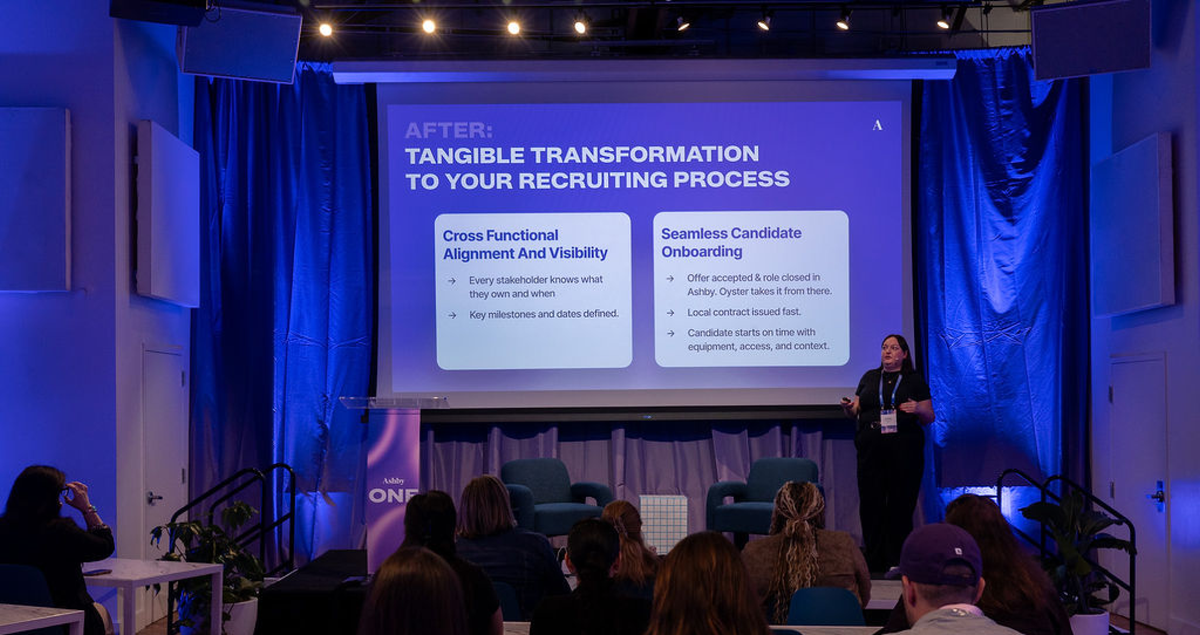
Global Hiring and Compliance with Ashby & Oyster HR
Erin Goodey, Global People Director at Oyster, breaks down how to expand hiring into new countries without compliance surprises, and shows how the Ashby-Oyster integration turns an accepted offer into a compliant local employment contract in minutes.
View session