The Evolution of Recruiting Coordination
Jai Bembry, Team Lead of Candidate Experience at Ontra, explains how his team turned scheduling-heavy recruiting coordinators into candidate experience coordinators, sharing four moves: showing up to intake with a plan, pressure-testing decisions with real signals, leading the conversation, and anchoring on candidate experience.
Speaker

Key Takeaways
The scheduling and calendar work AI increasingly automates is only the visible layer of recruiting coordination. The real value sits below it, in spotting process friction, building processes that scale, and shaping candidate experience, which is where Ontra's Candidate Experience Coordinators now spend their time.
A blunt candidate experience survey question like "did you have a good experience" tends to return little usable signal. Breaking it into specific prompts, role clarity, preparedness, interviewer impact, is what surfaced the drop-off points Ontra's team could actually act on.
Coordinators who walk into intake meetings with a job description, interview plan, and assessment questions already drafted change how hiring managers treat them. At Ontra, that shift started when the team swapped "What do you want to do?" for a proposed starting point to refine, and hiring managers began relying on them for direction.
Trimming a dense pre-interview email down to the handful of points a candidate actually needs strengthened both the candidate's first impression and the hiring manager relationship. It was one small edit, made by Ontra's Candidate Experience team after a hiring manager asked to attach a lengthy document to the outreach email.
Renaming a coordination function, from recruiting coordinator to candidate experience coordinator, only means something if the day-to-day work expands with it. At Ontra, that meant taking on interview design, interviewer training, and onboarding support alongside the new title.
Session Overview
As AI takes on more scheduling, the recruiting coordinator role is shifting toward higher-value work. Jai Bembry, Team Lead of Candidate Experience at Ontra, walks through how his own team moved from pure scheduling into process design, data-informed decisions, and candidate experience work, and shares four moves any recruiting coordinator or TA leader can use to do the same.
Bembry's own turning point came early in his career, when he realized his recruiter was fielding candidate emails, context, and decisions he never saw, while he handled scheduling alone. The gaps he was hitting, hiring managers left out of alignment, recruiters spread thin, were not accidental. They were structural, and once he mapped them, he stopped treating the coordinator role as scheduling only.
At Ontra, that shift became a title change, from recruiting coordinator to candidate experience coordinator, backed by four moves Bembry now coaches his team through: show up with a plan, pressure-test decisions with real candidate signals, use that data to lead the conversation, and anchor every decision in the candidate's actual experience.
The same shift shows up in how Bembry's team treats data. When the applicant tracking system Ontra used opened up new survey features, his team moved past a single catch-all satisfaction question and used the results to convince sales and engineering leaders to rework parts of their own interview processes, turning candidate feedback into a seat at the hiring-decisions table.
Bembry frames curiosity itself as the mechanism behind all of it: coordinators who ask why a candidate dropped off get better data, and better data is what earns a coordination team a seat at hiring decisions.
Chapters
- (00:04) The AI-and-coordination conversation, reframed
- (00:34) Early days as a scheduler
- (01:04) The sync that revealed the gaps
- (02:03) Coordination is an iceberg
- (02:33) From recruiting coordinator to candidate experience coordinator
- (03:30) Step one: show up with a plan
- (04:30) Steps two through four: pressure-test, lead, anchor on candidate experience
- (08:20) Curiosity as a career strategy
Q&A
Q: Will AI replace the recruiting coordinator role?
A: Automating scheduling only removes the visible layer of coordination. Jai Bembry, Team Lead of Candidate Experience at Ontra, compares coordination to an iceberg: the real work, spotting process friction, building processes that scale, and shaping candidate experience, happens below the surface.
Jai Bembry, Team Lead of Candidate Experience at Ontra: "I'd say that question only makes sense if coordination is only synonymous with scheduling. But coordination is a lot like an iceberg. So the scheduling, the candidate communications, that's just the tip of the iceberg. The real work is what's happening below the surface. Coordinators are spotting process friction, they're building processes that scale, and they're championing the candidate experience." (02:03)
Q: How can recruiting coordinators become more strategic instead of just executing tasks?
A: Show up with a plan before anyone asks for one. Jai Bembry, Team Lead of Candidate Experience at Ontra, had his team stop asking hiring managers what they wanted and start walking into intake meetings with a job description, interview plan, and assessment questions already drafted, which shifted hiring managers into relying on them for direction.
Jai Bembry, Team Lead of Candidate Experience at Ontra: "Today, my team walks into intake meetings with job descriptions drafted, interview plans outlined, questions written, and assessment prompts ready to go. We stopped asking hiring managers, 'What do you want to do?' And we started saying, 'Here's your starting point, and from here, let's refine.'" (03:30)
Q: How should teams collect candidate experience feedback that actually leads to change?
A: Break a single broad question into specific prompts on your candidate experience survey. Jai Bembry, Team Lead of Candidate Experience at Ontra, found that simply asking candidates if they had a good experience returned little useful data. Asking whether they understood the role, felt prepared, and how interviewers affected their excitement surfaced the process gaps driving candidate drop-off.
Jai Bembry, Team Lead of Candidate Experience at Ontra: "At the time, just asking candidates, did you have a good experience, believe it or not, was not yielding much useful information to us. So we started asking, do you really understand the role? Did you feel prepared? Did interviewers make you more or less excited about the opportunity?" (04:30)
Q: What's the difference between a recruiting coordinator and a candidate experience coordinator?
A: The title change at Ontra reflects an expanded scope in daily responsibilities. Jai Bembry's team went from recruiting coordinators to candidate experience coordinators because the day-to-day work grew: building interview plans, challenging process decisions, training interviewers, and supporting onboarding, well beyond scheduling and calendar management.
Jai Bembry, Team Lead of Candidate Experience at Ontra: "We went from recruiting coordinators to candidate experience coordinators. Now it wasn't just for the sake of rebranding, but the role actually changed. Today my team is building interview plans. They're thoughtfully challenging process decisions, they're training interviewers, and they're supporting onboarding." (02:33)
Q: Why can't AI fully replace the human side of candidate experience?
A: Employer brand is built one candidate interaction at a time, by the people closest to the process. Jai Bembry, Team Lead of Candidate Experience at Ontra, says a candidate who doesn't get the role but leaves feeling valued, informed, and respected is what employer brand actually is: no scheduler can turn a rejection into a reason to come back.
Jai Bembry, Team Lead of Candidate Experience at Ontra: "The candidate that doesn't get the role, if we did our jobs right, that candidate is leaving feeling valued, informed, respected. That's employer brand. That's not a marketing campaign. That's not a careers page. It's but one candidate interaction at a time by the people closest to the process. That's not something that can be automated either. There's not a tool out there that's going to make someone feel seen. There's not a scheduler that's going to turn a rejection into a reason to come back." (07:47)
Jai Bembry (00:04)
Hello everyone. My name is Jai Bembry, and I'm the team lead of Candidate Experience at Ontra. And I want to start our time today with something that might feel a little bit uncomfortable. Now, there's a conversation happening right now, maybe in your leadership meetings, in TA team syncs, and definitely in this very room, about what happens to the recruiting coordination function as AI starts to take over more of the work. Now, I'm not here to shy away from that conversation. I'm actually here to reframe it. So, two things in the next 10 minutes: one, being the role of the recruiting coordinator is evolving and not disappearing, and the second being how you can take control of that evolution.
So let's go. Recruiting coordination is evolving and not disappearing. Let's really hold on to that distinction because everything I'm about to say will build upon it. So to start, let me take you back to my early days as a recruiting coordinator. My role was as we expected. I was maintaining the ATS, scheduling candidates, keeping the process moving. And I'll be honest, at that time that felt a little bit incomplete to me.
And then one week, I'm sitting in a sync with my recruiter, and something shifts. She starts talking about things that I just had no idea about. Emails from candidates that I've never seen, conversations that had already happened without me, and context that was actively shaping the direction of the role, and I was sitting completely outside of it. Not to mention, the recruiter was already spread thin. Our recruiters are sourcing, they're screening candidates, they're keeping everyone aligned. This was supposed to be a partnership, but she was fully shouldering the process on her own. Now, what am I doing? I'm just scheduling everything. And oftentimes without the proper context.
So if myself and the recruiter can't be in lockstep, who's keeping the hiring manager fully aligned? Not to mention, we're all supposed to be working together to bring on this really great hire. And that's when it clicked for me. These gaps that I was seeing, they weren't just accidental, they were structural. And once I started seeing them, I couldn't unsee them. So let's get to the question at hand. If AI is automating the scheduling, do we still need recruiting coordinators?
I'd say that question only makes sense if coordination is only synonymous with scheduling. But coordination is a lot like an iceberg. So the scheduling, the candidate communications, that's just the tip of the iceberg. The real work is what's happening below the surface. Coordinators are spotting process friction, they're building processes that scale, and they're championing the candidate experience. Coordinators at Ontra are in the best possible position on the team to spot where things break. They're there to see how the candidate really feels and they connect the dots across the process.
So, the real question is not, do we need coordinators? It's what does this role now become? At Ontra, we've answered that question. We went from recruiting coordinators to candidate experience coordinators. Now it wasn't just for the sake of rebranding, but the role actually changed. Today my team is building interview plans. They're thoughtfully challenging process decisions, they're training interviewers, and they're supporting onboarding. So if your coordination team is only scheduling, you are vastly underutilizing one of the highest-leverage roles in recruiting.
But for us, this didn't just start with a title change, it started with how we showed up. And that's what no one is going to tell you. No one came to me one day and said, "Hey Jai, it's time to start being more strategic." There was no permissioning moment for me. I just started showing up differently. And then over time I got pulled into different conversations. I was trusted with more ownership. And then I was eventually asked to lead the function. The role expanded because the behavior changed.
So if you're a recruiting coordinator in this room looking to chase that next level, or if you're a TA leader looking to unlock more from your coordination function, this is for you. Here's how I coach my team on how to take control of that evolution. If you're a recruiting coordinator, you're here. Step one is to show up with a plan. I stopped waiting for people to tell me the process, and I started showing up with a version of it myself. Today, my team walks into intake meetings with job descriptions drafted, interview plans outlined, questions written, and assessment prompts ready to go. We stopped asking hiring managers, "What do you want to do?"
And we started saying, "Here's your starting point, and from here, let's refine." The result of that is that we get to lead the conversation. Hiring managers are relying on us, and leaders want to bring us into that conversation earlier. You stop being someone who just supports the process and you start to become someone who shapes it. Now, step two. The biggest shift for our team wasn't doing more work, it's actually asking better questions. So, step two is where we pressure-test using real signals.
As a company at Ontra, we think very carefully about where AI and other technology can open things up and where human judgment has to lead. We saw this for ourselves a few years ago when the ATS we were using at the time opened up new features to where we could completely change our candidate experience survey. At the time, just asking candidates, did you have a good experience, believe it or not, was not yielding much useful information to us. So we started asking, do you really understand the role? Did you feel prepared? Did interviewers make you more or less excited about the opportunity?
And what we found changed how we operated. Candidates were reaching late stages without process and role clarity. Some of our interview experience was directly driving drop off. This data gave us influence, and with the influence, we were able to convince sales leaders it was time to rewrite long-standing practical prompts. We were able to prove to our engineering leaders that it was time to completely reshape their interview process for scale. This change and influence gave us a seat at the table when it came to hiring decisions.
Now, better questions plus real signals equals real results. And steps three and four go hand in hand here. We lead the conversation and we anchor on the candidate experience. Here's how we do that in practice.
One day my direct report came to me after a hiring manager asked her to add a very lengthy document to our initial candidate outreach email. The email would have read something like: "Hello, welcome. Here's two pages of reading, and also can you please send us your availability?" She knew that this probably wasn't the best candidate experience, and she was right. The candidates receiving an email like that, they're getting a first impression of our company before they even interview. That's not a warm welcome.
That's basically homework. And for the tired job seeker or the sought-after professional, that can be a barrier.
So instead of just flagging it as an issue, together we asked, what is the hiring manager really trying to accomplish here? And how can we get that information in front of the candidate in a way that won't overwhelm them? Well, after drafting up some options and talking with the hiring manager, we found that the candidate only needed a couple of key points, and we were able to seamlessly bring that into the email in and of itself. So now I read something more like, "Hello, welcome. Here are some key points to help set you up for success, and when you're ready, we can get you scheduled for your first call."
That is a better candidate experience. And that situation yielded a stronger partnership with the hiring manager and more trust. And that's how you do it. That's how you go from just executing to improving, from reacting to leading, and the entire time you're anchored in the candidate experience. Now, candidates being the anchor doesn't mean we lose sight of the business need. If you're anything like me, I'm from the deep South, where SEC football is tradition. I'm a Georgia fan who grew up in an Ohio State family, so I know what a house divided looks like.
And to some, coordination may feel that way. But here's what I love about the function: coordination doesn't have to be divided at all. When the function is working as it should, everybody wins. Our stakeholders are getting a great hire. They're getting a professional who walked through a structured and thoughtful process. They're getting someone that was informed and they hit the ground running faster because of it. They're getting a shorter ramp, they're getting a stronger team, and that is a business outcome.
Now, we don't just stop there. The candidate that doesn't get the role, if we did our jobs right, that candidate is leaving feeling valued, informed, respected. That's employer brand.
That's not a marketing campaign. That's not a careers page. It's but one candidate interaction at a time by the people closest to the process. That's not something that can be automated either. There's not a tool out there that's going to make someone feel seen. There's not a scheduler that's going to turn a rejection into a reason to come back. That is a real skill that lives in coordination.
You may be asking, how do we get there? I tell my team to get curious, and I mean that very seriously. Curiosity is not a soft skill when it comes to coordination, it's actually a career strategy. When you're curious about why a candidate dropped off, you're going to ask better questions. When you ask better questions, you're going to get better data, and when you have better data, you can actually shape what happens next. And that's the cycle here.
It starts with caring about something outside of your usual task list. I tell my team to actually lean into those new AI tools, have retros with your hiring managers, find out what they wish candidates would have known before entering into the process.
You can go and volunteer for projects outside of your scope. I tell my team to lean into your interests or you can lean into the pain points of the company. Either way, you're going to learn something. The people that grow the fastest on my team are not the ones that waited for permission. They're the ones that got curious. They found the gaps. They came with a solution. You grow faster by asking better questions, and you let the answers tell you where to go next.
If I can leave you with anything as a former recruiting coordinator and now a team lead, it's that the role is evolving. No one is going to hand you the end result of that evolution, but it's yours if you want it. See the gaps, shape the process, and lead. Thank you.
Recommended Sessions
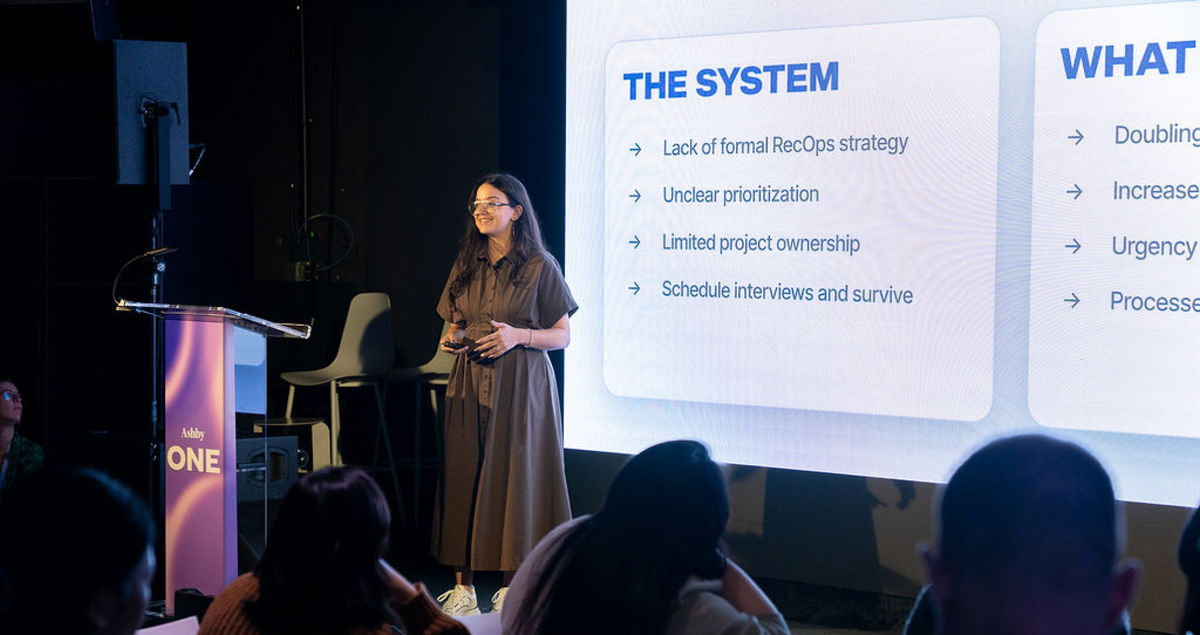
Setting a RecOps Strategy
Rachel Lanman, Manager of Recruiting Operations at Intercom, walks through the four-step framework she uses to build a RecOps strategy: start with company goals, build a backlog and run a listening tour, define pillars with clear metrics, then prioritize big bets against quick wins.
View session
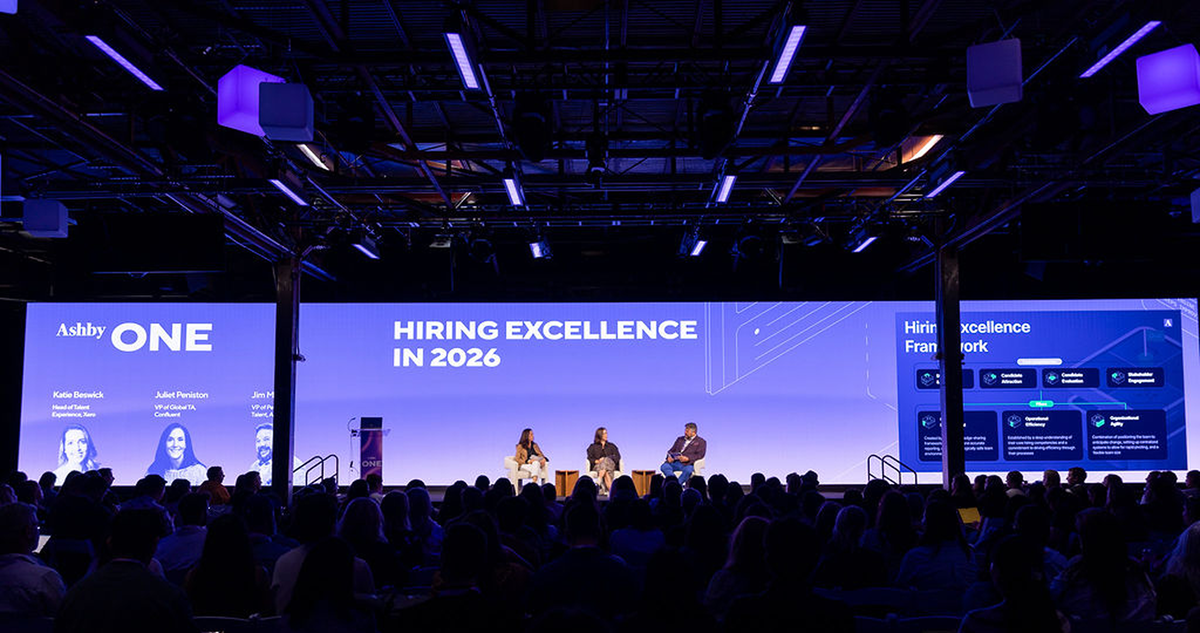
Hiring Excellence in 2026
Juliet Peniston of Confluent and Katie Beswick of Xero walk through a capacity model built on start dates, fraud detection that runs before the first pre-screen, and an AI rollout at Xero that the team built for itself.
View session