EMEA Recruiter Productivity | Talent Trends Report

Ben is a Data Analyst at Ashby
20 minute read
Topics
Table Of Contents
For the past few years, we've regularly published a Recruiter Productivity report to better understand how talent and recruiting teams are operating. In honour of our first Ashby One conference in London, we wanted to take a closer look at the EMEA region.
We recognise that EMEA (Europe, the Middle East, and Africa) is a broad definition. Within Europe itself, hiring patterns can vary from country to country, and sometimes even city to city. Our hope is that this first analysis helps move from a global view to the EMEA region as a starting point. And to help bring some sub-regional specificity, throughout this report you'll find qualitative colour from talent experts in specific locations within EMEA.
By the end of this analysis, we found a region facing much of the same pressure as in the Americas (AMER) — rising application volume, more intensive interviewing, and a tighter labour market for technical talent — while keeping outcomes like Time to Hire and the candidate experience remarkably stable throughout.
Key Findings
- EMEA recruiting teams have faced much of the same top-of-funnel surge we see globally, but have absorbed it consistently. As an example, Time to Hire has held in the 37-43 day range since 2021, even as application volume and interview load have both grown substantially.
- Business hiring looks like one global market, technical hiring does not. Technical roles in the Americas receive a far greater volume of applications than in EMEA.
- EMEA candidates have better odds of getting an interview than AMER candidates, though offer rates end up nearly identical between the two regions. Despite receiving fewer applications per hire than AMER, EMEA interviews a similar number of candidates.
I. Recruiter Capacity
Let's begin by understanding the work landing on recruiters directly. If helpful, here are quick definitions of the metrics we'll observe:
- Applications per Hire: The number of inbound applications a role receives, on average, for each candidate ultimately hired.
- Hires per Recruiter: The average number of hires a single recruiter makes per quarter.
- Applications Interviewed per Hire: The number of candidates who make it to an interview, on average, for each hire made.
Application volume rose sharply and has stayed elevated
Inbound applications per hire examines the very top of the hiring funnel. From 2022 into 2023, the average number of applications per hire rose sharply and has persisted at this higher level since. Most notably, applications per hire in EMEA doubled in the five-year period from the start of 2021 to 2026.
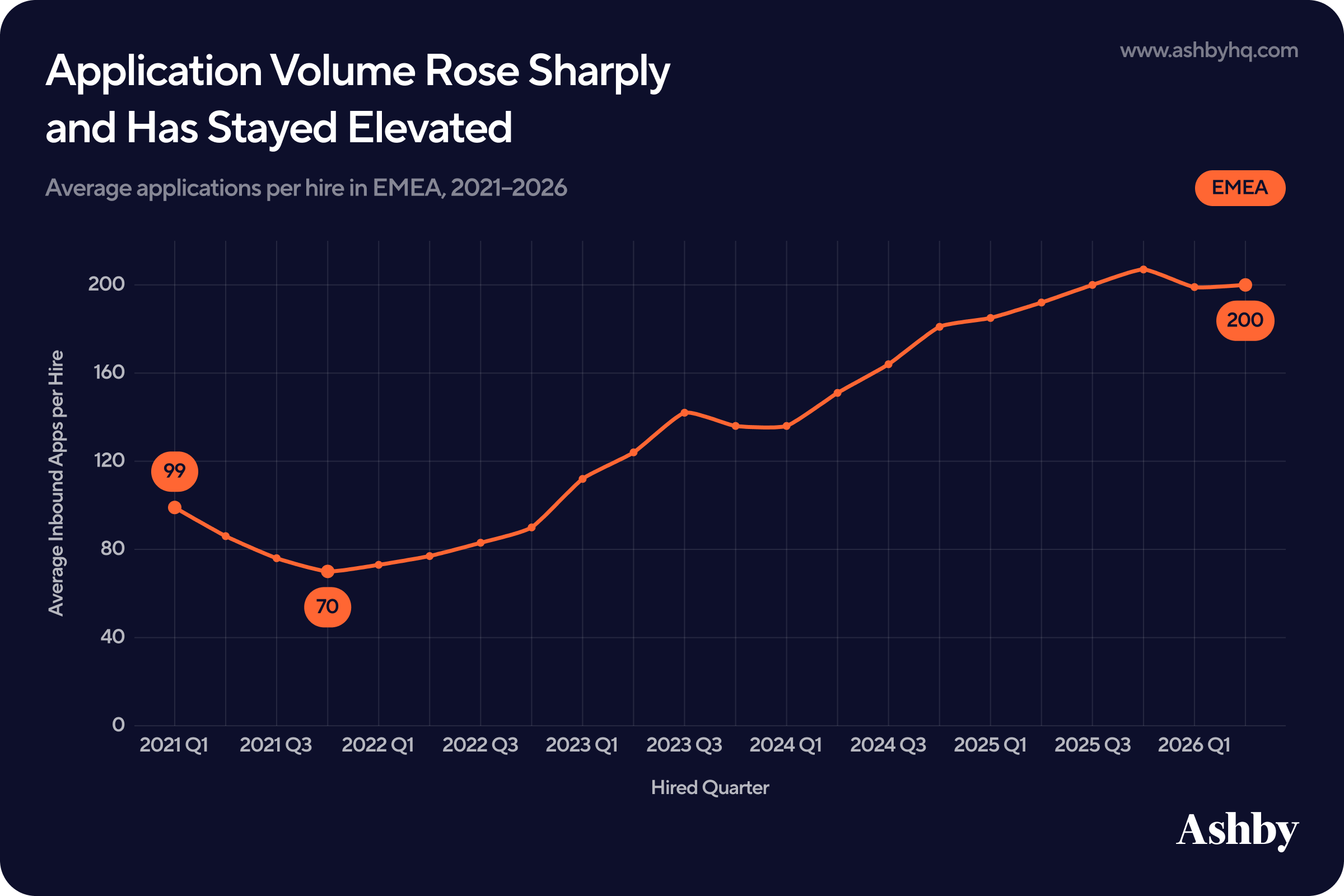
In our global Recruiter Productivity report, we included the backdrop of pandemic-era hypergrowth followed by waves of tech layoffs pushing more candidates into the market. Many of these themes also exist here with a couple of EMEA-region specific wrinkles layered on top, as shared by the experts we interviewed alongside this analysis:
- Ongoing political and economic instability globally has increased interest in relocating to Europe. A number of experts we spoke with shared a rise in applicants from the U.S. and other regions who are interested in moving to, and working from, Europe.
- While in our global report we spoke to a rise of fraudulent applications as a driver behind rising application volume, speaking with talent experts in EMEA suggests that fake candidates have begun to subside in the region.
- More recently, AI tools have made it dramatically easier for candidates to apply to many roles at once, though this is a qualitative signal rather than a hard stat. Amanda Johnson, Head of Global Talent at DeepL, shared how being an AI company puts the rise in inbound volume even more in focus.
"Our inbound has doubled since I joined in 2024. I think a lot of it is the AI buzz where candidates are moving from more traditional SaaS companies toward AI companies. But now we're also competing with every other AI company that's opened in London, so it cuts both ways."
— Amanda Johnson, Head of Global Talent Acquisition, DeepL
Business roles look similar across regions; technical roles don't
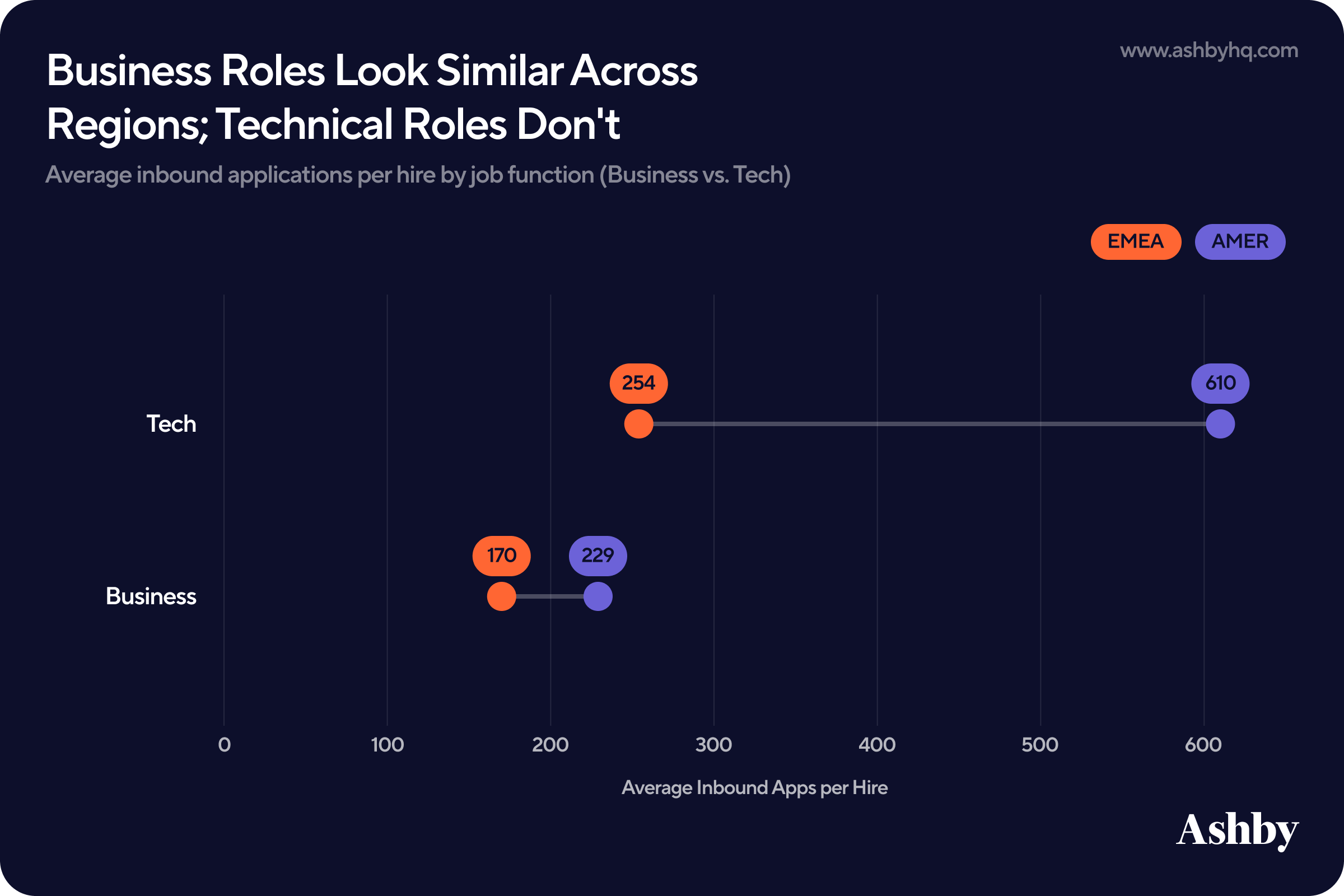
Though as we dug deeper, we found this trend isn't even across functions. In studying the split by business versus technical roles in the past year, business roles show near-parity between EMEA and AMER. Technical roles are where the real gap opens up, with AMER technical candidates applying at meaningfully higher volumes. Specifically:
- Business roles have 170 inbound applications per hire on average in EMEA vs 229 in AMER
- Tech roles have 254 inbound applications per hire in EMEA vs 610 in AMER (more than double)
Hires per Recruiter is at an all-time high
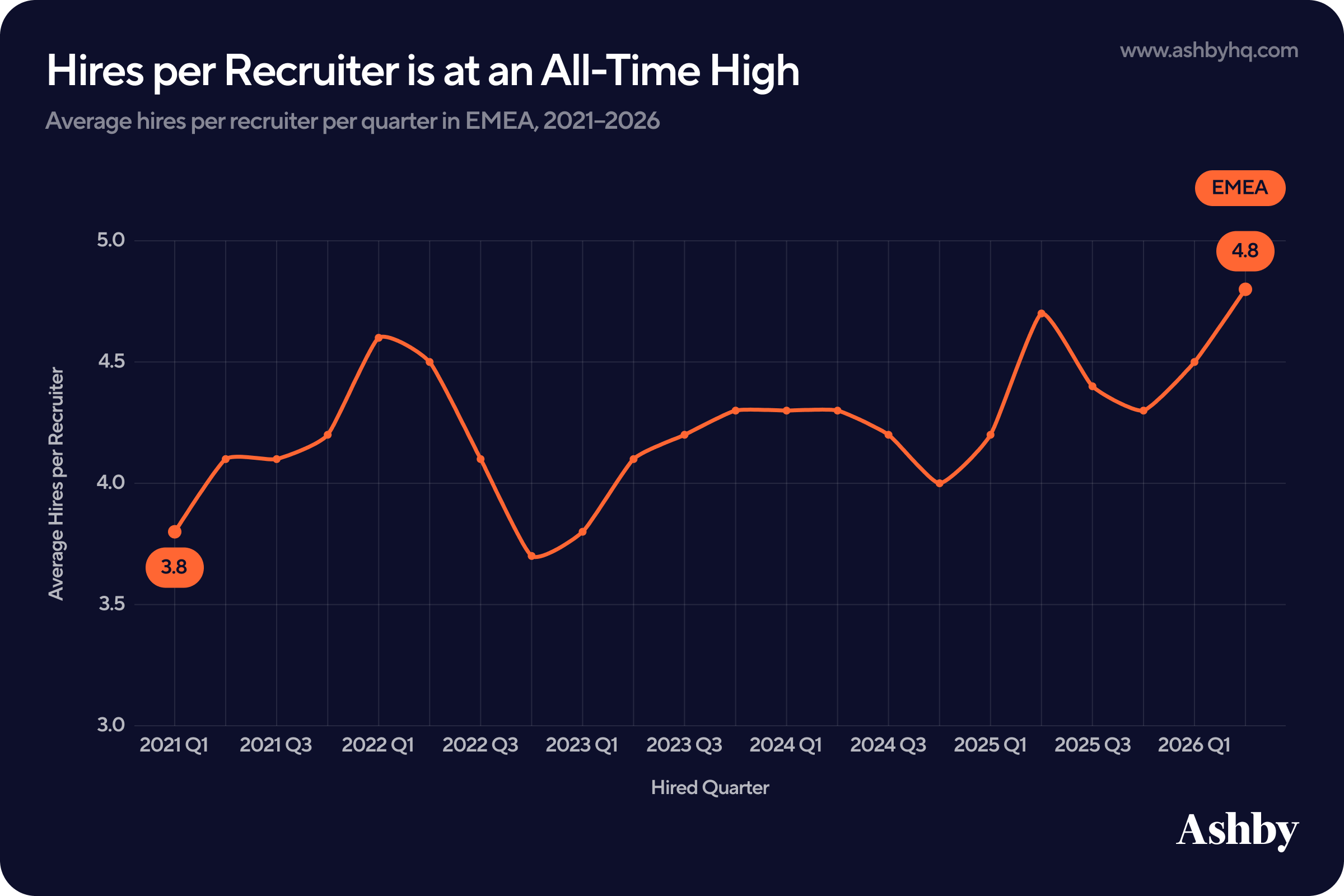
Even with rising application volume, EMEA recruiters are getting more done. The average number of hires per recruiter per quarter has fluctuated over the past 3+ years, anywhere from roughly 3.8 to 4.8 hires per recruiter.
It's worth noting that this metric can vary by company size. In our 2025 Recruiter Capacity report, we found that larger companies tend to see different scaling patterns. Specifically, Recruiting Coordinators were found to be handling 3x more jobs at a company with greater than 500 employees compared to companies with fewer than that.
Unsurprisingly, these efficiencies mirror many of the trends we've seen as we build software solutions in the space. From automated scheduling to AI-assisted application review, recruiting teams are increasingly offloading manual, repetitive work and freeing up time to focus on the hires that matter most.
Still, even teams outperforming the regional average can feel like they're on a treadmill. Célia Sauthier, Director of TA at Moss, shared that the team's interview volume has gone up by about 30% — though they're not converting into more hires. The rise in application volume has instead hindered productivity.
The screening load per hire keeps growing
So we've seen individual recruiters are hiring more people, but what does that load look like? Interviews per hire helps us understand how many applications move to interview with a recruiter. Here we see that the average number of applications interviewed per hire across EMEA has climbed steadily and reached double digits starting at the end of 2024.
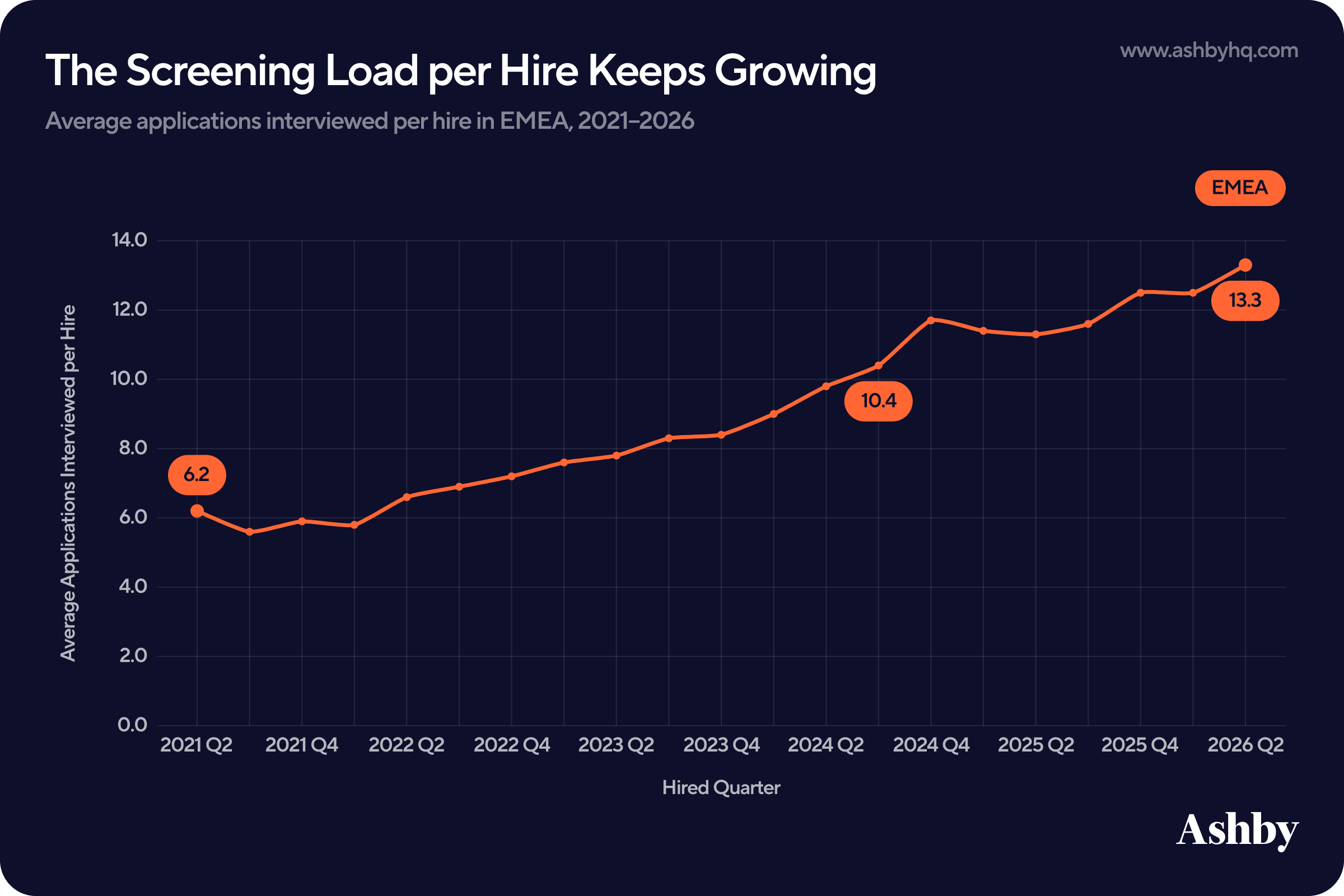
In other words, recruiters are interviewing considerably more applicants to reach each hire than they were just a couple of years ago. This could be a sign that recruiting teams are absorbing more work at every stage of the funnel; it could also be reflective of norms in the EMEA region. One example we see is candidates applying for a role in a region requiring a visa or location requirement they can't meet. This is where some teams introduce application filters to easily spot non-fits.
"When you look at the numbers, it's very compelling. You're spending a lot of time reviewing applicants when 5-7% progress to the next step. So we've had to become more intentional about auto-rejections. We track their pass-through rate for how many non-auto-rejected applications actually progress, so we know we're screening the right people in, and being aggressive enough to filter the right people out."
— Célia Sauthier, Director of TA, Moss
Another regional perspective comes from Sam Wright at Ashby, who shares how the variety of languages spoken across the EMEA region requires top-of-the-funnel screening to be more thoughtful. A candidate who looks excellent on paper might present themselves differently in writing.
"In EMEA, our hiring culture places greater emphasis on interviews and conversations. Hiring roles in Europe for a U.S. company with a remote-first, async culture also means clarity of thought carries more weight than it might in other hiring processes. We see about 38% of the candidates I screen in EMEA advance to hiring manager screen for senior tech roles compared to roughly 59% on our North America team. A lot of that gap reflects how much emphasis we put on clear, specific thinking at that stage, not just experience or fluency."
— Sam Wright, Technical Recruiter, Ashby
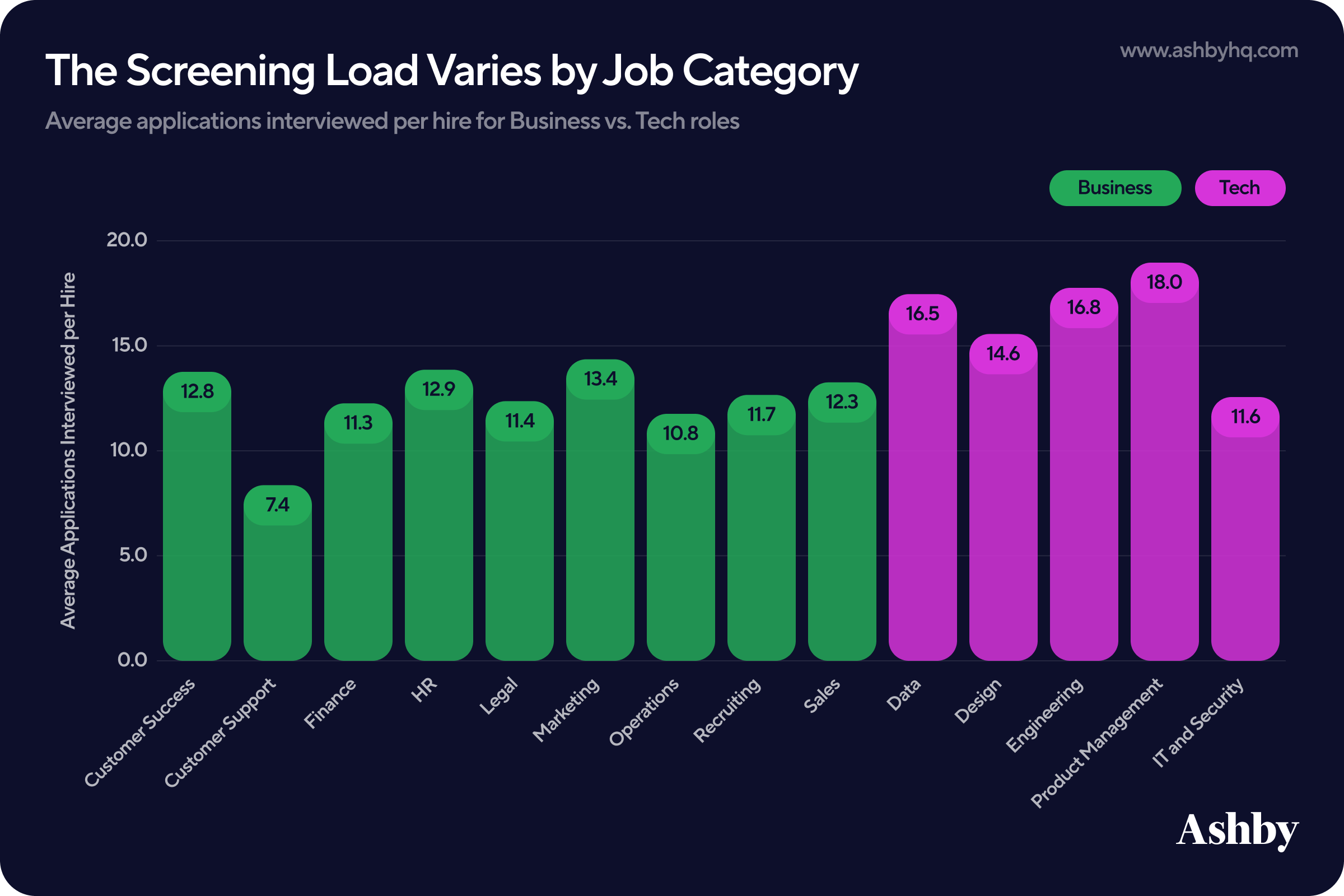
All that said, nuance does exist by role. The chart below shows the number of applications interviewed before a hire was made in the past year. Immediately we see the difference between Customer Support roles (7.4 applications per hire, on average) and Product Management roles (18.0, on average). Overall, technical roles take ~34% more applications interviewed than business roles on average.
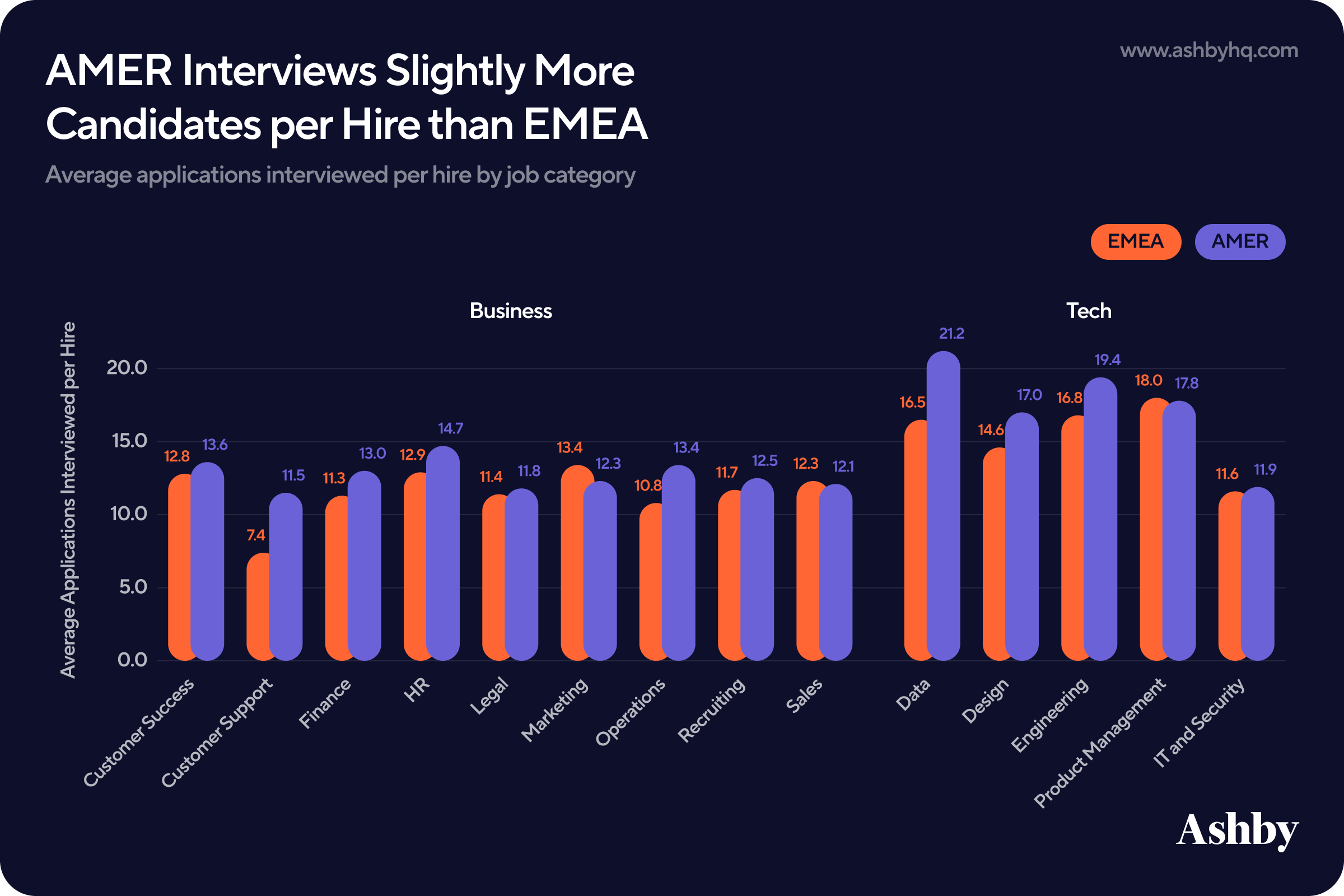
We were curious to see how this data differs between the Americas and EMEA. Across the board, we found AMER recruiters interview slightly more candidates per hire than their EMEA counterparts in the past year. The gap is especially pronounced in a few areas such as Data (21.2 vs 16.5) and Customer Support (11.5 vs 7.4). Marketing is one exception, where EMEA interviews more applications than AMER on average.
So while EMEA and AMER have differences in top-of-funnel inbound applications per hire, and the number of applications interviewed per hire can vary between region and role, the two regions have many similarities.
So far, the story is consistent: EMEA recruiting teams are facing more incoming volume, screening more candidates, and making more hires per recruiter than they were a few years ago, largely absorbing that load without it becoming unmanageable.
II. The Candidate Experience
Next we'll dig into how this looks from the other side of the table through the candidate experience. The metrics we'll look at in this section are:
- Percentage of applications resulting in an interview (interview probability)
- Percentage of interviews resulting in an offer (offer conversion; rate of interviews to offer)
- Interview hours per hired candidate (time investment)
- Interview events per hired candidate (number of scheduled interviews)
EMEA candidates have better odds of getting an interview
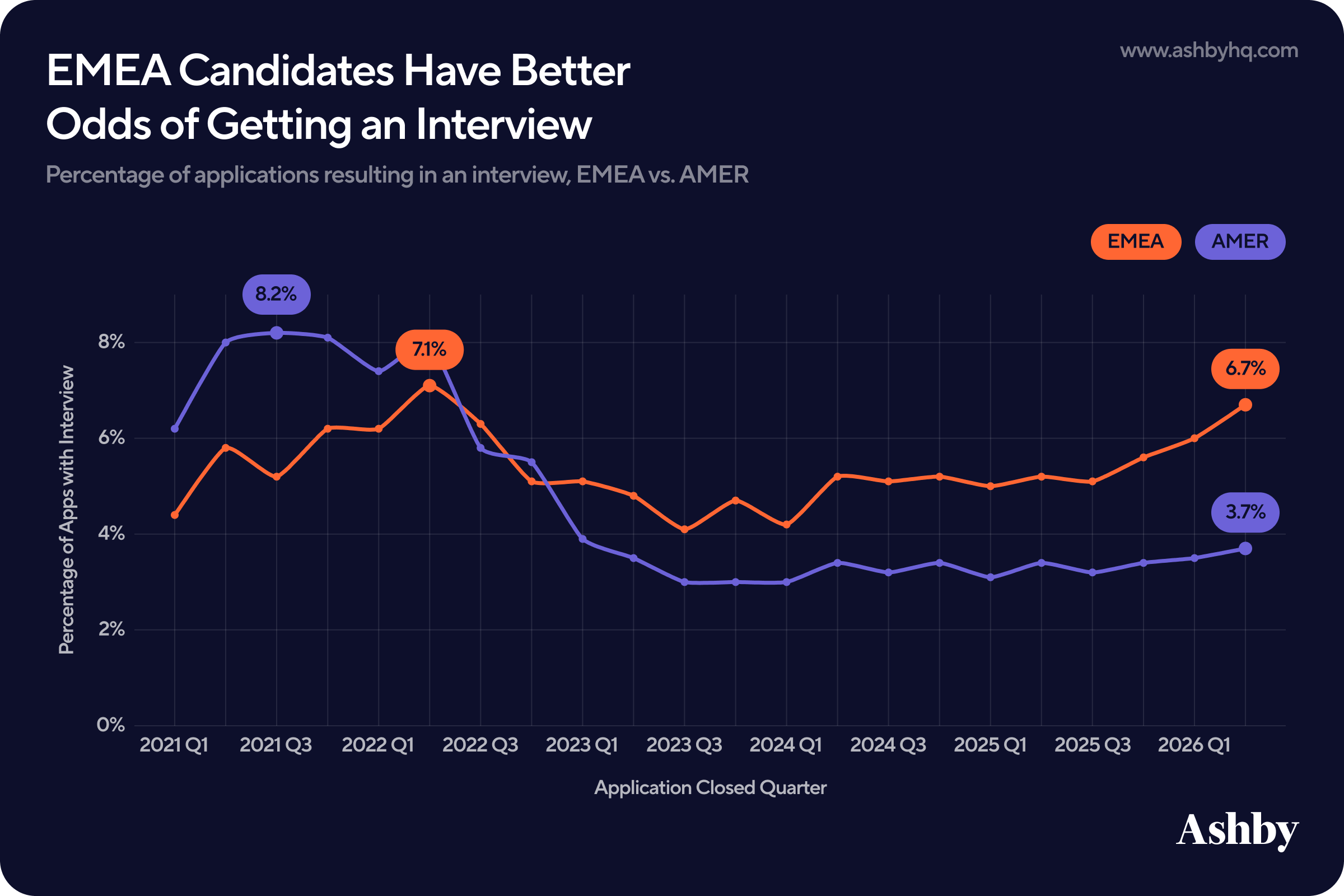
The odds of any given application resulting in an interview have fallen sharply globally since 2021. Though here it's interesting to compare regions. EMEA candidates have consistently fared slightly better than their AMER counterparts, particularly since 2023. This could simply be a function of fewer applications per opening, which improves the odds for any individual applicant.
That said, the percentage of candidates getting an interview for EMEA roles still has not rebounded to 2022 levels (7.1% in 2022; 6.7% as of Q1 2026).
The interview-stage advantage disappears at the offer stage
While we just saw that EMEA candidates enjoy modestly better odds of landing an interview than their AMER counterparts, that edge doesn't carry through to the offer stage. Once a candidate is in front of a hiring team, the likelihood of receiving an offer has moved in near lockstep between EMEA and AMER for the past 2+ years with both regions converging in the 6–8% range as of early 2025.
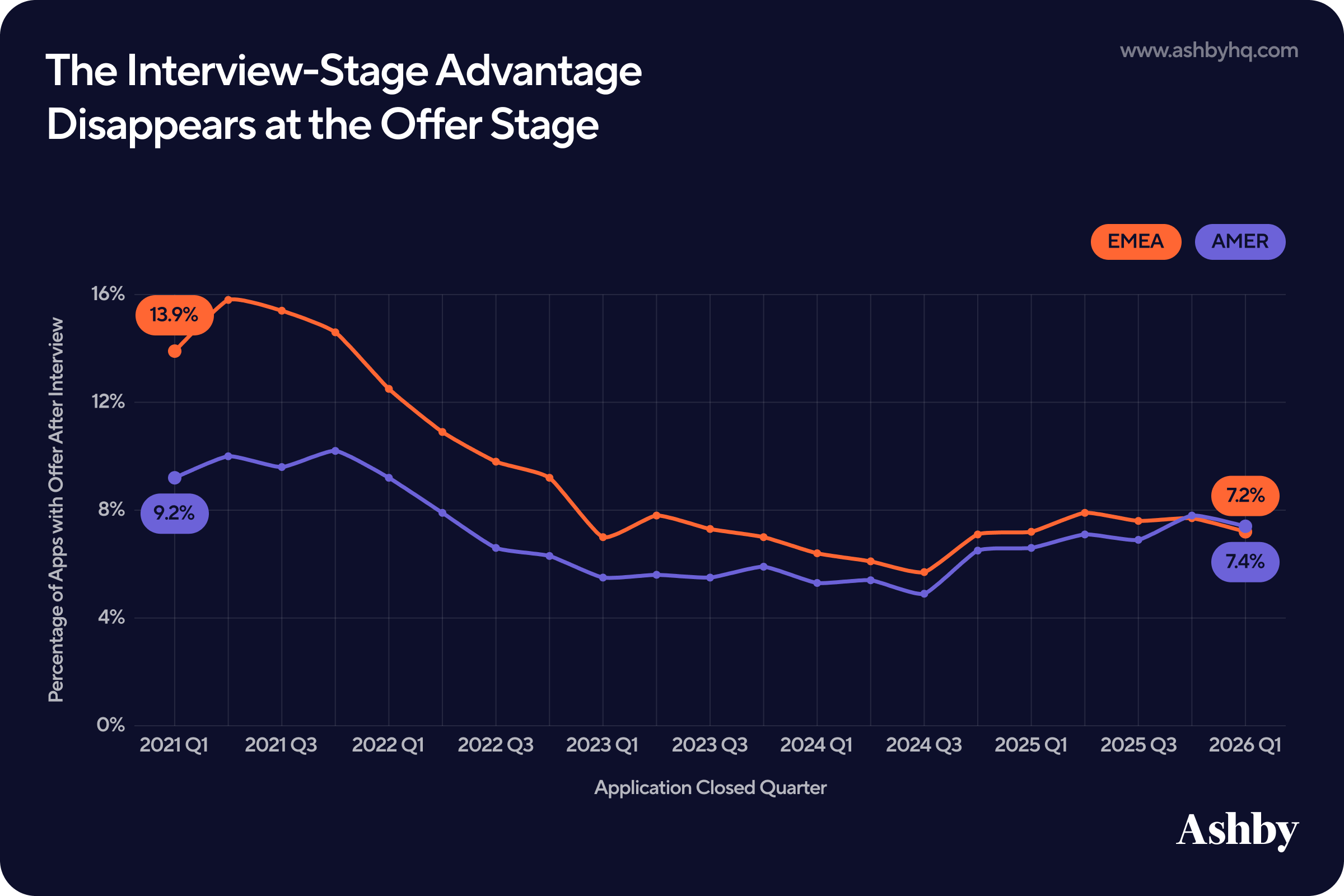
Though as visualised, this wasn't always the case. Early in 2021, EMEA candidates converted to offers at meaningfully higher rates than AMER candidates. That gap closed steadily through 2022 and 2023, and by 2024 the two regions were essentially indistinguishable on this metric. A few of the experts we spoke with pointed to increased scrutiny at the offer stage. In some cases, this is due to increased requirements around AI fluency. Sam Wright, a technical recruiter at Ashby, illustrates the growing trend across early and growth-stage companies of more senior decision-makers, founders, and executives getting involved at the offer stage.
"At Ashby, we've always had our VP of Engineering at the final stage for every engineering hire, and we work hard to keep the process lean around that. What's changing is that more organisations are adding senior decision makers late in the process, but without the discipline to keep things moving fast or aligning quickly. More opinions generally means slower decisions, longer gaps between stages, and candidates looking elsewhere. Generally speaking, time is the biggest killer of momentum."
— Sam Wright, Technical Recruiter, Ashby
The candidate's time investment has stayed remarkably consistent
Despite rising applications, more screening, and more interviews per hire, the experience for the candidate who actually gets hired has barely changed. On average, EMEA candidates have spent between 2.4 and 2.9 hours interviewing before receiving an offer since 2021, with no real upward or downward trend over five years.
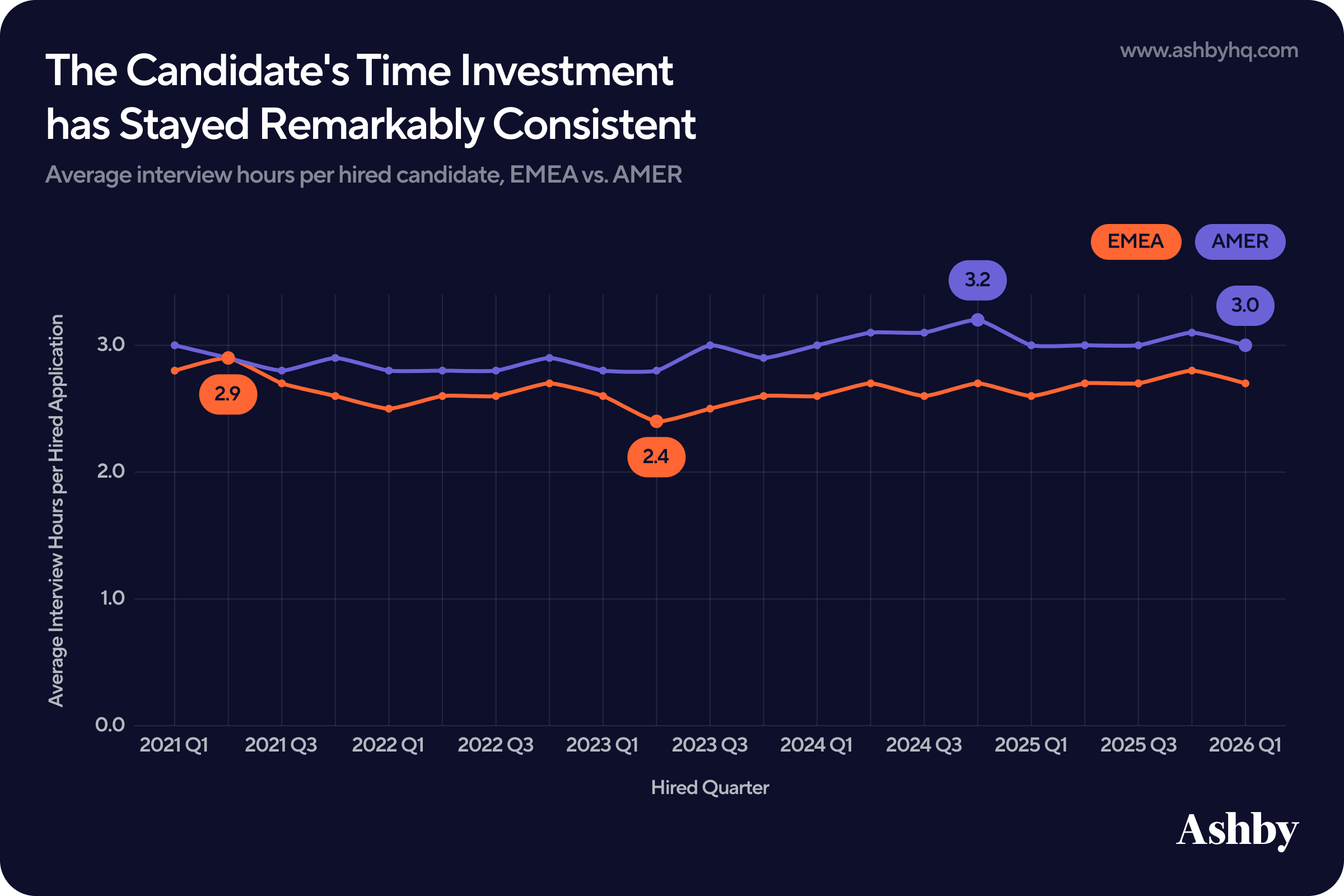
This matters because it tells us where the added weight of this market has actually landed. Recruiting teams have taken on more work at nearly every stage of the funnel without hired candidates having to shoulder any of that increase themselves.
Candidates aren't going through more rounds to get hired
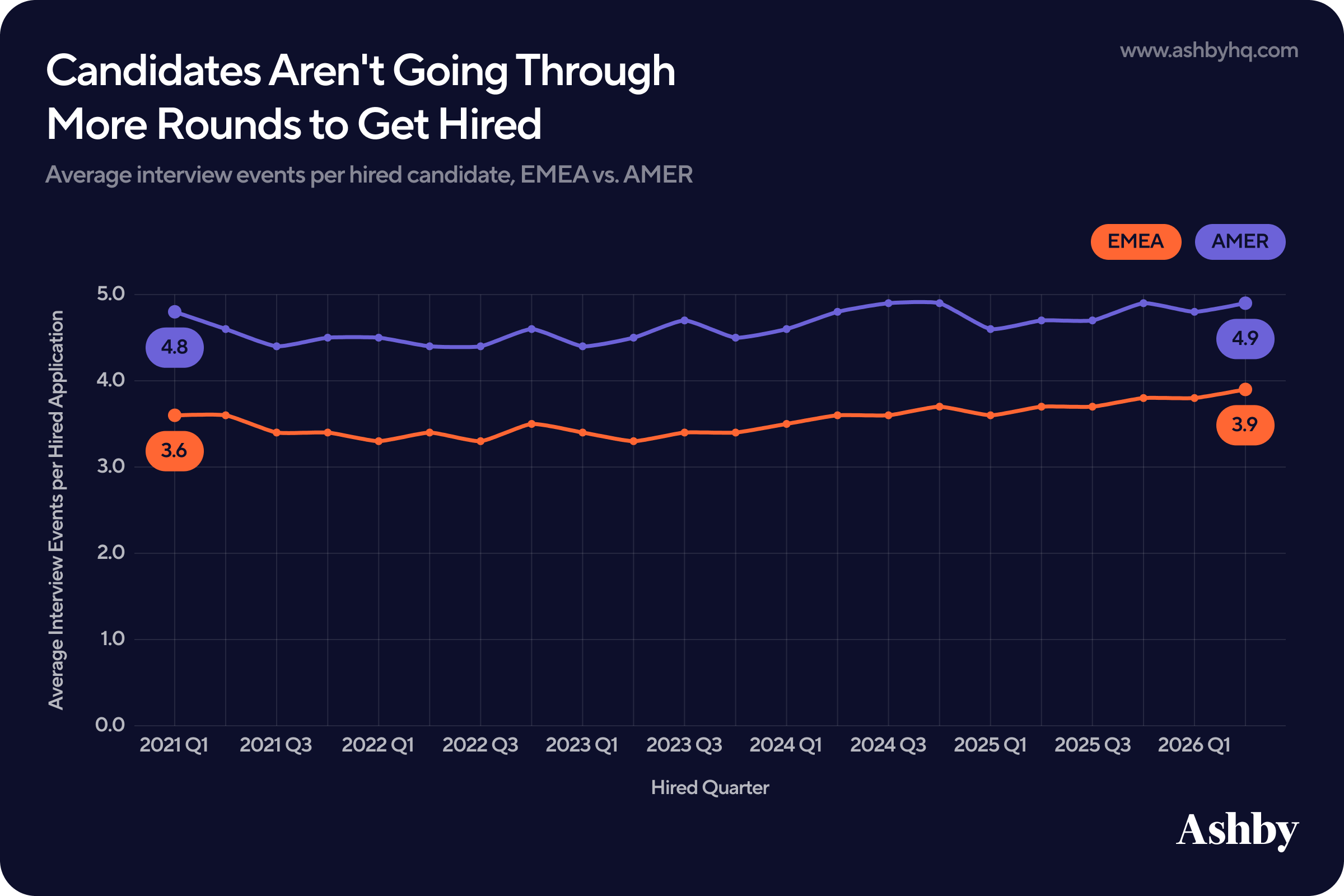
In addition to time spent interviewing, the number of interview rounds has also held steady.
- EMEA candidates went through an average of 3.6 interview events in 2021.
- By Q1 2026, that number has only ticked up to 3.9.
Combined with flat interview hours, this reinforces the same point: The structure of the hiring process, not just its length, has stayed consistent for candidates even as the surrounding market has intensified.
Taken together, these four metrics again emphasise that the EMEA candidate experience has held remarkably steady. That said, important nuance exists before a candidate enters a hiring pipeline. In speaking with Amanda and Sam, we found that more effort is going into the application stage itself, through pre-screening assessments and more intentional application questions, to help recruiting teams find signal through the noise.
"What I'm hearing anecdotally from candidates on the market is that a lot more companies are requiring intense upfront assessments. So the number of rounds might look the same, but the content within those rounds is shifting. There's more being asked of candidates even if the round count hasn't changed."
— Amanda Johnson, Head of Global Talent Acquisition, DeepL
III. Hiring Velocity
With understanding from both the recruiter and candidate experience, we'll next turn to hiring velocity: How long does it take for EMEA talent teams to fill a role?
The metrics in this section include:
- Time to Hire (Average Days to Hire): the average number of days between when an application is received and when a hire is made
- Time to Hire Distribution (Cumulative % of Hires by Time to Hire): the share of hires completed by a given number of days since application
- Time to Hire, Median and Interquartile Range: the midpoint of days to hire, along with the typical fastest and slowest quartiles of hires
Time to Hire has held steady in EMEA
Even with the varying changes in the hiring market, Time to Hire in EMEA has held consistently in the 37–43 day range since 2021. Recruiting teams have absorbed more work at every stage of the funnel without a cost to the business. Even with more time reviewing applications and more time interviewing candidates, hiring managers aren't waiting any longer to fill open roles.
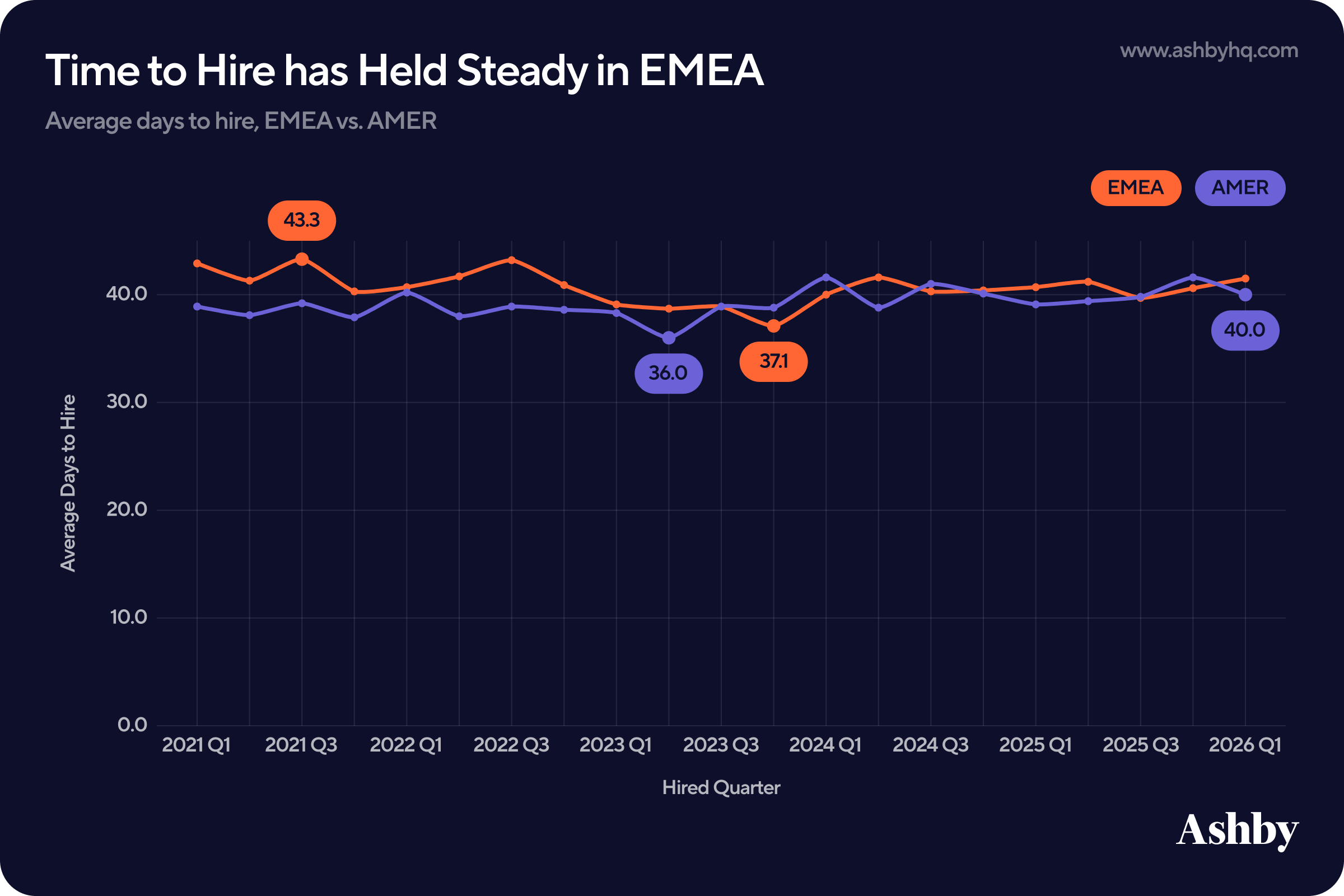
Célia sees the same consistency at Moss, where Time to Hire has held at 35–36 days — even as her team has faced a real headwind working against it. Final interview conversion rates at Moss have dropped sharply, from roughly 75% a year ago to around 50%, as hiring managers raise the bar on things like AI fluency.
That kind of drop could easily stretch out a hiring timeline; instead, Célia points to specific process changes that have kept Time to Hire steady anyway:
"A lot of what drives our consistent Time to Hire has been helped by automated scheduling and automated reminders, which was not possible for us before Ashby. We give candidates three chances through reminders to book a time, then archive them. This keeps aging candidates from just sitting in the pipeline. We've also consolidated stages, so even if a role technically has seven interviews instead of five, we group them into fewer formal rounds."
— Célia Sauthier, Director of TA, Moss
Time to Hire timelines track closely between EMEA and AMER
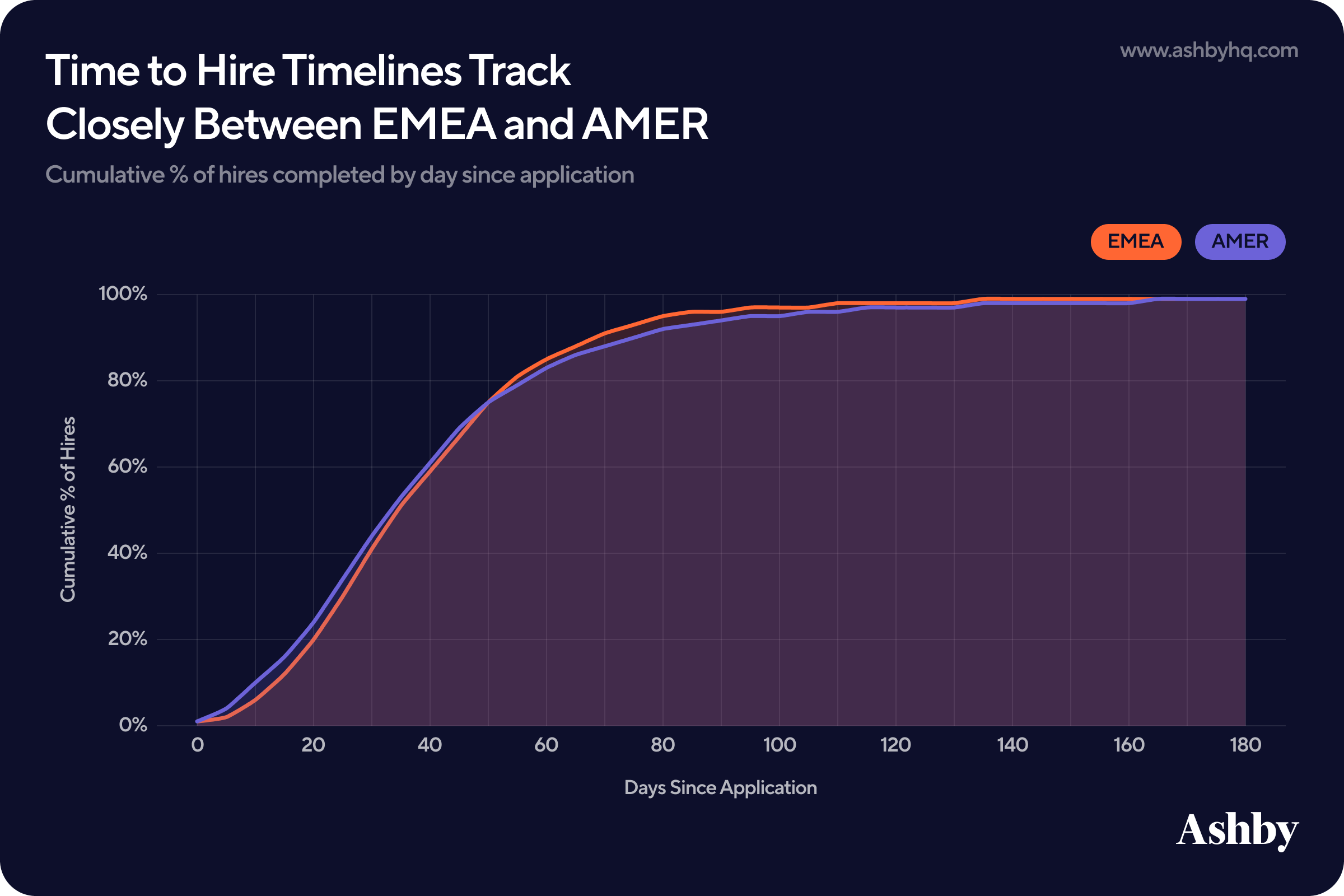
Looking at the cumulative distribution of Time to Hire in the past year, EMEA and AMER follow a strikingly similar curve. Half of all EMEA hires are made within 35 days, just one day behind AMER's median of 34.
That said, AMER does appear to move slightly faster in the earlier part of the process. By day 30, for example, AMER has filled a higher share of roles than EMEA has. The two regions converge by the time you reach the 50-day mark, where both land at the same 75th percentile.
How to read the chart below: Pick any value for Time to Hire on the x-axis (e.g., 40). From that point, go straight up until you hit the line. That is the percent of hires that have been hired at that point or faster. In this case, ~59% of hires in EMEA have a Time to Hire under or equal to 40 days. Since AMER tends to be to the left, that means that AMER's advantage in Time to Hire is consistent early on.
It's sometimes helpful to see this data instead in plain days. In the past year, we see the following:

In other words, the typical EMEA hire takes 35 days, just one day longer than AMER's 34. Even at the edges (the fastest quarter of hires and the slowest quarter), the two regions are only a day apart. One area this data doesn't capture is how long it takes a hire to actually start their new job. Sam noted that Time to Start tends to run meaningfully longer in Europe.
"I'll see a new Product Engineer get hired in the U.S. at Ashby and see their start date is a week later and think, oh wow, that's fast! In Europe, the common notice period for existing roles is often between one and three months. On top of that, the notice period in some cases doesn't begin until the first of the following calendar month, so if you share you're taking a new job on July 15, the one-month notice period would start August 1. We'll see candidates in Spain with a two week notice period and others in Germany with three months, which means keeping engagement through that gap becomes just as important as closing the offer."
— Sam Wright, Technical Recruiter, Ashby
IV. Sourcing and Candidate Origin
Finally, we looked at what sources hires are actually coming from and how that mix has shifted over the past five years.
Agency reliance has declined, and inbound dominates hiring in both regions
Sourcing patterns in EMEA and AMER have converged over the past five years. Inbound applications have grown steadily as a share of hires in both regions, and by Q1 2026, they account for more than half of all hires (54.3% in EMEA, 51.9% in AMER).
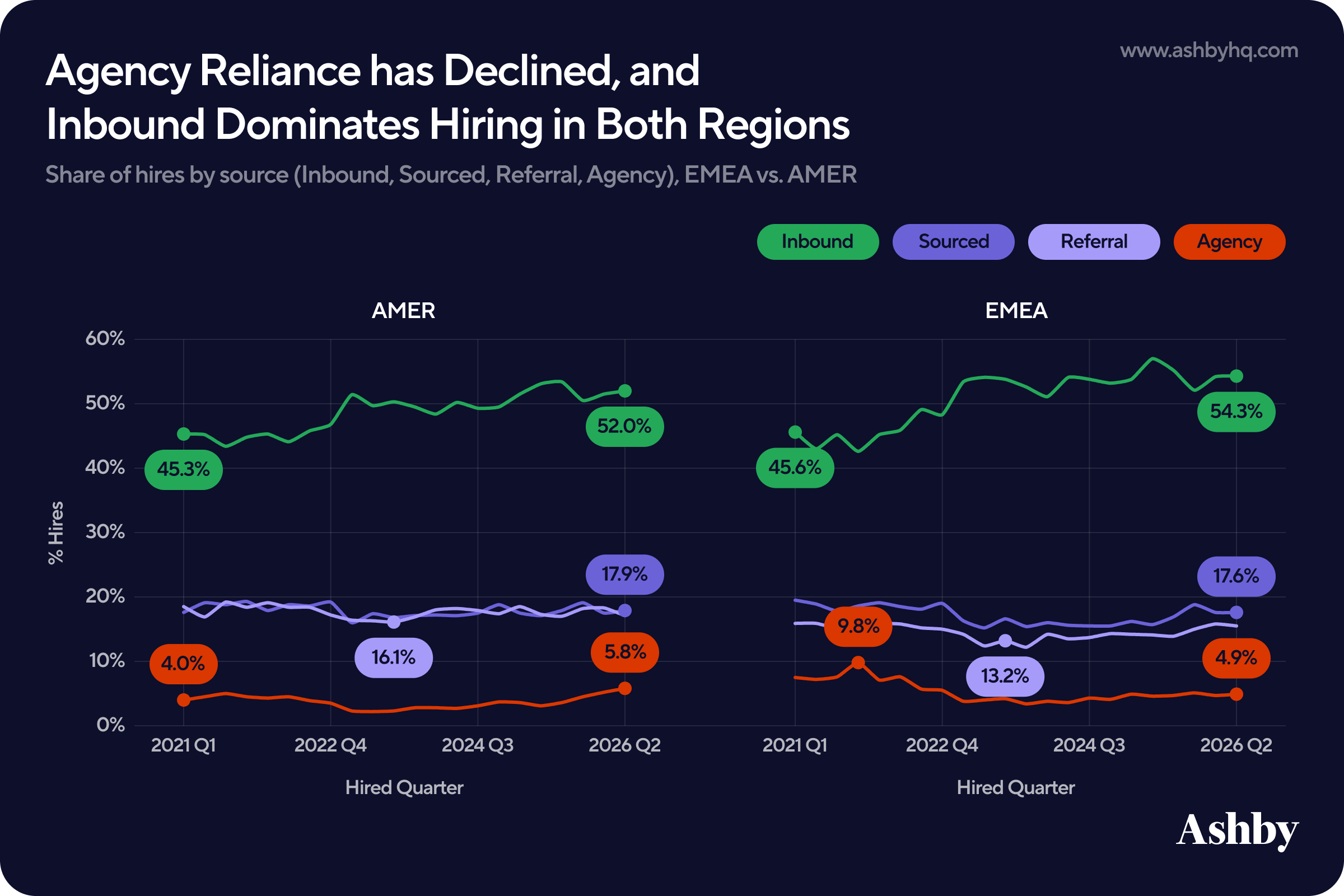
The bigger differences are in agencies, referrals, and sources.
- Agency-sourced hires in EMEA have declined. As recently as 2021, agencies accounted for as much as 9.8% of EMEA hires. That share has fallen steadily since, settling around 5% by Q1 2026, roughly half its earlier peak.
- Referral hires make up a slightly smaller share of hiring in EMEA than in AMER. EMEA has consistently relied on referrals slightly less than AMER throughout the period, a gap that has held steady rather than closing.
Amanda also pointed to geography specifically as a reason referrals are harder to come by in EMEA than in the Americas.
"Referrals are a bit harder in EMEA than in the U.S. In the U.S. you can refer across state lines easily. In EMEA we're spread across different countries and languages - if your whole team is in London, referrals come naturally, but once you're scattered across five or six countries, it becomes more challenging."
— Amanda Johnson, Head of Global Talent Acquisition, DeepL
Across every part of this analysis (recruiter workload, the candidate experience, hiring velocity, and sourcing), a single pattern kept surfacing: EMEA talent teams are operating in a market that looks a lot like the one we described globally.
Applications per hire have doubled since 2021. Recruiters are screening more candidates and conducting more interviews to reach each hire than they were a few years ago. And yet, hires per recruiter have climbed rather than stalled, Time to Hire hasn't budged from its 37–43 day range, and the candidate on the other side of that process is spending no more time in a hiring cycle than they were five years ago. More work has clearly landed on recruiting teams while they continue to meaningfully serve the business.
Other Reports

Offer Acceptance Rates | Talent Trends Report
We analyzed Offer Acceptance Rate (‘OAR’) patterns over a three year period to share valuable insights and benchmarks for talent teams.

Quality of Hire | Talent Trends Report
73% of new hires exceed expectations, and first impressions rarely change. See what 35,000+ Quality of Hire scorecards reveal about what makes a great hire.

Subscribe for more talent trends and insights
We will be regularly releasing new reports around trends and insights we're seeing in our data and you will be the first to know.