Introducing Ashby People Workflows
Melissa Bierly, Senior Product Manager at Ashby, introduces Ashby People Workflows, an engine for automating onboarding orchestration. Laura Barnes, VP of Talent at Flock, shares how her team used it to cut background checks from days to minutes and save 20 hours of manual work a week.
Speakers

Key Takeaways
-
Onboarding does not need to be fully automated to recover significant time: getting to roughly 90% automated, with 10% deliberately left to human judgment, is enough. Using Ashby People Workflows, Flock built toward that ratio and now saves about 20 hours of manual work a week.
-
Manual pre-boarding steps tend to stack delay across separate systems and handoffs. Flock's background check process ran 48 to 72 hours through manual data entry into Rippling; tying it directly to a signed offer in Ashby cut that to minutes.
-
Recruiters are often a new hire's most trusted relationship from the hiring process, which makes them a natural fit to carry that relationship through onboarding. Flock's recruiters now split their time roughly 75/25 between recruiting and new hire success.
-
Measuring new hire experience alongside quality of hire catches what manager-only feedback misses. Flock's new hire surveys track five themes (role clarity, manager effectiveness, enablement, connection, and impact), sent at one week, 30, 60, and 90 days.
-
Scaling onboarding across employee types works better as a small number of tailored workflows than one for every variation. Flock runs five: standard, international, warehouse and field, interns, and account executives, then layers filters and custom fields on top.
Session Overview
Hiring a great candidate does not guarantee a great employee if onboarding falls apart right after the offer is signed. Ashby built People Workflows to close that gap: an engine that automates onboarding tasks, communications, and stakeholder handoffs so a new hire's momentum from recruiting carries through to day one. Melissa Bierly, Senior Product Manager at Ashby, introduces the product, then Laura Barnes, VP of Talent at Flock, a public safety technology company that has scaled from about 100 to 1,700 employees, walks through how her team put it into practice.
Before People Workflows, Flock ran onboarding on multiple trackers and roughly 30 draft emails staged by day and reused across every hire, sent manually for the roughly 900 people the company hired in a single year. Rebuilding it meant automating pre-boarding steps that used to depend on manual handoffs between systems: a background check that used to route through PeopleOps and into Rippling by hand, and hardware requests that used to guess at a new hire's laptop instead of letting them choose.
Flock also rebuilt the hiring manager experience, which had gone mostly silent after a hire closed. Managers now get staged nudges through pre-boarding and a check-in schedule through the first 90 days, including green and red flags tied to specific milestones, plus a day-one message that hands over the new hire's 90-day plan. Recruiters stay the face of onboarding throughout, continuing the relationship they built during hiring.
Flock measures the result with new hire surveys layered on top of quality of hire, tracking five themes across the first 90 days so a strong manager review doesn't mask a disengaged new hire.
Chapters
- (00:02) The onboarding drop-off: why hiring wins don't always stick
- (02:22) Introducing People Workflows: an engine for automating onboarding
- (03:24) Flock: a public safety tech company scaling to 1,700 people
- (04:01) Flock's manual era: crazy trackers and 30 staged draft emails
- (08:56) Rebuilding pre-boarding: background checks in minutes, hardware without guesswork
- (13:18) Five onboarding workflows for five kinds of employees
- (15:47) Redesigning the hiring manager experience
- (19:46) Recruiters as the face of onboarding, and measuring beyond quality of hire
Q&A
Q: How can talent teams cut down on manual onboarding work?
A: Onboarding does not need to be fully automated to recover significant time: getting to roughly 90% automated, with 10% deliberately left to human judgment, is enough. Laura Barnes, VP of Talent at Flock, built her onboarding process in Ashby People Workflows toward that ratio and now saves about 20 hours of manual work a week.
Laura Barnes, VP of Talent at Flock: "Our goal was to get to a point where our onboarding journey could be about 90% automated and then have 10% still manual work where we wanted a human in the loop. And today we've been able to save about 20 hours of manual work a week." (05:23)
Q: How can you speed up background checks after a candidate signs an offer?
A: Tie the background check trigger directly to the signed offer instead of routing it through manual handoffs. Laura Barnes, VP of Talent at Flock, cut a process that used to take 48 to 72 hours, moving a signed offer through PeopleOps into Rippling by hand, down to minutes once Ashby automatically kicked off the workflow.
Laura Barnes, VP of Talent at Flock: "Today, what it looks like: now, when someone signs their offer letter in Ashby, they are automatically sent into the correct People Workflow, and then they are automatically sent their background check. It's like minutes, maybe even seconds. I honestly don't know how you get better than that. It's quite incredible. So that was a massive win for the business." (11:00)
Q: Why should recruiters own onboarding after the offer is signed?
A: Recruiters are often the person a new hire trusts most, which makes them a natural fit to keep going after the offer is signed. Laura Barnes, VP of Talent at Flock, restructured her team so recruiters spend about 75% of their time on recruiting and 25% on new hire success, continuing the relationship that helped close the offer.
Laura Barnes, VP of Talent at Flock: "I find recruiters are already viewed as that new hire's first friend, right? You're their confidant, you're that person that they trust. I cannot tell you how many times, I think, when we got to offer close, that a candidate chose Flock because of the relationship they had with you. So naturally, continuing that relationship just makes so much sense." (06:44)
Q: What should new hire surveys measure?
A: Laura Barnes, VP of Talent at Flock, tracks five themes in her new hire surveys: role clarity, manager effectiveness, enablement, connection, and impact, sent at one week, 30, 60, and 90 days. That lets her diagnose which part of onboarding is slipping, rather than watching one overall score.
Laura Barnes, VP of Talent at Flock: "With our new hire surveys, we are tracking five key things: role clarity, manager effectiveness, enablement, connection, and impact." (22:52)
Q: How do you build onboarding workflows for employees in different roles or countries?
A: Map the real differences between employee types before building separate workflows for each one. Laura Barnes, VP of Talent at Flock, runs five: standard, international, warehouse and field, interns, and account executives, then layers team and department filters and custom fields on top rather than building a workflow for every variation.
Laura Barnes, VP of Talent at Flock: "Today we've landed at five workflows: we have a standard one, we have one for our Finnish employees, one for our warehouse and field employees, one for our interns, and then we also have one for our account executives, that was built in conjunction with revenue enablement." (13:58)
Melissa Bierly (00:02):
Hi, welcome to From Great Hires to Great Employees: Scaling Onboarding with People Workflows. I'm Melissa, and I'm a senior product manager at Ashby. And later I'm going to be joined by Laura Barnes, VP of Talent at Flock.
A little bit about what to expect. First, I'm going to talk a little bit about what People Workflows is and why we built it into Ashby. And then we're going to put it into practice with a Q&A with Laura, to share how she's approached onboarding since becoming a People Workflows design partner.
Have you all heard a story like this? There's an excited new hire who went through a really engaging recruiting process, but it all kind of falls apart after that. They haven't heard from their manager, they can't log into the systems they need, they don't even have their laptop — everything is just not working out.
This was a chance for us to get the new hire excited as an official employee, but we've already lost them. For a lot of teams, unfortunately, this story doesn't sound too unfamiliar. Onboarding is where the new hires that you worked so hard to acquire are activated, but usually it's lacking that considered approach that we see during the hiring process. It's your first opportunity to get new hires engaged, successfully ramped, and to ultimately retain them. It's a critical extension of hiring.
So if onboarding is important, why are we not doing it well? Well, onboarding is hard to manage. There's a ton of manual work, particularly if you're scaling across countries, departments, teams, regions. It's hard to even understand what's happening, let alone make it excellent.
The teams I've talked to are usually working with this Frankenstack of spreadsheets and emails and Slack pings. Everyone's trying to figure out where everything is and what's going on. And that means things get delayed or missed, and that's a missed opportunity for us to successfully activate that new hire and continue the great experience they had during the recruiting process. And that's why we added the People Workflows add-on.
Alongside Quality of Hire, it helps you ensure that you close the loop that you started with an excellent hiring process.
People Workflows is a workflow engine that helps you automate onboarding. So it handles the orchestration of tasks, communications, and stakeholder coordination that's happening behind the scenes. And for the new hire, they don't know that this coordination is happening, which is a good thing. All they know is that they have what they need and they know what they need to do. It's a seamless experience. And this frees you up to not just complete onboarding, but to make it incredible.
We are currently working with over 25 design partners to ensure that this product is delivering what we built it for. And one of those design partners is Laura Barnes, VP of Talent at Flock. Instead of a demo, we thought it would be great to bring up someone onto the stage who can actually talk about how she's been strategically thinking about onboarding and putting it into practice using People Workflows. So, Laura, please come up!
All right, so Laura, could you first tell us a little bit about what Flock is and what you do there?
Laura Barnes (03:24):
Flock is a public safety technology company. Today we solve about 20% of crime in America, and we've returned over thousands of missing people back to their families. So it's extremely impactful work, it's really exciting, it's one of the reasons I've been there for five years. Like Melissa said, I joined as their founding technical recruiter and then grew into a VP of Talent, and I've been able to see it go from about a hundred to seventeen hundred people. Been a fun ride.
Melissa Bierly (03:53):
Can you give us a quick picture of what onboarding looked like before you had People Workflows at Flock?
Laura Barnes (04:01):
Extremely manual, like probably most people in this room I have to imagine. I have to shout out my broader people team who was handling it — it's insane the amount of work those people put into it. It was crazy trackers, we organized it by draft emails. We would have like 30 draft emails for all the hires, ready to go and staged by day — absolute insanity, but somehow they managed to stay organized, efficient, and put on this massive production. And the new hires had no idea that we were panicking.
But to put it lightly, we hired about nine hundred people last year. So just think about the amount of time, effort, energy — every email, every reminder, every spreadsheet, every calendar invite that was manually sent by a person. That's crazy.
When we got to sit down and actually think about redesigning onboarding for the first time in a long time, the first thing I wanted to do was build something that captured the amount of love and dedication that our team was already putting into this, but build it around an infrastructure that was based on automation. Our goal was to get to a point where our onboarding journey could be about 90% automated and then have 10% still manual work where we wanted a human in the loop.
And today we've been able to save about 20 hours of manual work a week.
Melissa Bierly (05:23):
That's a lot. That's a lot. I think in some companies it might seem a little strange for talent to own onboarding. So I'm curious why you decided to raise your hand to do that.
Laura Barnes (05:35):
Like most startups or companies in general, you're going to go through periods of growth and periods of focus, right? So clearly last year was a massive growth year for us with all the hiring we did. Going into 2026, we knew it was going to be a focus year. I knew that we weren't going to hire as many people. I went to my chief people officer and I was like, hey, we have a really great team. Instead of doing the natural thing most people do, where they let them go, I was like, let's refactor their job. Let's sit back and actually think about how do we make the job more impactful and more strategic.
Today our recruiters spend about 75% of their time still focused on recruiting, and 25% of their time actually focused on new hire success, which has been a really awesome transition for us to go through. And if you think about it too, in general, I find recruiters are already viewed as that new hire's first friend, right? You're their confidant, you're that person that they trust. I cannot tell you how many times, I think, when we got to offer close, that a candidate chose Flock because of the relationship they had with you.
So naturally, continuing that relationship just makes so much sense.
Melissa Bierly (06:44):
And then for folks who know that their onboarding needs some improvement — where would you suggest they start it? Where did you start?
Laura Barnes (06:53):
Hopefully you do it before you're 1,700 people — major regrets over here. Onboarding is very complicated. When I raised my hand for this project, I thought it was going to be really fun and easy. I was proven quite wrong. There are way more cross-functional partners involved in onboarding than you probably even realize today.
I feel like I still honestly find some, every week, coming out of the woodwork, and I'm like, my God, wait, shit, you want that? Okay, we'll build it for you, no problem.
So what you should do: go and meet with all of those people first, right? Get a list of your stakeholders, set a meeting, go talk to them about everything they're doing — what sucks, what's painful, what do they like. And then what I usually do is pull out Lucidchart, a Google Sheet, whatever your favorite tool is. Make that list, and then in that list write down who owns everything, what's the context behind it, is it manual today or is it automated. And what I personally like to do is, all those big pain points, really terrible manual things, I put a big red mark on it. And those are the first things that I want to go and tackle when I'm thinking about onboarding.
Because since it's such a massive cross-functional project, the only way to get people to want to go on that journey with you is to create buy-in. You create buy-in by solving their problems. So if you can remove those massive blockers and roll out small enhancements where that one team goes, oh my God, I just got hours back, I don't have to think about that — suddenly they're going to want to help you when you want to shake up their current process and do something new. That's definitely where I would start.
And then get to a point where you're getting to that 90% automation, right? Because there's always going to be an aspect of onboarding that has to be manual. Think about maybe a failed background check, right? That's super sensitive. You probably want a human in the loop. There's other situations for Flock too, where we have to do motor vehicle record checks — unfortunately our vendor is not very modern, so that will just never be automated for us. So that 10% you're just stuck with. But if you can get ninety percent there, which we're doing with Ashby today, that's a massive, massive win.
Melissa Bierly (08:56):
So I know from some of the conversations we've had, as well as you being a design partner, that you identified the pre-boarding process — so, before the start date — as a prime opportunity for improving. Can you talk a little more about that?
Laura Barnes (09:10):
Yes, of course. Pre-boarding is the most logistically taxing thing that exists. It is so cross-functional, it is so nuanced. And it is also the first time that your new hire is experiencing a company process as an employee. You want to get that right — it's embarrassing when you don't.
When we were sitting back and thinking about it, I could probably spend honestly an hour right now going through every single thing we've changed. I'll focus on two, and you can always grab me afterwards if you want to noodle on the rest.
First one for us is background checks. Historically, how we did background checks at Flock: our candidate would sign their offer letter in Ashby. We would then have an automated report that went to our PeopleOps team three times a week with all of the offer details. They would receive that report, have to go into Rippling, manually create that employee's profile, invite them into Rippling. The employee would then have to sign up for Rippling, get into Rippling, sign some documents, and eventually initiate their background check. This process was taking somewhere between forty-eight to seventy-two hours.
Which — if you own onboarding today, you probably realize that every second actually counts during pre-boarding, especially when you're trying to get someone through all that pre-screening so you can actually honor their start date. Nothing's worse than pushing a person. Today, what it looks like: now, when someone signs their offer letter in Ashby, they are automatically sent into the correct People Workflow, and then they are automatically sent their background check. It's like minutes, maybe even seconds. I honestly don't know how you get better than that. It's quite incredible. So that was a massive win for the business.
The other one that comes to mind for me is hardware requests. Historically, how we did that at Flock is, we actually didn't let new hires choose the hardware or laptop they wanted — we just provided it to them. And how we were able to manage that is, we had this gnarly spreadsheet of all the teams inside of Flock, and we've gotten so big that the list is really scary. And then each team had the laptop we assumed that they would need.
Eighty percent of the time, we probably got it right. But that 20% — think engineering, think FP&A — we would be sending them a Mac, they would go in on their first day... your new hire's probably nervous, they're not going to tell you, I hate my laptop. So generally they get like two weeks in and they're finally, I work here now, and they're like, I hate this laptop, I want a new one. And of course, we are a wonderful employer, so we were like, yes, we will send you a new one. But that is horrible, right? That is — now my IT team has to go and reconfigure a whole new laptop, new hire has to ship back their old laptop, receive the new laptop, and then reset up all of your passwords, which — all of us have gotten new laptops and phones, that is a nightmare. That has also lost productivity.
Now, today, with Ashby, what we have redesigned is: we now have a tiered approach to our laptops, and our new hires are able to request the hardware that they want. So we have about five tiers, which is kind of ridiculous, but for us it makes sense — like, our mechanical engineers use a 10K laptop, it's crazy, but we want to make sure they can have it. So each of the new hires gets to pick what is best for them. And then it is automatically sent to either our IT team or our third-party shipping partner, and then they handle getting the laptop correctly to the new hire on day one. Now we don't have that issue, we don't have to spend extra time, we don't have to have people shipping them back. And people are really thrilled on day one, without feeling that weird resentment they used to have.
Melissa Bierly (13:00):
Now, another thing that makes Flock a little unique is that you have different types of workers. So you have workers who are in the field, starting installing security cameras, and then you have employees who are in the office, and then you have employees who are in the United States, and employees who are not in the United States. So how do you manage that?
Laura Barnes (13:18):
We're very complicated, we don't like to be easy. Like she said, what we've kind of done is look at all of the different employee types that exist inside of Flock, and started mapping out what is that person's onboarding journey, where are the changes between those groups. And today we've landed at five workflows: we have a standard one, we have one for our Finnish employees, one for our warehouse and field employees, one for our interns, and then we also have one for our account executives, that was built in conjunction with revenue enablement. What's nice about this is Ashby gives you so much flexibility to actually sit back and say, those people do need something different.
If you think about it: our field employees do not receive the same benefits, nor do they go through the same pre-screening requirements as our standard employee. Our Finnish employees do not receive the same benefits or go through the same pre-screening requirements as our standard or field employees. Our interns experience Flock on a very condensed 12-week basis, so their journey is vastly different. And then our regional account executives — they have revenue enablement and all their training that goes into it, so their onboarding is vastly different from everybody else's. But now we're able to cater to each unique one, making those people feel like their experience is super personalized.
Now, the thing I will leave you with here is: you don't want to go absolutely berserk building out 17 workflows — you will hate yourself for it. You definitely want to have that mindset of set it and forget it, right? That's the point of automation. "Standard" probably sounds super misleading. But inside of standard, Ashby's fantastic, and you're actually able to filter by team and department. So I can make sure that engineers are receiving different messaging than maybe someone in marketing. You can also build custom fields. So for us, we do orientation every other week, so we have on-cycle and off-cycle start dates. Depending on which one you're in, I make sure that you get the right messaging to know when you're going to orientation, what your schedule looks like.
It's all extremely personalized, without me actually having to give any thought to it.
Melissa Bierly (15:28):
I know another thing we talked about that really stood out to me was your focus on the hiring manager experience, and how that changes from recruiting over to employee. I was wondering why you decided to focus there, and what it's like with Ashby now.
Laura Barnes (15:47):
We didn't really have a hiring manager experience. And that's a bummer, right? Because they're coming from just hiring this person — with recruiting, you're probably doing weekly syncs, you probably Slack them way too much, you know every single thing about that human, right? They're having this high, they've just made this hire, and then it was crickets. That sucks.
When we finally sat down and started thinking about, okay, let's actually make it good for them — what first came to mind for me was actually thinking about all of our manager types. So at Flock, and probably at most of your companies too, you have first-time hirers at your company, you have first-time managers in general, you have hiring managers who maybe hire three or four times a year, and you also have some people who may onboard 20-plus people. Each person's onboarding muscle is actually quite different across your entire workforce. And another thing I realized is managers don't really like asking for help — it's awkward, they want to look competent, right?
We sat down and first built out what is our standard workflow for a manager. So, during pre-boarding, we now tell them, hey, your candidate just signed. We also let them know when they're cleared to start — so they've passed all their pre-screening requirements. We message them again when they're one week out, and we message them again the day before a hire starts. Now, what's really fun about our one-week-out messaging is we actually baked in two really cool things: one, we love 90-day plans at Flock, so we ask them to submit their finalized 90-day plan at that moment. And we also ask them, would you like extra support? It's entirely optional, but it puts the ball in their court to not have to awkwardly ask you for help. But now, no matter where they are in their journey as being a manager, they can opt in, they can opt out, and then they're going to receive the correct journey as we go into onboarding.
Onboarding for us, kind of what that looks like, is: on day one, I have a SOBO message that goes from the hiring manager to the new hire and delivers the 90-day plan. I love this, because let's say your hiring manager just refused to give it to you — well, they just sent a broken link to their new hire, and their new hire is going to ask them for that 90-day plan. So they've got about three hours to scramble and deliver it. That's called reinforcing your culture. We love that — a little light shaming is always good, in a very friendly way.
And then we also check in with them with a two-week experience survey. And then we also follow up with a 30-day, 60-day, 90-day nudge to let them know, hey, your new hire is hitting these big milestones. And what's awesome about that is, in that nudge, we provide them — hey, here are green flags, so this is what your person should actually be achieving by this point in time. And here are red flags, and here's what to do if you're experiencing red flags right now. Because how many of you have gotten to the point where it's 90 days in, your hiring manager is now like, I hate this person, I want to fire them, and you're like, where is the documentation? It's non-existent. So now we're baking in ways to actually get them to start documenting and having those conversations earlier, when those mis-hires do happen. So it's been really fun.
But if you think about the other journey we have, which is the extra support journey — kind of what that looks like is, we also help them with, how do you hold a daily stand-up when your new hire gets there the first two weeks, what does that look like. How do you go and transition to an actual one-on-one — even though they're employee-led, what should you still be getting out of it as a manager? What are your responsibilities as the manager versus the new hire coming into this relationship? And just so much more coaching, and it's fed to them at the appropriate moments in the sequence, and they don't ever have to reply. We can act like it never happened, but we now know that they're actually receiving the coaching that they want and need, when it's the right time to deliver it.
Melissa Bierly (19:33):
On a similar note — I think we've talked about it a lot, but the experience for the new hire, from the point of recruiting and then into the employee experience, there can be a big drop-off. So I'm curious about how you've been managing that with Ashby.
Laura Barnes (19:46):
I was a recruiter not too long ago, and I still work [reqs], so I love my candidates deeply. And I find, you know, recruiters should own it. You have this beautiful relationship, and like I said earlier, a lot of times, the recruiter is the reason someone joined your company. That's incredible.
When we were sitting down and really thinking, how do we continue to capture that magic and make it really go into the onboarding side — we were like, the recruiter should be the face of it. At Flock, we don't have a formalized buddy program like a lot of other companies do — it just didn't work for us. Instead, we've kind of injected our recruiter into that role. All of our automated messaging that starts from, you've entered into our funnel as a candidate, all the way out to the program-end message at 90 days, all comes from your recruiter. And it's all written and tied back to our employee value proposition. So it feels extremely Flock, it feels extremely authentic. You, as the new hire, are so freaking excited, because your recruiter, your best friend, your first friend, is checking in with you on all these big milestones as you go through those 90 days, and they're rooting for you.
We're teaching you how to go and have that 30-day conversation with your manager, we're providing you a guide. We're teaching you how to go and build your working-with-me doc, we're reinforcing the culture, we're holding your hand, we're teaching you about our ERGs, our Slack groups. It feels really natural, and it's been a super cool transition to put in place.
Melissa Bierly (21:14):
You've talked pretty extensively about Quality of Hire in Ashby, kind of the poster child of Quality of Hire. How are those different than Quality of Hire?
Laura Barnes (21:33):
New hire surveys are the missing puzzle piece to Quality of Hire — that is how I would sum it up. Last year, if you did see my talk, I definitely alluded to wanting this V2 model, right, where you had the new hire perspective and you had the manager perspective. And what's really cool with this tool that Ashby's built is, they're giving you that V2 right now. It's yours, go and take it. You now have both perspectives, and you can put it together as a talent team. That's incredible. And that used to be something that you couldn't go and do on your own — you would have to collaborate with HR. Like I said, the lines are getting a little blurry these days, which is kind of fun.
With our new hire surveys, we are tracking five key things — and I'm going to read them off the sheet of paper, otherwise I will forget one. So for us, it's role clarity, it's manager effectiveness, it's enablement, it's connection, and it's impact. And ideally, as we send these surveys — at one week, 30 days, 60 days, and 90 days — we want to see those five themes keep trending upward. That's really important to us. And maybe they stay consistently high — some new hires come out the gate and they're tens across the board, then we want to keep that ten energy going. We want them to love every second of Flock.
But now we're really able to go in and start analyzing — okay, for some reason enablement is dropping, that probably means there's something in our pre-boarding, or how we're getting people ramped into the role, that's not working. Let's actually go and diagnose that. I would definitely encourage you, as you're setting up these surveys, think about those five things that are really important to your company, put them into place, and start analyzing that data. And then when you're bringing it back alongside Quality of Hire, now you actually have both sides of the puzzle, right? You get to tell this really beautiful story about whether this hire was actually a quality one, not just from the manager's perspective, but also from the new hire's engagement with your company?
Melissa Bierly (23:26):
I remember a conversation we had where you said, if the manager loves the new hire, but the new hire hates it here, that's not a good hire.
Laura Barnes (23:35):
It's a terrible hire. They're gonna quit.
Melissa Bierly (23:37):
Yep. You didn't do your job.
Laura Barnes (23:38):
Yep.
Melissa Bierly (23:39):
Okay, so last question for you — what would you say to a recruiting team that's not sure if they should handle onboarding?
Laura Barnes (23:47):
Yeah, it can be extremely weird putting yourself out there, and especially asking for something that historically has not been owned by talent, right? We're kind of entering this new era, and to bring AI back into it, the lines are blurred. You have a really unique opportunity to actually go out there and position yourself as a very strategic recruiter.
We're probably all already doing so much with Quality of Hire. You probably want to do more than just report on it — don't you actually want to action on it? I do. I would encourage you to go back to your companies, start seeing how can you bring it into the role, how can you start having those conversations, how can you actually inject yourself into these conversations about new hire success? Because I think that's where the future of talent is going, and we all want to be on that ship, right? So right now is your time. Reach up and grab it. Go make yourself more valuable at your company, stop being viewed as a role filler, and jump into this really strategic position. It's super exciting.
But do be warned, onboarding is very complicated — I've definitely got my ass handed to me a few times, but I have enjoyed every second of it, and it's honestly made me better at talent acquisition as a whole.
Melissa Bierly (25:01):
Thanks so much, Laura. Let's get a big hand for Laura Barnes, please.
And if any of you are interested in People Workflows, I've got my QR code again, which you can get on the waitlist. We're rolling it out throughout this year as we approach general availability. And Laura and I will be milling around here, so if you have any questions, please come find us. Thank you.
Recommended Sessions
Onboarding at Scale
Abe Spahn, Sr. Director, Head of People Strategy and Talent Acquisition at Renuity, took onboarding for thousands of frontline hires from 120 emails a week, to a webhook into Airtable, to one connected flow from Ashby Recruiting through Ashby People Workflows into ADP. His test for onboarding at scale is whether the team can see a stuck candidate in time to help.
View session
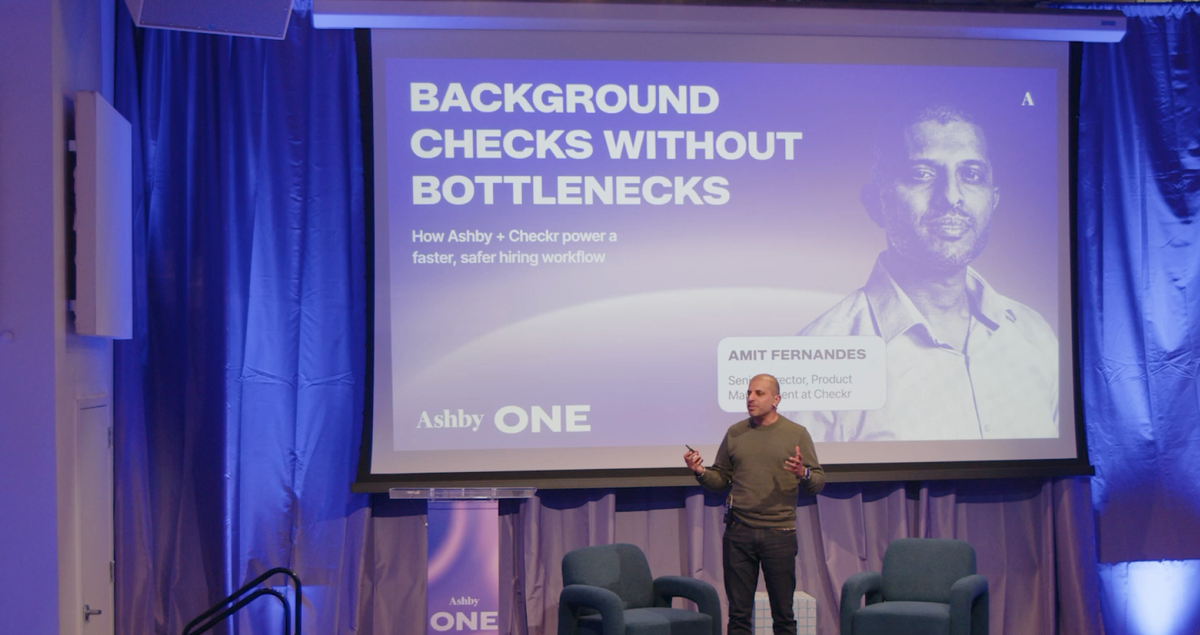
Background Checks Without Bottlenecks
Checkr's Amit Fernandes shows how Ashby and Checkr connect background checks directly to the hiring workflow, so recruiting teams get automatic status updates, verified identity at the start of the process, and a hiring decision as soon as results are back, without leaving Ashby.
View session