Using Data to Influence as a Solo TA Leader
Emily Paik, Senior Recruiter at Kit, turned a one-person recruiting function with no data owner into a dashboard-backed operation using her Flow, Focus, Friction framework, cutting time to hire from 45 to 29 days and lifting candidate experience and quality of hire along the way.
Speaker

Key Takeaways
- Asking what data a recruiting function actually needs, rather than what data already exists, is what turns scattered reporting into decisions made with confidence. That shift is what let Emily Paik, Senior Recruiter at Kit, replace manual reporting with a shared recruiting dashboard in Ashby.
- Diagnosing recruiting problems works best as a repeatable loop: identify the pain, review the data, test a change, then measure the outcome. That loop is the core of the "Flow, Focus, Friction" framework Emily Paik, Senior Recruiter at Kit, built to run recruiting as a team of one.
- Tracking exactly where candidates drop off, in time in stage and pass-through rates by stage, shows where to focus on cutting time to hire. That's what led Kit to automate scheduling and add AI-assisted application review in Ashby, taking time to hire from 45 days to 29 in about six months.
- Tracking quality of hire alongside hires by source turns sourcing spend into a testable hypothesis with a concrete goal attached. Kit used that data to set an OKR for four of ten hires from top-performing sources, and reported quality of hire consistently above 4.2 out of five as a result.
- At Kit, interviewer burnout traced back to open roles and interview load that weren't tied to real business need. Expanding the interviewer pool and setting explicit target hire and start dates together raised the percentage of on-time hires and relieved that pressure.
Session Overview
Emily Paik built Kit's entire recruiting data practice alone, and used it to become a true strategic partner to the business. As the sole recruiter at the email marketing platform for creators, she started with no dashboards, no KPIs, and no clear owner of data, and a manual reporting process that took six-plus hours and returned zero ROI.
The turning point came when Emily stopped asking what data existed and started asking what data the recruiting function actually needed to support the business. She built a recruiting performance dashboard in Ashby, defined Kit's KPIs for the first time, and set real goals the business could track against. Within about six months, candidate experience, quality of hire, and time to hire all improved.
To diagnose where to focus next, Emily uses a framework she calls "Flow, Focus, Friction." Flow covers speed and delivery, focus covers where time and sourcing spend go, and friction covers burnout and overload. For each, she runs the same loop: identify the pain, review the data, try something, then measure the outcome.
When a third of Kit's engineering team turned over in a single year, Emily built a dedicated engineering hiring dashboard so she could partner with those leaders directly on priorities, pipeline, and when to open roles, rather than giving ad hoc updates and hoping they landed.
That shift, from reporting on recruiting to diagnosing it, has expanded Emily's role at Kit beyond hiring into broader people ops work.
Chapters
- (00:05) Introduction: why a self-taught recruiter is on the RecOps track
- (01:03) Starting from zero: no RecOps, no KPIs, no owner of data
- (02:27) The old process: six-plus hours of manual reporting, zero ROI
- (03:44) The shift: building a recruiting performance dashboard in Ashby
- (04:57) A focused dashboard for Kit's highest-stakes hire: engineering
- (05:39) Introducing the Flow, Focus, Friction framework
- (06:07) Flow, Focus, and Friction in practice, with results
- (09:38) From reporting to strategic partner, as a team of one
Q&A
Q: How can a solo recruiter build a data-driven recruiting function without a dedicated RecOps team?
A: A solo recruiter can build a data-driven function by starting with an automated dashboard instead of a full RecOps team. Emily Paik, Senior Recruiter at Kit, replaced six-plus hours of manual, calculator-based reporting with a shared Ashby dashboard, then used it to grow her scope into broader people ops work.
Emily Paik, Senior Recruiter at Kit: "Not just reporting on recruiting, but actually diagnosing it. Recommending changes, connecting headcount decisions to business outcomes. The best part is that my scope is expanding because of it. I'm now taking on broader people ops work, not despite being a team of one, but because of what I've been able to build as a team of one. You don't need an entire RecOps team to do this if you don't have one." (10:06)
Q: What is the Flow, Focus, Friction framework for diagnosing recruiting problems?
A: Flow, Focus, Friction is a diagnostic loop, not a checklist, that Emily Paik, Senior Recruiter at Kit, built to triage recruiting problems as a team of one. Flow covers speed and delivery, focus covers wasted time and spend, and friction covers burnout; each gets the same four-step review.
Emily Paik, Senior Recruiter at Kit: "I used a framework to diagnose recruiting data as a team of one. I call it "Flow, Focus, and Friction." It's not a checklist, it's a diagnostic loop. Each category targets a different kind of problem, and for each one, I follow four simple steps: I identify the pain, review the data, try something, and then measure the outcome." (06:07)
Q: How do you cut time to hire without adding more recruiters?
A: Cutting time to hire usually means fixing the stages where candidates actually drop off. After tracking time in stage and pass-through rates, Kit automated scheduling and added AI-assisted application review in Ashby, and Senior Recruiter Emily Paik took time to hire from 45 days to 29.
Emily Paik, Senior Recruiter at Kit: "I saw that time in stage and pass-through rates by stage were where the biggest drop-offs were happening. When we implemented Ashby's scheduling automation, we reduced the number of interview stages, and we used the AI-assisted application review in Ashby, which helped me spot top candidates faster instead of drowning in thousands of applicants. The outcome is that candidate experience has gone up from 50 to over 80. Quality of hire has increased. Time to hire has dropped from 45 days to 29 days. This all happened in a matter of six months after we implemented Ashby." (07:20)
Q: How can recruiters tell which sourcing channels actually produce their best hires?
A: Recruiters can find their best sourcing channels by tracking quality of hire alongside hires by source. Emily Paik at Kit used that data to set an OKR targeting four of ten hires from top-performing sources, and reported quality of hire consistently above 4.2 out of 5 as a result.
Emily Paik, Senior Recruiter at Kit: "I went to the data, I looked at hires by source and quality of hire by source. We implemented automated quality-of-hire surveys sent through Ashby, and based off all that data, we set an OKR to make four of ten hires from top-performing sources. The outcome is that four of ten hires now come from top-performing sources, and quality of hire is consistently above 4.2 out of five." (08:10)
Q: How do you reduce interviewer burnout without hiring more interviewers?
A: Reducing interviewer burnout starts with tracking interviewer load and open roles per function to find where the real pressure is coming from. Kit's Emily Paik expanded her interviewer pool and set firm target hire and start dates tied to business need, which raised on-time hires without adding staff.
Emily Paik, Senior Recruiter at Kit: "We tried expanding our interviewer pools, and we introduced real target hire and start dates, which sounds simple, but for me that changed everything. Because we got intentional about not opening roles on a whim and connecting hiring timelines to actual business need. That also meant for me being honest about what I could actually own as a sole recruiter, as a team of one. The outcome is that we have a much higher percentage of on-time hires." (09:10)
Emily Paik (00:05)
So I'm Emily, senior recruiter at Kit. Kit is an email marketing platform for creators. And you might be thinking, why is a recruiter doing a RecOps track? And it's because I'm self-taught. So today I'm going to be walking you through my journey of becoming a data-driven TA leader and how that transformation changed not just how I recruit, but how I show up as a strategic partner. So two things that we're going to be covering today.
First is how I became self-taught in recruiting ops and how that led me to make decisions confidently with data. Second is a framework that I call flow, focus, friction. Remember that — we're going to come back to it. These aren't just concepts, they're actually how I triage problems and make recommendations back to our business. But before I talk about dashboards and metrics, I want to set the scene, and maybe some of you can relate.
Show of hands again — who else here is a team of one or on a small recruiting team? Yeah? Okay, well you're in the right session. Because I joined Kit as the only recruiter. I still am, and not to sound too dramatic, but I had no idea what I was doing. We didn't have recruiting ops, we didn't have KPIs, we had no clear owner of data. And that was suddenly a "me" problem.
When hiring was happening, it was all instincts-driven and based on vibes. So for a while, when I had to figure this out, I felt very overwhelmed and challenged. And the reason that I felt this way is because I came from much larger TA orgs. Places for dedicated support for all of these things. And then I got to Kit and I thought, wait, I need to define that myself.
I didn't even consider myself a data person. I was Googling things that I now feel fluent in, or like we all do nowadays, I was asking ChatGPT. And for the first few months, when I had to figure this out, I felt intimidated. So here's what happened every time an executive leader at Kit asked me, how is recruiting doing?
Step one, I would painstakingly pull all of our data from our old ATS. Step two, I would manually calculate metrics with a literal calculator. Step three, I would then try to translate that data into a readable report in Notion. Step four, no one read the report. Which was sad.
And eventually I just stopped doing it. Not because I didn't care, but because the ROI of that entire process that I just walked you through was zero. And yes, you heard that right. It took me six-plus hours, and the ROI was zero. And this is where I was. I didn't know where to start. I didn't know what mattered.
I didn't know how to connect data to a narrative that our business actually cared about. But here's what I've since learned in talking with other recruiters that are in a similar situation as me, is that this is incredibly common. This wasn't a me problem. I'm curious — has anyone else felt this way before? Yeah? Yeah. It's a systems problem until I decided to fix it.
So the shift happened for me when I stopped asking what data exists, and I started asking what data do we actually need as a recruiting function to support our business. So we built a recruiting performance dashboard in Ashby. It looks just like this. And for the first time, there was finally a shared source of truth. The conversation changed from what is happening in recruiting to what should we do next? And how can we become more proactive instead of reactive?
The KPIs that you see, I defined them, and we set real goals for the first time as a business. And that was the moment that I decided owning what good looked like. Fast forward to today, cNPS rating, candidate experience has gone up, time to hire has dropped, quality of hire is up, and these are all improvements that we saw in about six months. That's it.
And I'll talk more about how we got there in just a sec, but what I want to leave you with right now is that these aren't vanity metrics. They're proof that data is actually working. So engineering is our highest-volume role, like it is for many SaaS companies. And last year was our most critical hire.
It's because a third of our engineering team turned over. So we had to get really granular, quickly. So I built a focused engineering dashboard to partner more effectively with those leaders. This became our shared decision-making tool.
Instead of me giving updates ad hoc and hoping that they landed, we were having real conversations about priorities, pipeline, and when to open roles based on business need. These types of dashboards have helped me build trust and operate with more intention. Okay, so now the part to take you home. Remember this framework?
I used to diagnose recruiting data as a team of one. I call it flow, focus, and friction. It's not a checklist, it's a diagnostic loop. Each category targets a different kind of problem, and for each one, I follow four simple steps: I identify the pain, review the data, try something, and then I measure the outcome. So let's walk through each one.
So, flow is about speed, experience, and delivery. Our pain was that we were missing target hire dates. We had candidate dropout, we had roles open for 60-plus days on a regular basis. Our time to hire and time to fill were way too long. I was interviewing 30 to 40 candidates just to make a single hire. So I went to our data.
And I saw that time in stage and pass-through rates by stage were where the biggest drop-offs were happening. So then we implemented Ashby's scheduling automation, we reduced the number of interview stages, and we used the AI-assisted application review in Ashby, which helped me spot top candidates faster instead of drowning in thousands of applicants.
The outcome is that candidate experience has gone up from 50 to over 80. Quality of hire has increased. Time to hire has dropped from 45 days to 29 days. This all happened in a matter of six months after we implemented Ashby.
Focus is about targeting time and energy waste. Our pain was that we had an ineffective sourcing strategy, and to be honest, we just didn't have a real recruiting strategy. I was spending money on job boards and agencies without knowing where our best hires actually came from. So again, I went to the data, I looked at hires by source, and quality of hire by source. We implemented automated quality-of-hire surveys sent through Ashby, and based off all that data, we set an OKR to make four of ten hires from top-performing sources.
The outcome is that four of ten hires now come from top-performing sources, and quality of hire is consistently above 4.2 out of five.
Friction is about burnout, imbalance, and overload. Our interviewers were sick of interviewing. They were declining panels, missing feedback forms — I'm sure many of you can relate — and just fatigued from interviewing too many candidates that weren't the right fit. So I looked at interviewer load, open roles per function, and time in stage to understand where that pressure was actually coming from.
We tried expanding our interviewer pools, and we introduced real target hire and start dates, which sounds simple, but for me that changed everything. Because we actually got intentional about not opening roles on a whim and actually connecting hiring timelines to actual business need. That also meant for me being honest about what I could actually own as a sole recruiter, as a team of one. The outcome is that we have a much higher percentage of on-time hires.
And interviewers who are genuinely engaged to support hiring again. No more reminding people to fill out the feedback forms. The trust in our recruiting function has gone way up. So here's where I've landed. Because I took the time to build these systems, define KPIs, and actually use our data, I've been able to show up as a true strategic partner to Kit.
Not just reporting on recruiting, but actually diagnosing it. Recommending changes, connecting headcount decisions to business outcomes. And the best part is that my scope is expanding because of it. I'm now taking on broader people ops work, not despite being a team of one, but because of what I've been able to build as a team of one. You don't need an entire RecOps team to do this if you don't have one.
You just need to start building, iterating, and experimenting. And this framework is how I've been able to do that. And I want you all to know: if I can do it, you can do it too. And I hope this gives you a starting point. Thank you so much.
Recommended Sessions
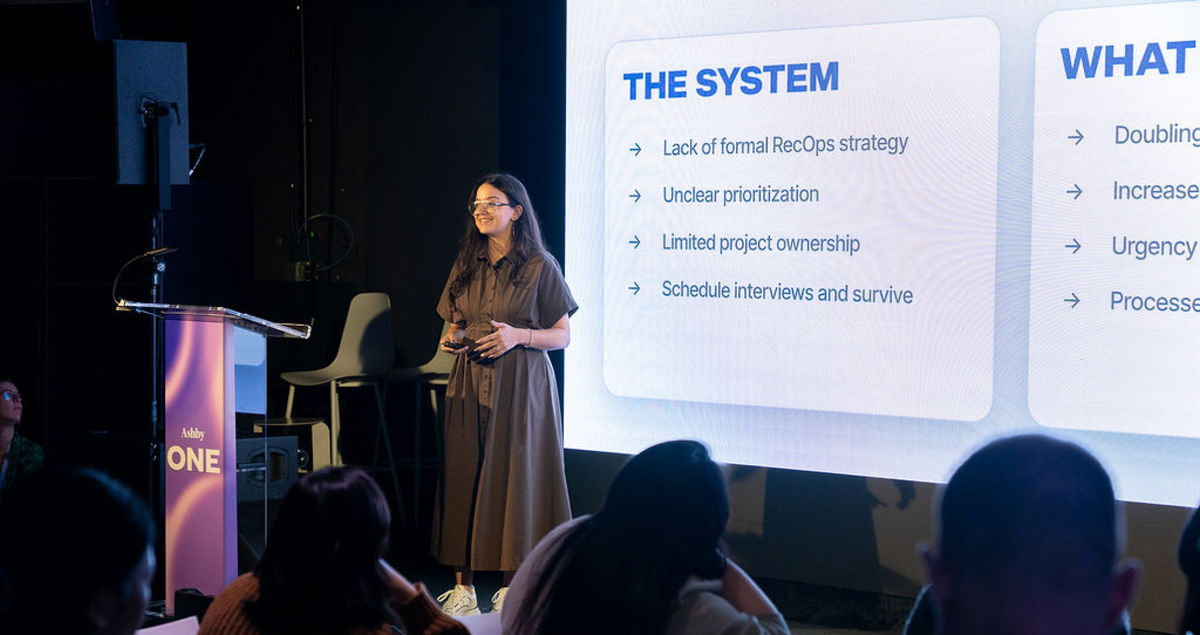
Setting a RecOps Strategy
Rachel Lanman, Manager of Recruiting Operations at Intercom, walks through the four-step framework she uses to build a RecOps strategy: start with company goals, build a backlog and run a listening tour, define pillars with clear metrics, then prioritize big bets against quick wins.
View session
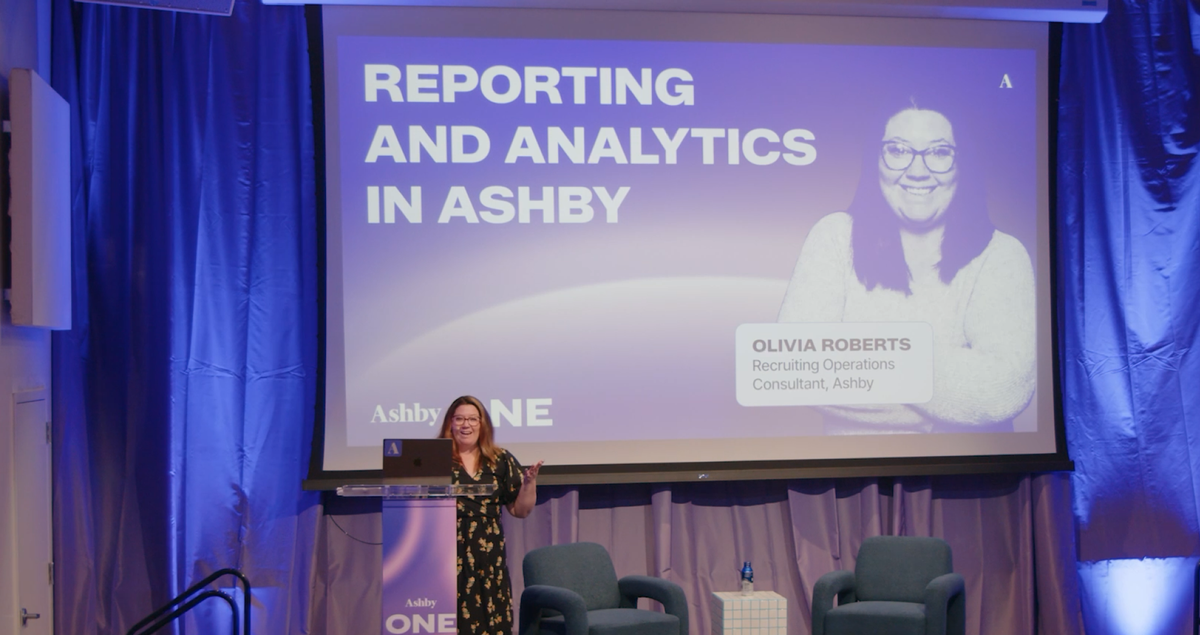
Reporting & Analytics in Ashby
Olivia Roberts, Recruiting Operations Consultant at Ashby, shows how to turn Ashby reports into action with calculated fields and automated SLA alerts, covering feedback tracking and scheduling visibility in a live demo.
View session