Customer story
How Fin Scales Hiring by Improving Data Literacy with Ashby Analytics
Story from

Christian Novicki
Customer Success
Fin (formerly Intercom) is an AI Customer Agent company with an AI agent that resolves customer queries automatically across all channels for more than 30,000 customers globally. The company has over a thousand employees with plans to hire more than 600 people in the coming year — a scale of growth that also required doubling the size of its talent acquisition team. Rachel Lanman, Senior Manager of Recruiting Operations, leads a large team within Fin’s broader talent organization. Her mandate is to make sure their recruiting data is accessible and usable across the whole team.
Problem: Fragmented Recruiting Data Prevented Accurate Planning
Hiring 600 people in a year is difficult when the processes underneath were built for a smaller company. When new growing pains emerged, Fin needed to understand where its funnel was leaking, whether its interview volume was efficient relative to the number of candidates hired, and how to speed up without sacrificing quality. Answering those questions meant leaning hard on recruiting data, something their current data resources weren’t capable of supporting:
- The data existed, but it wasn’t clear. Though Fin had reporting tools, the data could not be easily understood, conveyed to leaders, and then mobilized into decisions.
- The data was mistrusted. Rachel’s concern was more than just data accuracy. Without a true analytics tool to track multiple data points, the team lacked visibility into the data's impact. The data they did have wasn’t widely engaged with due to limited access, so it was difficult to get key stakeholders to trust what the numbers were saying.
- Recruiters weren’t trained to organize the data through the system they had. Every hour a recruiter puts into learning how to use SQL to derive the right numbers is an hour they don’t spend with candidates. At the pace they are scaling, the math does not forgive that tradeoff.
"Recruiters shouldn't have to be analysts or data scientists. They should be able to look at the data, the visualizations, and look at charts, get some insights and drive that to action immediately."
— Rachel Lanman, Senior Manager of Recruiting Operations at Fin
Solution: Analytics Built for the Hiring Function
What tied these problems together was a single thread: data that a recruiter, a hiring manager, and a leader could each open, understand, and act on without a data scientist in the room. Fin found that solution in Ashby Analytics. With Ashby dashboards tailored to each audience, recruiters and hiring managers could now access the numbers themselves without any analytics background required.
Dashboards tailored for their audience
Rachel's team built a set of core dashboards over several months, organizing each by who would read them rather than by what data they contained. What a recruiter needs to see to manage evergreen requisitions and what a hiring manager needs to see to understand when a role could reasonably be filled are inherently different.
"For hiring managers, I think it's much more important to zoom out and to see not the number of recruiting screens, not the number of onsites that are happening, but what is our offer acceptance rate, what's our time to fill, our time to start, especially in countries where maybe there's a three month notice period."
— Rachel Lanman, Senior Manager of Recruiting Operations at Fin
This audience-first approach helped Fin plan the opening of its new office in Berlin with accurate headcount forecasts. A market with unfamiliar hiring dynamics is exactly where assumptions carried over from other locations tend to break, and the dashboards gave the team a way to see the difference instead of discovering it late.
"The biggest ‘wow’ or ‘aha’ moment was the difference between our time to start metrics for the other locations that we had versus Berlin, where the offer and notice periods are longer. Understanding that helped us backtrack timelines to determine when we needed to make these hires by to have people in seat by the time the office opened."
— Rachel Lanman, Senior Manager of Recruiting Operations at Fin
A long notice period can surface as a hiring plan that quietly misses its date. Seeing Berlin's time-to-start sit apart from every other office allowed the team to change their strategy, and plan backward from a headcount deadline rather than forward from a job opening. This is the difference between planning for a market and reacting to one.
Self-serve drill-down, without needing to know SQL
Beyond the dashboards Rachel builds herself, Fin's managers and leads hold admin seats, which allow them to build their own reports. The bar she sets for what self-service should feel like comes from a tool built for a different audience entirely:
"I often refer to Ashby as the Looker of recruiting teams. Looker is an analytics platform that allows you to drill down into data and create visualizations without needing to know any technical knowledge or SQL. That’s what Ashby's doing for recruiters."
— Rachel Lanman, Senior Manager of Recruiting Operations at Fin
Because recruiters can gain access to data easily, they can spend more time on strategy and analysis. Ashby’s data visualization lets them easily filter the data by time frame, funnel stage, and job opening. In one recent example, the team compared application volume against open-job volume over time, which surfaced how the ratio of applications per open role was shifting year over year. Understanding the delta and planning for the continued trend helped Rachel’s team be agile in pivoting their capacity planning.
AI interpretation that turns a chart into a decision
Fin was an early beta customer for Ashby's AI interpretations feature. Its most relevant use case for Rachel's team is defending the team’s work via the data. In a live conversation, it lets her answer a hiring manager's challenges on the spot, explaining the filters and dataset behind a visualization. It can even identify trends that aren’t visible in the chart itself. The effect Rachel dwells on, though, is what it gives to the recruiter looking at the screen alone.
"AI interpretation with Ashby is incredible. Really what it's doing is building that confidence with recruiters. They can look at the data, the visualizations, at charts, and get some insights, and then drive that to action immediately."
— Rachel Lanman, Senior Manager of Recruiting Operations at Fin
A recruiter who trusts their own reading of a chart does not spin up a backlog of questions behind Rachel or an analyst to have a hunch validated. Removing that one-person dependency is what has allowed her team to keep pace with 600 hires.
Impact: A Recruiting Team the Business Trusts
The through-line across Fin's use of Ashby is the number of folks who are empowered to use and read the recruiting data. Analytics that once belonged to a small expert group became a shared instrument, and that redistribution is what turns an ambitious hiring number from an aspiration into an operating plan.
"Ashby will help us to grow by 600 people this year by giving us the data to show how we'll get there and how we'll be able to scale. The way that we could really do that is by giving that data and the visualizations to the entire team – from recruiters at req level to hiring managers and leaders organization wide. Now we have that visibility into what's going on in the process."
— Rachel Lanman, Senior Manager of Recruiting Operations at Fin
The deeper change is in the relationship between Talent and the rest of the business. When a data report can be drilled into to show where the numbers came from, the team gains credibility, and it becomes a shared investigation between them and the hiring manager.
"Ashby has allowed us to build that trust with hiring managers and show where the data's coming from. Instead of just one point in time visualization, we’re able to really look into the why, the how, and the where associated with it."
— Rachel Lanman, Senior Manager of Recruiting Operations at Fin
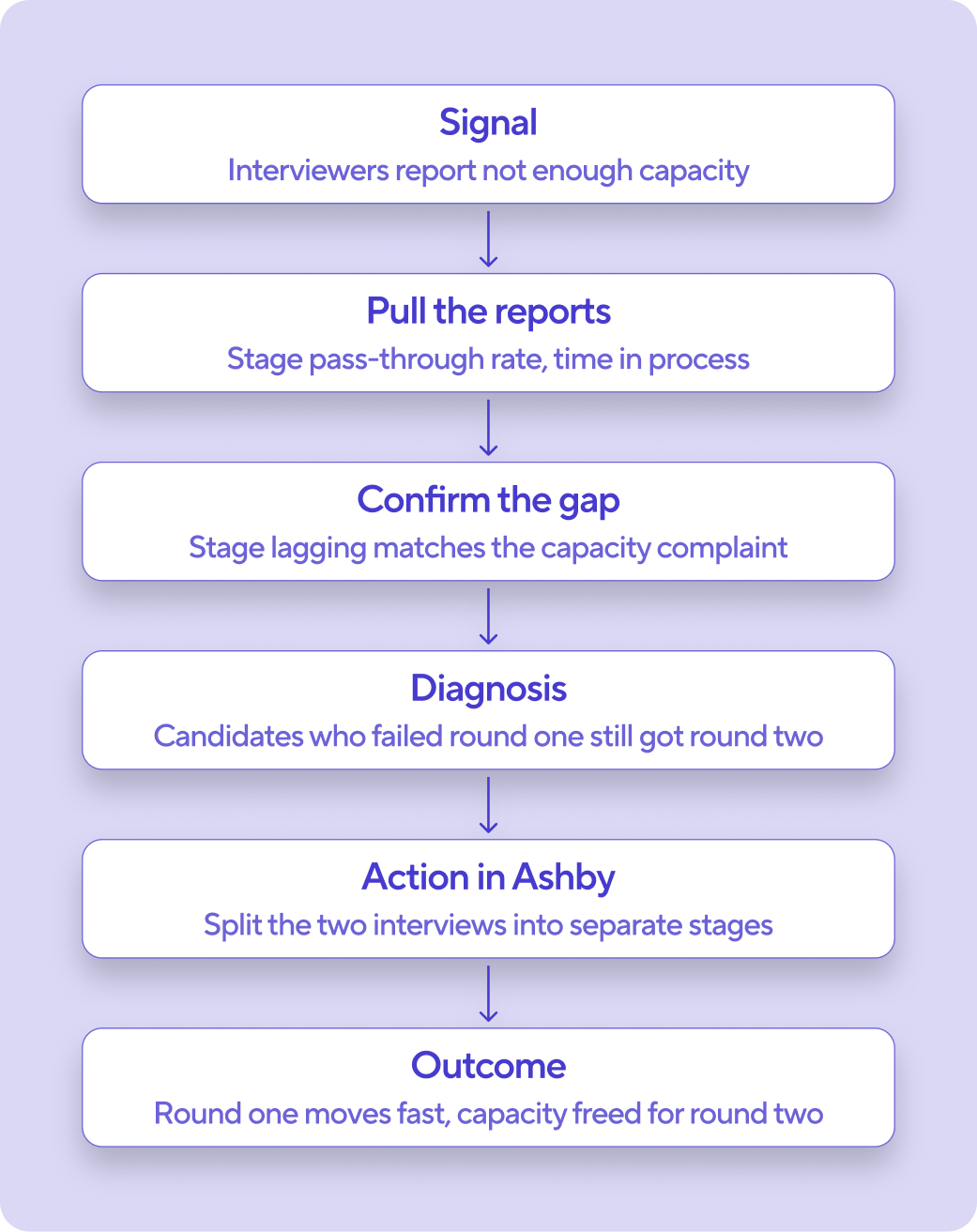
This is what earns a recruiting team its seat at the table. One concrete case brought the whole loop together: Hiring managers were hearing from interviewers that there was not enough capacity to support the volume of interviews on their calendars. Rachel's team pulled the reports, saw what percentage of candidates reached the stage in question, and used time-in-process data to confirm that the stage was lagging because of that capacity gap.
The diagnosis revealed that candidates were being scheduled for both parts of a two-part interview. This impacted the candidate experience for those who didn’t pass the first and consumed valuable interviewer capacity. Fin separated the two interviews so the first could be scheduled fast and the second stayed open for the candidates who earned it. That is data moving directly to action, which is exactly what the team set out to make possible.
Rachel spoke with Ashby about why she considers analytics the foundation of a scaling talent function, and how AI interpretation is changing what recruiters can do with data on their own.
By building recruiting analytics that recruiters, hiring managers, and leaders can each use on their own terms, Fin turned reporting from an expert-only function into shared infrastructure for scaling hiring. The change shows up across the team:
- A plan to hire 600+ people in a year, backed by data that shows how and when the team will get there
- Audience-specific dashboards that let recruiters diagnose a single requisition and leaders see org-wide trends
- Self-serve reporting that lets managers and leads with admin access answer their own questions without technical skills
- Faster diagnosis-to-action through AI interpretation, letting recruiters confirm a bottleneck in one click rather than waiting on an analyst
Ready to give your whole team recruiting data they can act on? Request a demo today.
Other customer stories



























Size
1400+ Employees
Founded
2011
Products
Ashby Analytics