Customer story
How Wisp Cut Onboarding Work in Half with Ashby’s People Workflows
Story from

Victoria Hill
Sr. Customer Success Manager, New Products
Wisp is a telehealth company offering reproductive health treatment and contraception, delivered discreetly or available for same-day pickup. It has between 50 and 60 full-time employees, but that headcount understates the operation behind it; their business model means they are often onboarding dozens of clinicians at any given time. Wisp hires across a corporate entity and a clinical one, brings on contractors and clinicians in addition to full-time staff, and works under HIPAA and SOC 2 requirements that a company its size would not usually carry. Liz McConnaughey, VP of People, and Jake Payne, People Operations Partner, run onboarding for all of it.
Challenge: Complex Onboarding on a Patchwork of Tools
Wisp’s onboarding had to serve a multi-entity, compliance-bound business, but it ran on disconnected tools and manual follow-up that left no room to absorb a surge in hiring.
Onboarding data lived in four places
Wisp operates between two different HRISs to accommodate compliance for telehealth. They first ran onboarding from a checklist in Notion, then moved it into Slack, where a form and dedicated channel stood in for an actual candidate portal. Offer paperwork ran through DocuSign, and every new hire’s details went into a Google Sheet that served as the HR tracker.
“Onboarding had just been so fractured. We had a Google Sheet where we kept every employee’s data and then DocuSign and Notion. We had so many things splintered that don’t talk to each other, so it was on us to make the connections between tools, which took up a lot of time.”
— Jake Payne, People Operations Partner at Wisp
For a company working through a SOC 2 audit, scattered records are also a compliance cost. Showing that a given hire completed a security step meant assembling the evidence from several systems, each with its own permissions.
Every touchpoint was manual
Wisp’s hiring often happens in waves. At the end of 2025, the team onboarded more than 50 clinical providers. Each of those hires were onboarded via a series of emails, reminders, and forms, sent in the right order at the correct time.
“We try to have a really high-caliber onboarding program for people, but it’s tough when there’s only two of us. For example, we were onboarding 50 providers. So how do you keep that quality at that volume? A lot of it is having those constant touchpoints to be able to talk to people. But that takes up a lot of our time, because we’re also the ones copying the templates to send out the emails, making sure that we haven’t forgotten a step because that would mean dropping the level of candidate experience we want to have.”
— Liz McConnaughey, VP of People at Wisp
A process that runs on recall scales only as far as the people running it. The quality of a new hire’s first weeks could depend on how crowded the team’s calendar was when they signed.
One checklist couldn’t serve many hire types
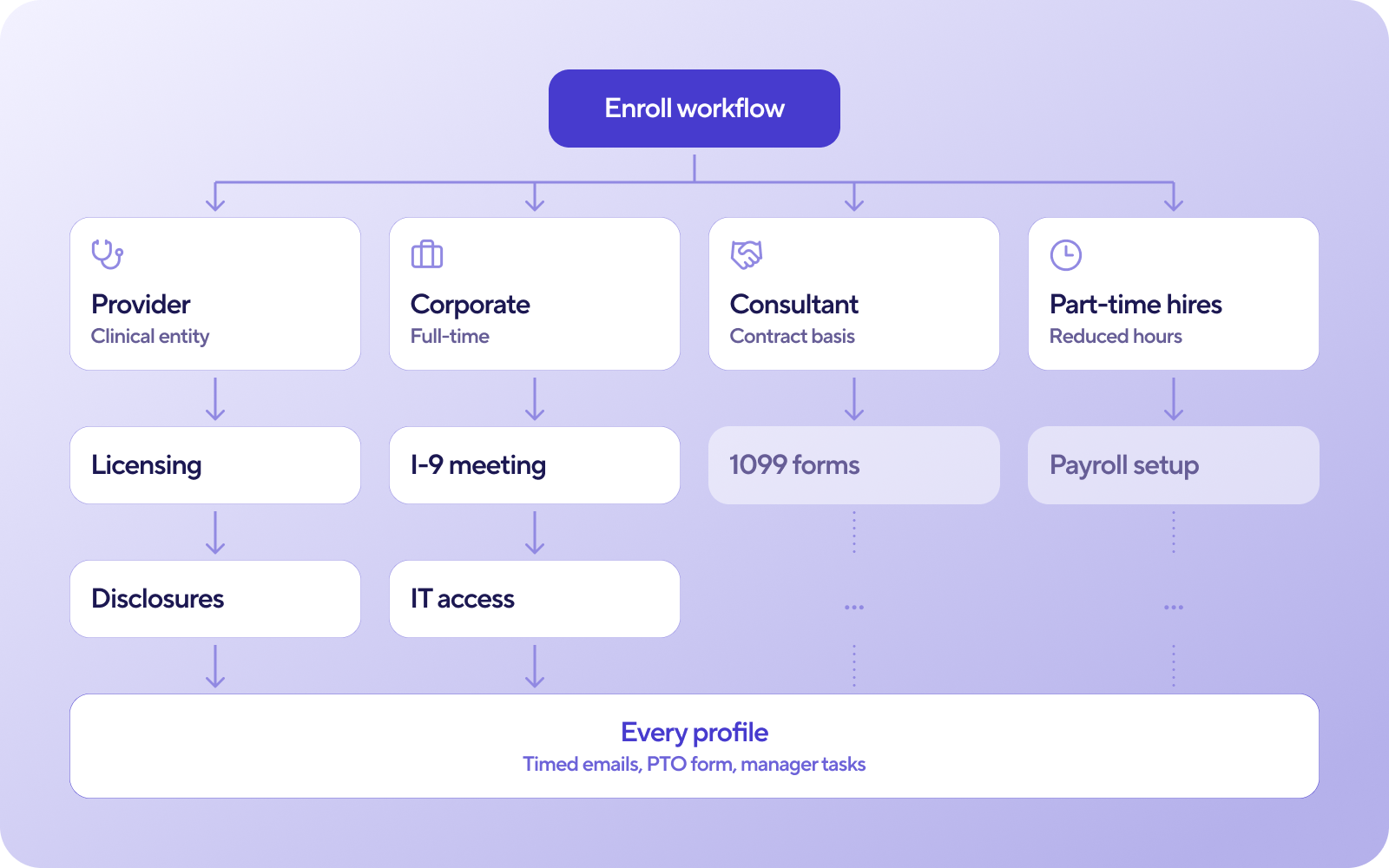
Wisp hires into four distinct profiles across its corporate and clinical entities. Clinical providers need to submit licensing information and sign disclosure agreements that a corporate hire wouldn’t need. Full-time corporate hires need to complete virtual I-9s. A single checklist wasn’t capturing those nuances clearly.
The Slack-based process the team was using missed part of the audience. The Wisp team found clinicians responded more reliably via email than in Slack. Some new hires arrived from workplaces that used other internal communication systems like Microsoft Teams, so a pre-start process within Slack was asking new hires to learn a new tool before the job had started.
It was unclear who owned the onboarding process: hiring managers or the people team
The line between what People Operations handled and what a hiring manager handled was not always clear. Wisp’s post-onboarding survey surfaced the occasional new hire without software access on day one or without a first one-on-one scheduled with their manager.
“I think sometimes there was confusion or hesitation in terms of, hey, what are we owning versus what are you owning? Is there anything else I need to do for my person?”
— Liz McConnaughey, VP of People at Wisp
Solution: One Workflow From Offer to First Day
Each of these problems indicated a need for a single place where a hire’s onboarding could run on its own schedule, branch by hire type, and tell each person what they owned. Wisp already ran recruiting in Ashby, and in January 2026 the team became a design partner for People Workflows.
Wisp did not want an all-in-one HR suite that expects every function to live inside it. The team had chosen each of its tools for fit, so what it needed was a layer that could coordinate them.
“Ashby is like Zapier for People and Recruiting, but it’s more user-friendly in the sense that it anticipates a lot of the tasks that you would normally do. It allows you to program more of the mundane tasks and then set triggers for a human in the loop when it becomes more complex.”
— Liz McConnaughey, VP of People at Wisp
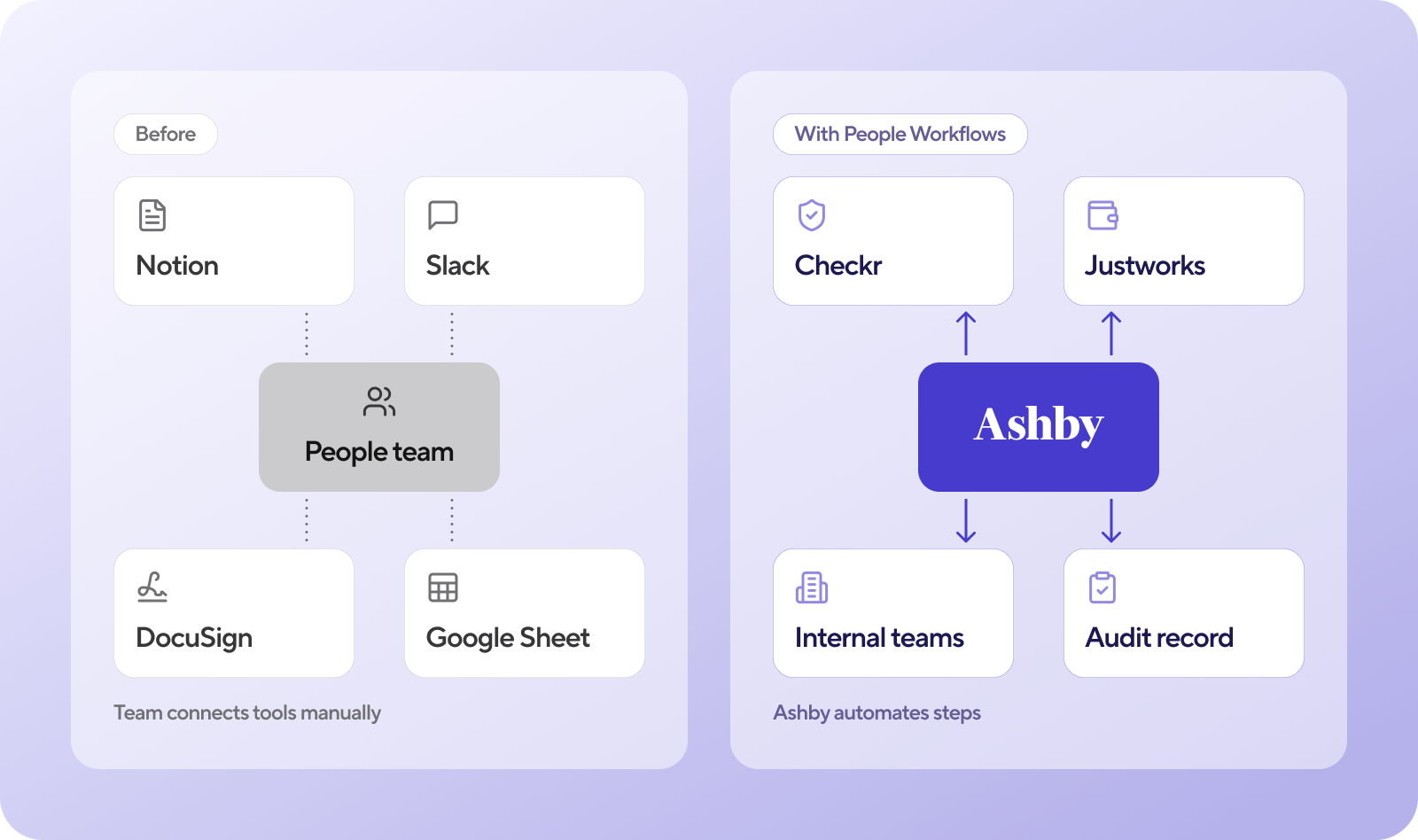
With Ashby’s People Workflows, Wisp has:
- Recruiting data that flows straight into onboarding
- Communications timed around the start date
- Separate automated workflows for each kind of hire
- Clear handoffs for hiring managers
-
Recruiting data that flows straight into onboarding
Because every candidate has already moved through Wisp’s pipeline in Ashby, their information is stored when they accept an offer. That means starting their onboarding takes one action. Background checks run through Ashby’s Checkr integration, and the team’s goal is to retire the separate HR tracker altogether.
“It takes so much mental load off not having to think about moving all the employee data to something else because we’ve been recruiting them in Ashby. It’s nice to be able to just press the enroll workflow button and know that this person will be taken care of as far as next steps.”
— Jake Payne, People Operations Partner at Wisp
Every hire’s completed steps now sit in one record, regardless of which of the two HRISs their information flows through, which helps with the audit process.
“We’re going through our SOC 2 audit right now. Having all of that onboarding data and the checklist there in one easy place, and being able to say, “Yes, this person got this security step done,” just makes it so much easier to present that information to auditors.”
— Liz McConnaughey, VP of People at Wisp
Communications timed around the start date
Wisp built its onboarding communications as a sequence that runs on its own:
-
Within 24 hours of a hire, a welcome email sets expectations for what comes next along with reminders to:
- Enroll in Justworks
- Complete tax paperwork
- Book an I-9 verification through a scheduling link within the first three days of employment.
-
On the Friday before a start date, a recap email covers the I-9, benefits enrollment, and anything outstanding
-
A first-day email lands 30 minutes before the hire’s first morning setting up expectations for the day.
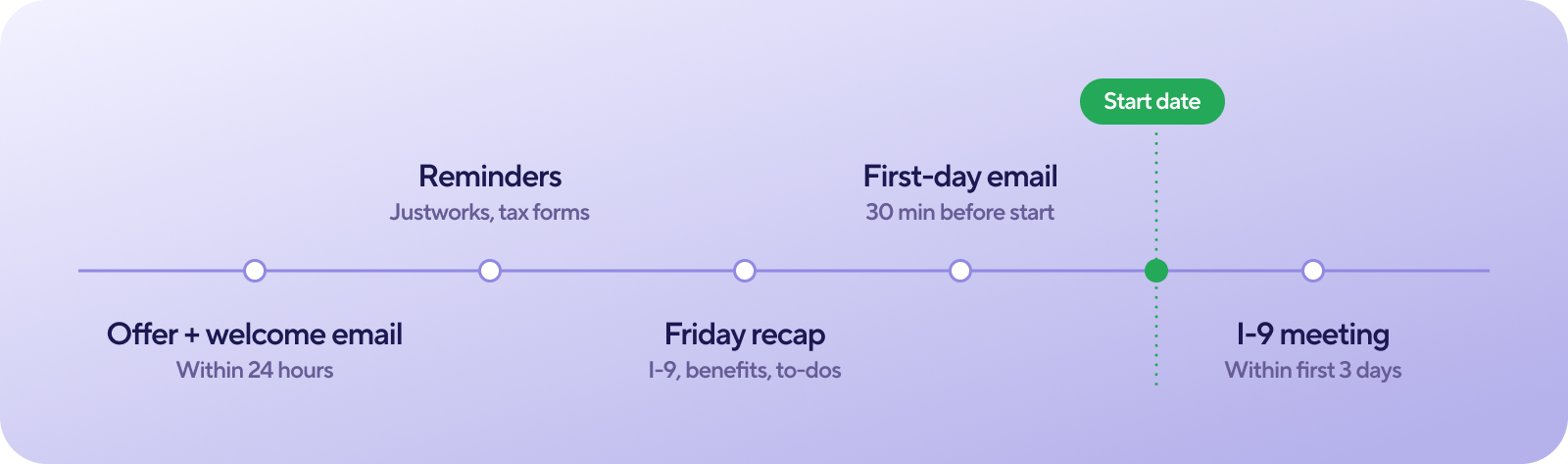
Every step is scheduled relative to the start date rather than the hire date. When a hiring manager needs someone in-seat in three days, the team enrolls the hire as usual and the workflow compresses the timeline automatically. The old process would have meant rewriting every communication for a one-off case. The same logic covers hires who start a month after signing, ensuring they receive regular touchpoints that keep them engaged until their start date.
“When you work fully remote, you have to over-communicate, and it is the exact same thing with remote onboarding. People are eager to start, and they come in the door like, ‘Hello, I don’t know what I’m supposed to be doing, but I’m ready to do something.’ Now, they never have to guess at that because it’s all been laid out for them with emails leading up to the start date.”
— Liz McConnaughey, VP of People at Wisp
Separate workflows for each kind of hire
Every Wisp hire now runs through People Workflows, whichever entity they join, Corporate or Clinical.
“One of the things I like about People Workflows is that we have been able to design different workflows depending on the unique, specific profiles that we hire. For clinical, we have a provider workflow, which is very different from most else we do. We’re asking for licenses and things like that. On the corporate side, they’re needing laptops and access. We can enroll them in the right flow based on their profile and it’s all automated without us having to remember, ‘Oh did we get the disclosure agreement from this provider?’”
— Liz McConnaughey, VP of People at Wisp
Pre-start communication now goes out by email, instead of the Slack workflow. New hires get Slack on their first day, and Wisp’s onboarding covers how the company uses it and what its communication norms are.
Clear handoffs for hiring managers
People Workflows assigns internal tasks as well as candidate ones. When a hire is about to start, their manager receives a prompt to begin a 30-60-90 day plan along with the resources Wisp provides for it. A required step asks every new hire about planned time off in the weeks before they start so their hiring manager can schedule their onboarding plan around it.
“Our hiring managers really don’t have to worry about onboarding anymore. They just know it’s going to happen and it’s going to get done. Their person’s going to turn up. They’re going to have their laptop. They’re going to be ready to go on their first day.”
— Liz McConnaughey, VP of People at Wisp
Because the steps are programmed, the experience no longer varies by team: a new engineer and a new marketer go through the same process to the same standard.
Impact: Time Back for Planning and People
Wisp timed a full onboarding, end to end, before and after moving it into People Workflows.
“We timed it. It was approximately 47 minutes to do just one full onboarding. Multiply that by 20, 30 hires at a time, there goes half your week. When we moved to Ashby, we cut that in half. And actually, that’s being conservative. I think we’ve cut it even further.”
— Liz McConnaughey, VP of People at Wisp
Per-hire minutes matter most in the weeks when Wisp onboards providers in volume, which are also the weeks when a two-person team has the least room to absorb extra work. That time can now be spent on more strategic, longer-range work.
“On my end as an exec, it’s making sure my exec team is getting what they need, making sure that we can be more focused on headcount planning and looking ahead to the future in 2027, versus spending time going, ‘Oh well, did this person over here get her laptop? And if not, what happened?’”
— Liz McConnaughey, VP of People at Wisp
Wisp’s approach also changes what its tooling decisions cost. Because onboarding now runs as a process the team designs in Ashby, with other systems plugged into it, the process does not have to be rebuilt each time one of those systems changes.
“I like the fact that we just have more control over this, and that Ashby is so agnostic that it wants to integrate with a wide variety of things. That really makes the difference for us, because it just gives us so much more flexibility as we grow. So if we need a new HRIS, or if we’re going to switch our background check systems, we can still keep the onboarding flow the same. It’s just switching in and out a form, switching in and out a system and Ashby plugs into all of it.”
— Liz McConnaughey, VP of People at Wisp
What’s Next: Offboarding and Retiring the HR Tracker
Wisp’s next goals extend the same model in two directions. The first is offboarding, where the compliance stakes mirror onboarding: When someone leaves, the team wants the right owner alerted automatically (the Head of Engineering, for example, to remove system access) and the completed step recorded for the next audit. The second is retiring the Google Sheet HR tracker, so that onboarding data entered once in Ashby flows through to Okta and Justworks.
“Make the investment in the right tooling, so that you’re building a half size larger than what you think you need, because it’s going to give you more space and grace. When you do start noticing things are starting to not work as great as they did before, you have a little more time to figure out what is the next solution you need to invest in, whether that’s a person, a tool, or a process revamp. We don’t believe we’ve outgrown Ashby onboarding. If anything, we feel like we are really just getting started.”
— Liz McConnaughey, VP of People at Wisp
By treating onboarding as a process to design rather than a checklist to work through, Wisp’s two-person People team built an operation that keeps pace with its hiring surges and holds up to audit, across every type of hire it brings on. So far, Wisp has:
- Cut the time spent on each 47-minute onboarding in half
- Moved four distinct hire profiles, across corporate and clinical entities, into one automated onboarding system
- Replaced a Notion checklist, a Slack-based process, and manual follow-ups with communications timed to each start date
- Gave hiring managers automated prompts and advance notice of each new hire’s planned time off
- Kept every hire’s onboarding record in one place for its SOC 2 audit
Ready to run onboarding that keeps up with your hiring? Request a demo today.
Other customer stories